EasyManua.ls Logo

Fiat 411 Rb - Page 9

Fiat 411 Rb
27 pages
Print Icon
To Next Page IconTo Next Page
To Previous Page IconTo Previous Page
Loading...
<w»-----»-.--<---
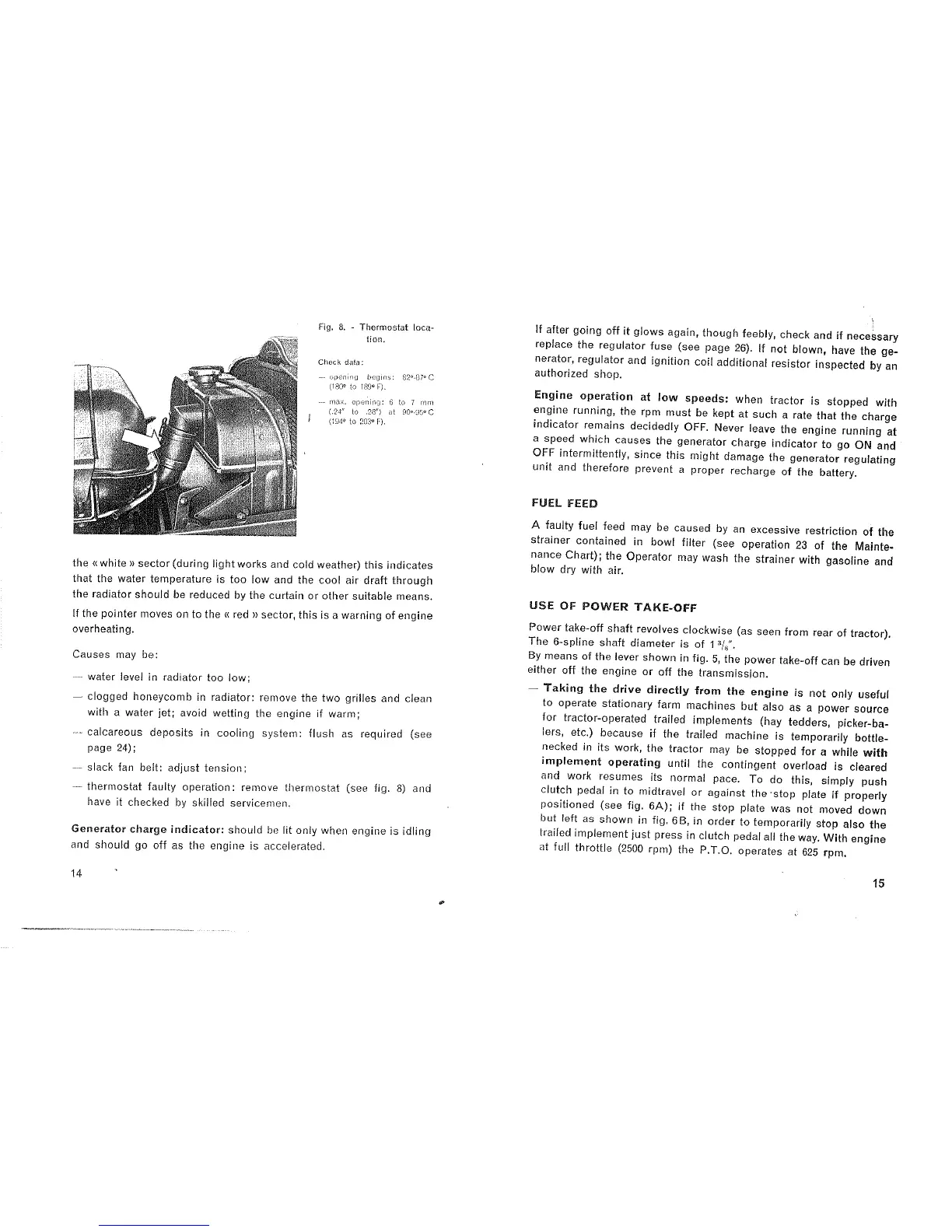
Fig.
8.
-
Thermostat
loca-
tion.
Check
data:
—-opening
begins:
82°-87°C
(1809
lo
l89°
F).
---
max.
opening:
6
to
T
mm
[.'24”
to
.28")
at
90"-95°C
l
new
to
203%).
the
<<white
»
sector
(during
light
works
and
cold
weather)
this
indicates
that
the
water
temperature
is
too
low
and
the
cool
air
draft
through
the
radiator
should
be
reduced
by
the
curtain
or
other
suitable
means.
if
the
pointer
moves
on
to
the
<<
red
»
sector,
this
is
a
warning
of
engine
overheating.
Causes
may
be:
****
~
water
level
in
radiator
too
low;
clogged
honeycomb
in
radiator:
remove
the
two
grilles
and
clean
with
a
water
iet;
avoid
wetting
the
engine
if
warm;
--M
calcareous
deposits
in
cooling
system:
flush
as
required
(see
page
24);
--—
slack
tan
belt:
adjust
tension;
¢—'-'-
thermostat
faulty
operation:
remove
thermostat
(see
fig.
8)
and
have
it
checked
by
skilled
servicemen.
Generator
charge
indicator:
should
be
lit
only
when
engine
is
idling
and
should
go
off
as
the
engine
is
accelerated.
14
1
1
If
after
going
oft
it
glows
again,
though
feebly,
check
and
it
necessary
replace
the
regulator
fuse
(see
page
26).
If
not
blown,
have
the
ge-
nerator,
regulator
and
ignition
coil
additional
resistor
inspected
by
an
authorized
shop.
Engine
operation
at
low
speeds:
when
tractor
is
stopped
with
engine
running,
the
rpm
must
be
kept
at
such
a
rate
that
the
charge
indicator
remains
decidedly
OFF.
Never
leave
the
engine
running
at
a
speed
which
causes
the
generator
charge
indicator
to
go
ON
and
OFF
intermittently,
since
this
might
damage
the
generator
regulating
unit
and
therefore
prevent
a
proper
recharge
of
the
battery.
FUEL
FEED
A
faulty
fuel
teed
may
be
caused
by
an
excessive
restriction
of
the
strainer
contained
in
bowl
filter
(see
operation
23
of
the
Mainte-
nance
Chart);
the
Operator
may
wash
the
strainer
with
gasoline
and
blow
dry
with
air.
USE
OF
POWER
TAKE-OFF
Power
take-off
shaft
revolves
clockwise
(as
seen
from
rear
of
tractor).
The
6—spiine
shaft
diameter
is
of
13/B".
By
means
of
the
lever
shown
in
fig.
5,
the
power
take-off
can
be
driven
either
oft
the
engine
or
off
the
transmission.
e
Taking
the
drive
directly
from
the
engine
is
not
only
useful
to
operate
stationary
farm
machines
but
also
as
a
power
source
for
tractor-operated
trailed
implements
(hay
tedders,
picker—ba-
Iers,
etc.)
because
it
the
trailed
machine
is
temporarily
bottle-
necked
in
its
work,
the
tractor
may
be
stopped
for
a
while
with
implement
operating
until
the
contingent
overload
is
cleared
and
work
resumes
its
normal
pace.
To
do
this,
simply
push
clutch
pedal
in
to
midtravel
or
against
thestop
plate
if
properly
positioned
(see
fig.
BA);
if
the
stop
plate
was
not
moved
down
but
left
as
shown
in
fig.
68,
in
order
to
temporarily
stop
also
the
trailed
implement
just
press
in
clutch
pedal
all
the
way.
With
engine
at
full
throttle
(2600
rpm)
the
P.T.O.
operates
at
625
rpm.
i
15

Related product manuals