
 Need help?
Do you have a question about the Fiate Aviation MZ202 and is the answer not in the manual?
Engine not approved for aeronautic use; user assumes all risks and responsibility for failures.
Procedures for adjusting choke and idle settings on the carburetor.
Adjusting throttle cable freeplay and synchronizing carburetors.
Setting the correct freeplay for the choke cable.
Explains the purpose and benefits of the engine's gear reduction system.
Details the type of gear reduction used and its advantages.
Lists probable causes and remedies for the engine failing to start.
Identifies causes and solutions for irregular engine idling.
Addresses common issues causing irregular engine operation.
Provides troubleshooting steps for when the engine stops unexpectedly.
Outlines causes and remedies for unsatisfactory engine performance.
Safety warning regarding the preassembled wiring harness and connections.
Procedures for inspection to be carried out before every flight.
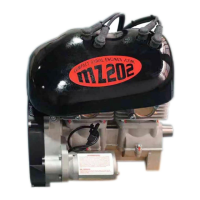
The device is an MZ202 engine manufactured by FIATE Aviation. It is a two-stroke, double-cylinder in-line, reed valve engine designed for use in Ultralight (ULM) aircraft or other airplanes where engine failure would not lead to serious consequences. It is explicitly stated that this is not an aeronautic approved engine and has not undergone durability and safety tests in compliance with aeronautical standards. Users must assume all risks associated with its use, as sudden engine failure is possible and could result in emergency landings, material damage, injury, or death.
The MZ202 engine serves as a lightweight, sturdy, and reliable propulsion system. It incorporates an air cooling system with forced air (fan) and features a counter-clockwise rotation when viewed from the Power Take-Off (PTO). The engine is equipped with an electric starter motor and a 13.8 volt, 180-Watt alternator for ignition and battery charging. It utilizes an electronic double ignition switching type with variable automatic timing to ensure reliability, safety, and optimal performance. The engine is designed to operate with a mechanical gear reduction system, which includes helical gears and a centrifugal clutch. This gear reduction helps to reduce noise, boost performance by allowing the propeller to operate at lower RPMs, and mitigate dangerous torsion movements to the crankshaft during start-up. The centrifugal clutch allows the propeller to freewheel at start-up and engages only when the engine RPM exceeds 1900-2100 RPM.
The engine requires careful preparation of the fuel/oil mixture, emphasizing the use of clean, approved containers and filtering the fuel to prevent impurities. It is crucial to use a 50:1 synthetic oil blend (Castrol TTS recommended) and Super 95 RON fuel. Users are advised to stick to the same type and brand of oil and avoid switching between synthetic and mineral-based oils due to incompatibility risks. Before starting, a general inspection is required, including checking carburetor and fuel feed circuits, vacuum pressure tubing, electrical cables, spark plug leads, engine mounts, gearbox bolts, and propeller condition. The engine requires a specific break-in procedure, involving two steps of controlled RPM increases and monitoring of Cylinder Head Temperature (CHT) and Exhaust Gas Temperature (EGT). Prolonged full throttle should be avoided for the first two hours of use, with optimal performance achieved after ten hours. Carburetor adjustment, including choke and idle settings, is detailed, with a minimum idle speed of 1800 rpm. The throttle cable requires proper adjustment to ensure free movement and correct end play. A "STOP PROCEDURE" is outlined, recommending a cool-down period at 2000-2500 RPM before shutting down to extend engine life.
The manual provides a comprehensive maintenance schedule, with checks and work to be carried out at specified hour intervals (1, 9, 12, 25, 50, 75, 100, 125, 150, 175, 200, 225, 250, 275 hours). Key maintenance tasks include:
Daily checks and pre-flight inspections are also detailed, covering electrical contact, fuel tank water, inlet manifold, carburetor float chamber, air filter, cylinder head leakage, ignition coil connections, starter motor security, engine attachment to frame, reduction and starter motor bolts, fuel lines, unusual noises, and propeller condition. A logbook is provided to record engine repairs.
 General
| Brand | Fiate Aviation |
|---|---|
| Model | MZ202 |
| Category | Engine |
| Language | English |

 To Next Page