Need help?
Do you have a question about the FIM FLEXY and is the answer not in the manual?
Read and follow all instructions for safe assembly and use of the FLEXY unit.
Use FLEXY for sun protection only; close during strong winds, thunderstorms, heavy rain, or snow. Secure bases properly.
Assemble the bases and attach upright poles, ensuring correct alignment and securing.
Join crossbars C and D, align sliders, and attach castings R and R' to the canopy.
Safely lift and mount the sliding canopy onto the support poles, ensuring correct orientation.
Detailed steps for fastening canopy panels into the track for a clean, smooth appearance.
Instructions for applying the protective cover to the Flexy awning when not in use.
Guidance on how to attach lateral and frontal valances to the Flexy awning.
Procedure for safely removing and reinstalling the fabric canopy panels from the support arms.
Methods for cleaning canopy panels by hand or machine, with recommended cleaning agents.
Advice on proper disassembly, cleaning, and storage of the Flexy awning for longevity.
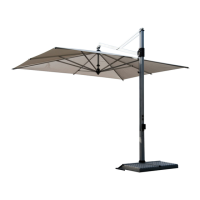
This document is a user manual for the FIM Flexy Umbrella, a cantilever sunshade designed for outdoor use.
The FIM Flexy Umbrella is primarily designed as a protection from the sun. It features a sliding canopy that can be opened and closed, and also tilted, to provide shade. The umbrella is available in various sizes and can be installed as a single unit, two units sharing a pole, or multiple units sharing poles in the middle, catering to different space requirements and configurations. The canopy operates via a crank-and-belt mechanism, designed for smooth and effortless opening and closing.
The manual provides a table of measurements in inches for various nominal Flexy sizes, including 10x16, 10x14, 10x12, 10x10, 8x16, 8x14, 8x12, and 8x10. These measurements include dimensions for components like A, B, C, D, E, F, G, H, and L, which are crucial for assembly and positioning. For freestanding bases, a minimum weight of 550 lbs is required, achieved using six 24"x24" concrete pavers per base, or four pavers plus heavy planters filled with sand or gravel. The tilt mechanism allows for an incline change of 'G' inches per tooth in the tilt casting. The handwheels, when tightened, should engage the teeth firmly without any play. For installations where the canopy tilt remains stationary, it is recommended to exchange the handwheels for included lock nuts and washers, which should be torqued to about 70 ft/lbs.
The Flexy umbrella is operated by inserting an opening rod into the opening mechanism and then using handwheels to tilt the canopy. To tilt, the handwheels on both sides must be loosened to fully separate the locking teeth, allowing free movement of the top. Once the desired position is reached, the handwheels must be re-tightened to firmly engage the teeth. The canopy closes towards the side where the crank mechanism is located. For safety, the umbrella must be closed in the presence of strong winds, thunderstorms, heavy rain, or snow to prevent water pooling on the cover. It should also be closed when not in use, and an optional storage cover is recommended for longer periods of unattended storage. The assembly process requires two persons and two step ladders to avoid damage, especially when mounting the sliding canopy onto the poles. The drain hole on the bottom of the poles should face back towards the base slabs. The bases must be perfectly aligned, horizontal, and on the same level on the ground for proper installation.
Regular maintenance is crucial for the longevity and smooth operation of the Flexy umbrella. The crank-and-belt mechanism should operate smoothly; any increased resistance, squeaks, or squeals indicate a need for maintenance. Users are advised never to force the crank handle, as this can damage the belt. Increased friction, often caused by dust, grit, insect deposits, or airborne pollution, is the primary reason for operational difficulties. Both the fabric panels and the mechanical parts (crossbars and roller carriers) should be cleaned frequently.
Cleaning the canopy panels can be done by hand with a smooth cloth, lukewarm water (around 30°C ~ 85°F), and a common detergent for delicate fabrics, followed by extensive rinsing and drying. Industrial washing machines can also be used for panels, with a mild detergent, delicate program, extensive rinsing, and water temperature not exceeding 40°C (≈ 110°F). Panels should be air-dried and not tumble-dried or ironed. To maintain or restore waterproofing, 303 FabricGuard is recommended after cleaning.
For cleaning the mechanical parts, the canopy should be gently cranked open, then the tilt knobs loosened to fully separate the locking teeth. With two people and no wind, the canopy should be slowly rotated upside down so the crossbar and runners face the floor. After locking the canopy by closing the tilt knobs, all components can be rinsed and cleaned with a garden hose and a soft bristle brush, or an irrigated automotive brush, using mild soap for stubborn residue. After thorough drying, all moving parts and aluminum crossbars should be sprayed with a high-grade, non-stick lubricant like SailKote Marine Dry Lubricant or Jigaloo. Oil-based lubricants are not recommended as they can accelerate dust accumulation and stain the fabric.
At the end of the season, it is advisable to disassemble and store the awning in a dry place. Before storage, the structure should be cleaned with a damp cloth and dried. It is important to check the integrity of all components and order spare parts for any damaged elements. Chipped paint can be touched up, and all moving parts should be lightly lubricated with silicon spray. Crucially, the TENDASOL FLEXY should never be stored wet or damp to prevent mold or oxidation.
 General
| Brand | FIM |
|---|---|
| Model | FLEXY |
| Category | Patio Furniture |
| Language | English |


 To Next Page