
 Need help?
Do you have a question about the Fire-Eye RED-EYE INSTRUMENT PREAMPLIFIER and is the answer not in the manual?
Details input impedance, output, boost control, treble control, power options, and filtering.
Details input/output impedance, frequency response, boost levels, and noise floor.
Explains basic connection, treble control, solo boost, and tuner muting.
Details connecting effects or a stomp-tuner in series with the effects loop.
Describes adding effects between preamp and PA, and preamp's control functions.
Highlights its function as a direct box with linear response, no power needed.
Visualizes boost gain and treble response across frequencies.
Provides contact information for technical support and inquiries.
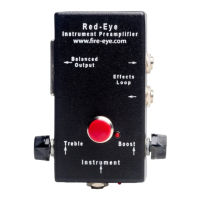
The Red-Eye Instrument Preamplifier is a versatile device designed to enhance the sound of instruments, particularly those with high-impedance piezoelectric pickups. It offers a direct-connect solution for musicians, ensuring a smooth, natural, and balanced acoustic instrument tone. The preamplifier is compatible with instruments featuring passive or active piezo pickups, as well as those with magnetic pickups like electric guitars and basses. Its core function is to provide impedance matching, which is crucial for optimizing the performance of piezoelectric pickups. This results in a clear tone, even when instruments are played percussively and loudly, thanks to its low distortion, low noise, and generous headroom.
The Red-Eye Instrument Preamplifier serves as an essential link between an instrument and a sound system or amplifier, optimizing the signal for superior audio quality. Its primary role is impedance matching, which is achieved through a field-effect transistor input circuit specifically designed to track and match the impedance of passive piezoelectric pickups. This process ensures that the instrument's signal is accurately translated without loss of fidelity.
The device features a balanced XLR output, which is ideal for connecting to sound systems, mixers, or recording equipment. This output provides a low-impedance signal, minimizing noise and signal degradation over long cable runs. A ground-lift switch is integrated into the XLR output, allowing users to eliminate hum and buzz caused by ground loops, a common issue in live sound and studio environments.
For musicians who require an extra boost for solos or specific passages, the Red-Eye Preamp includes a "Boost" button with an adjustable volume control. This feature allows for on-the-fly amplification, ensuring that solos cut through the mix effectively. An indicator light, the "Boost Light," illuminates when this function is active, providing visual confirmation to the user.
Tone shaping capabilities are provided by a "Treble Control," which allows users to either boost or reduce the treble frequencies. When the control is centered, the frequency response is flat, offering a neutral sound. Adjusting it enables musicians to fine-tune their instrument's brightness to suit different musical contexts or personal preferences.
The preamplifier offers flexible power options. It can be powered by 48-volt XLR phantom power, which is commonly available from mixing consoles. Alternatively, it can operate on an internal 9-volt battery, providing portability and independence from external power sources. For extended use or when phantom power is unavailable, the device also accepts 9 to 18-volt center-negative, center-ground power via a dedicated jack. The preamplifier intelligently prioritizes power sources, using the battery only when other power options are not present.
An "Effects Loop" is a significant feature, comprising a 1/4-inch output and input. This loop allows musicians to integrate external effects pedals, stomp-tuners, or other accessories into their signal chain. It can also be used to send the signal to an on-stage guitar amplifier or PA system, offering versatility in stage setups. When a stomp-tuner is connected and activated, the XLR output to the mix board is muted, facilitating silent tuning during performances.
The Red-Eye Preamp also incorporates internal filtering mechanisms to reject radio-frequency interference (RFI) from common sources such as neon lights and cell phones. This ensures a clean signal, free from unwanted noise that can compromise audio quality.
Beyond its active preamplification capabilities, the Red-Eye Preamp can function as a high-quality passive direct box. In this mode, it utilizes an isolation transformer that provides a linear frequency response. This allows the device to be used without power, offering a simple, reliable solution for converting an unbalanced instrument signal to a balanced XLR output, particularly useful for instruments that do not require active preamplification.
The Red-Eye Instrument Preamplifier is designed for ease of use and adaptability across various musical scenarios. Its straightforward interface makes it accessible for musicians of all levels.
To activate the device, simply plug in an instrument or connect an external power source. The "Pwr Chk Light" will briefly illuminate, indicating that the preamp is powered up and ready for use. When operating on battery power, this light will also signal when the battery is in the first half of its life, providing a useful reminder for replacement.
For connecting to a club's sound system, the Red-Eye Preamp provides a direct and efficient solution. Musicians can plug their instrument into the preamplifier, and then connect the XLR output to the mix board. This setup allows for immediate control over the instrument's treble and provides the solo boost function, giving the performer direct control over their sound on stage. If a stomp-tuner is used within the effects loop, activating it will mute the XLR output, enabling silent tuning without disrupting the audience.
When integrating multiple effects pedals or a pedal board, the effects loop of the Red-Eye Preamp is invaluable. Users can connect their effects in series within this loop, and these effects will directly influence the XLR output to the mix board. This provides a centralized point for managing the instrument's signal chain before it reaches the front-of-house.
For musicians using an on-stage guitar amplifier or instrument PA, the Red-Eye Preamp can be placed in front of the amplifier. Any desired effects boxes can be added in series between the preamplifier and the PA. In this configuration, the Red-Eye Preamp continues to offer treble control and the solo boost button, allowing the musician to shape their tone and add emphasis when playing through their personal monitoring system.
The ability to function as a passive direct interface adds another layer of utility. For instruments that do not require active preamplification, or in situations where power is unavailable, the Red-Eye Preamp can be used to convert a single-ended quarter-inch instrument signal to a balanced XLR output. This ensures a clean, isolated signal for the sound engineer, without the need for additional power.
The compact size and robust construction of the Red-Eye Preamp make it suitable for both studio and live performance environments. Its intuitive controls and versatile connectivity options ensure that musicians can achieve their desired sound with minimal hassle.
The Red-Eye Instrument Preamplifier is designed for reliability and minimal maintenance, ensuring consistent performance over time.
One key maintenance aspect is battery management. The device includes an internal 9-volt battery for portable operation. The "Pwr Chk Light" serves as a useful indicator for battery status. When the preamp is powered up on battery, the light will illuminate if the battery is in the first half of its life. This feature helps users anticipate when a battery replacement will be needed, preventing unexpected power loss during performances. The long battery life, approximately 200 hours, means infrequent replacements, but regular checks are advisable, especially before critical engagements. The intelligent power management system ensures that the battery is not used when phantom power or an external power supply is connected, preserving battery life.
The robust construction of the Red-Eye Preamp, housed in a small chassis, contributes to its durability. The internal components are designed to withstand the rigors of travel and live use. While specific maintenance instructions for internal components are not provided for user intervention, the overall design suggests a focus on longevity and reliability.
The internal filtering system, which rejects radio-frequency interference from sources like neon lights and cell phones, is a built-in maintenance feature that ensures signal integrity without requiring user input. This passive protection helps maintain a clean audio signal in various environments.
Regular cleaning of the exterior chassis and connectors with a soft, dry cloth is recommended to prevent dust and grime buildup, which can affect the longevity of the device and the quality of connections. Ensuring that all cables are in good condition and properly connected will also contribute to the reliable operation of the preamplifier.
In summary, the Red-Eye Instrument Preamplifier is engineered for dependable performance with minimal user maintenance. Its battery status indicator, robust build, and internal interference rejection mechanisms are all designed to ensure a consistent and high-quality audio experience for musicians.
 General
| Channels | 1 |
|---|---|
| Type | Instrument Preamplifier |
| EQ | 3-band |
| Inputs | 1/4" instrument input |
| Outputs | 1 x 1/4" TS |
| Power | 9V DC |
| Power Supply | 9V battery or external power supply |

 To Next Page