Need help?
Do you have a question about the Firesense 1902415 and is the answer not in the manual?
Safety advice for preventing fire and explosion risks.
Information on carbon monoxide poisoning and burn risks.
Precautions for safe use, service, and outdoor operation.
List of all main parts included in the package.
List of all hardware components for assembly.
Components not included but necessary for operation.
Essential preparation and tools needed for assembly.
Instructions for attaching the wheel assembly to the base.
Steps for securing post supports to the base.
Steps to perform before turning gas supply on and lighting.
Instructions for lighting, flame adjustment, and normal operation.
Steps and safety precautions for re-lighting the heater.
Guidelines for cleaning the exterior surfaces of the heater.
Recommendations for storing the heater between uses.
Advice on when and how to service the appliance.
Technical details and performance metrics for different models.
Details on gas categories, adjustments, and injector sizes.
Visual and textual identification of all replacement parts.
Information on how to get assistance for parts or issues.
Details on warranty period, what's covered and excluded.
Information on legal rights, exclusions, and liability.
Customer service contact information and legal disclaimers.
This document describes the assembly, operation, and maintenance of a Fire Sense patio heater, an appliance designed for both home and commercial use. It is intended for outdoor use only and is fueled by propane gas.
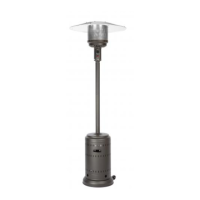
The Fire Sense patio heater provides radiant heat for outdoor spaces. It operates by burning propane gas, which heats an emitter screen that then radiates warmth. The heater features an electronic ignition system, requiring one AAA battery (not included) for operation. A control knob allows users to adjust the flame intensity from low (LO) to high (HI) and to turn the appliance on or off. The design includes a reflector panel at the top to direct heat downwards, maximizing its effectiveness. The heater is designed to be stable, with a base that can be filled with water or sand for added stability, and wheel assemblies for easy portability. A chain is provided to secure the LPG cylinder within the tank housing.
Before initial use or after a cylinder change, the control knob should be held in for two minutes to purge air from the gas lines. To light the heater, the control knob is turned to the "OFF" position, the LP cylinder valve is fully opened, and then the control knob is pushed in and turned to "HI." While holding the knob in, the red igniter button is pushed to ignite the main burner. Flame intensity can be adjusted by rotating the control knob. To turn the appliance off, the control knob must be depressed and then rotated clockwise to the "OFF" position. A waiting period of at least five minutes is recommended before attempting to re-light a hot heater.
The heater is designed for outdoor use only and must not be operated inside a building, garage, or any other enclosed area. Adequate clearances from combustible materials are crucial, with a minimum of 91.44 cm (3 feet or 36 inches) from the top and sides. The area around the heater must be kept clear of combustible materials, gasoline, paint thinner, cleaning solvents, and other flammable vapors or liquids. Propane cylinders should be stored outdoors in a well-ventilated area, out of reach of children, and never in an enclosed space. The cylinder should not be filled beyond 80 percent full, and a dust cap should be installed on the cylinder valve outlet when not in use.
Users are warned about the hazards of high surface temperatures, and children and adults should be alerted to these risks. Young children must be carefully supervised when near the heater. Clothing or other flammable materials should not be hung from or placed near the heater. The heater consumes air (oxygen), so it should not be used in unventilated or enclosed areas to avoid asphyxiation. Carbon monoxide poisoning is a risk if the heater is not used and maintained according to instructions, as it produces carbon monoxide during combustion. Symptoms of CO poisoning include flu-like symptoms, watery eyes, headaches, dizziness, and fatigue. If these symptoms occur, users should immediately get fresh air.
A leak test is mandatory before initial use and whenever gas connections are loosened or removed. This involves applying a soapy water solution to connections and checking for bubbles, which indicate a leak. If a leak is detected, the cylinder valve must be turned off, and the connection tightened or replaced as necessary. Smoking is strictly prohibited during leak testing.
Regular maintenance is essential for the heater's optimal performance and longevity. Exterior surfaces should be cleaned with soapy water, avoiding flammable or corrosive cleaning agents. The area around the burner and control compartment must be kept dry. Airflow must remain unobstructed, ensuring that controls, the burner, and circulating air passageways are clean. Signs of possible blockage include a gas odor with an excessively yellow flame, the heater not reaching the desired temperature, uneven glow, or popping noises. Spiders and insects can nest in burner orifices, which can damage the heater and render it unsafe. Burner holes should be cleaned with a heavy-duty pipe cleaner, and compressed air can help clear smaller particles. Carbon deposits on the dome and burner screen should be cleaned with warm soapy water to prevent fire hazards. In salt-air environments, corrosion occurs more quickly, necessitating frequent checks and prompt repairs.
Before servicing, the heater must be allowed to cool completely. Any guard or protective device removed for servicing must be replaced before operating the appliance. Installation and repair should be performed by a qualified service person, and the heater should be inspected before each use and annually. The hose assembly should be inspected for excessive abrasion, cuts, or wear, and any suspected areas should be leak tested. If the hose leaks, it must be replaced with a manufacturer-specified assembly before operation.
For storage between uses, the control knob should be turned off, and the LP source disconnected. The heater should be stored upright in an area sheltered from inclement weather, such as rain, sleet, hail, snow, dust, and debris. Covering the heater is recommended to protect exterior surfaces and prevent debris buildup in air passages. The LP cylinder should never be left exposed to direct sunlight or excessive heat.
 General
| Model | 1902415 |
|---|---|
| Type | Patio Heater |
| Fuel Type | Propane |
| Heat Output | 46, 000 BTU |
| Height | 87 inches |
| Material | Stainless Steel |
| Diameter | 32 inches |
| Ignition Type | Piezo |
| Warranty | 1 year |

 To Next Page