These are the lowest distortion big power transistors I have seen. To give you a
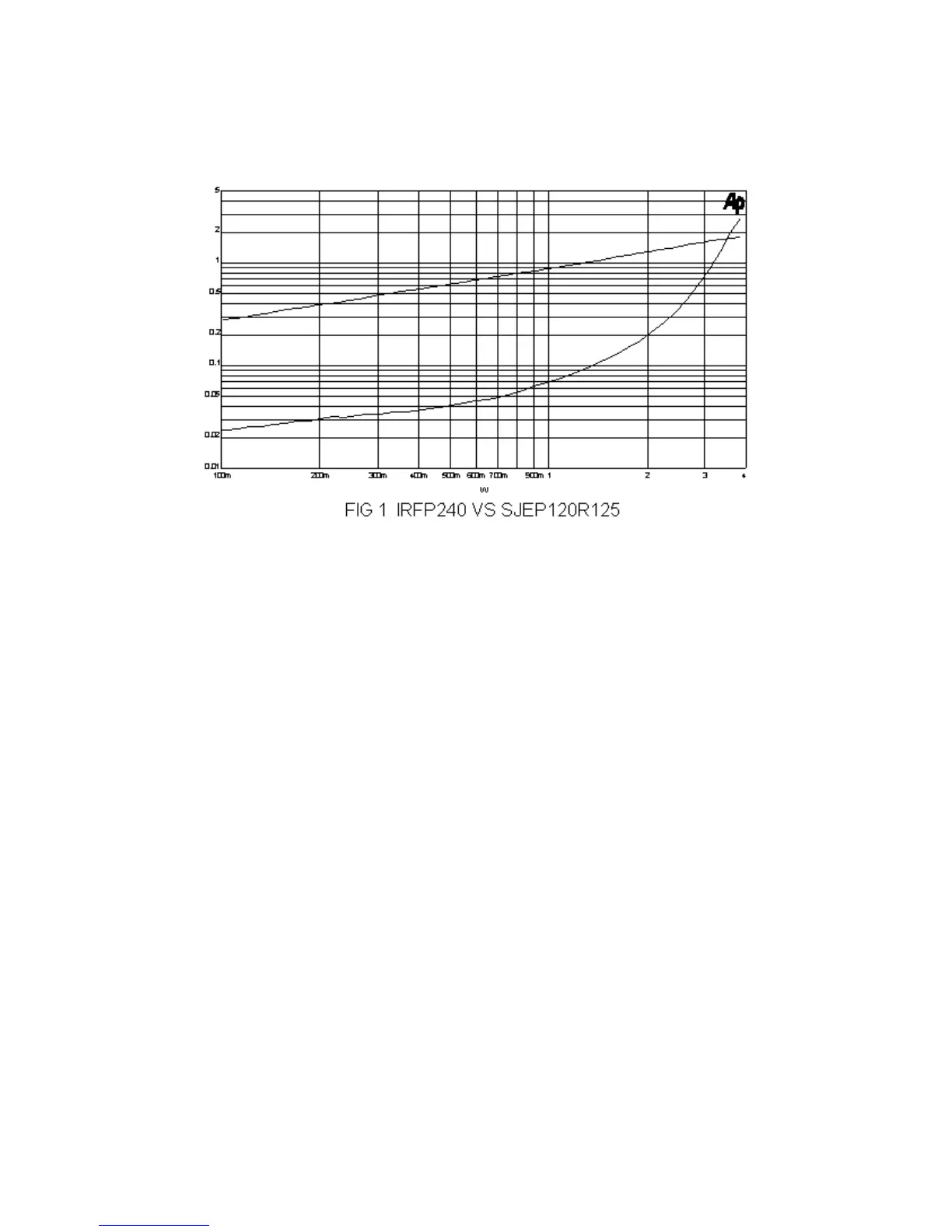
sense of the of the difference, Fig 1 shows the distortion between two different
transistors operated under identical conditions in a First Watt F2 amplifier:
Here we see the popular IRFP240 N channel Mosfet (top curve) versus a
SemiSouth SJEP120R125 N channel JFET, both operated in Common Source
mode, biased at 10 Volts DC and 2 amps by a constant current source and driving
an 8 ohm load without feedback.
Zowie! The JFET is about 20 dB better. At the higher power level in this particular
circuit, you will see that the difference declines, but that is simply the effect of the
triode-like character of the JFET at lower voltages across the device – you can
take care of that with a couple extra volts on the supply.
And with a 1200 volt rating you have some margin to burn, in fact you could stick
this in where a 300B used to go. Not that I would do such a thing....
Also, the distortion remains much lower at high frequencies as well. This part has
about half the input capacitance and about 2/3 the reverse capacitance of the
IRFP240 and the value is more linear, so in typical amplifiers we see about a
quarter of the distortion due to junction capacitances.
If we have a gain device that behaves a bit like a tube, then it is natural to try it out
in a popular tube amplifier topology. For many aficionados that would be single-
ended Class A. 300B’s, 211’s and their cousins are often operated single-ended
and coupled to an output transformer and regarded by many as the low power
musical standard. Single-Ended Class A tube amplifiers are not very powerful,
and their measurements are nothing to write home to mom about, but there is no


 To Next Page
 Loading...
