denying that they have strong musical appeal to a sizable segment of the
audiophile population.
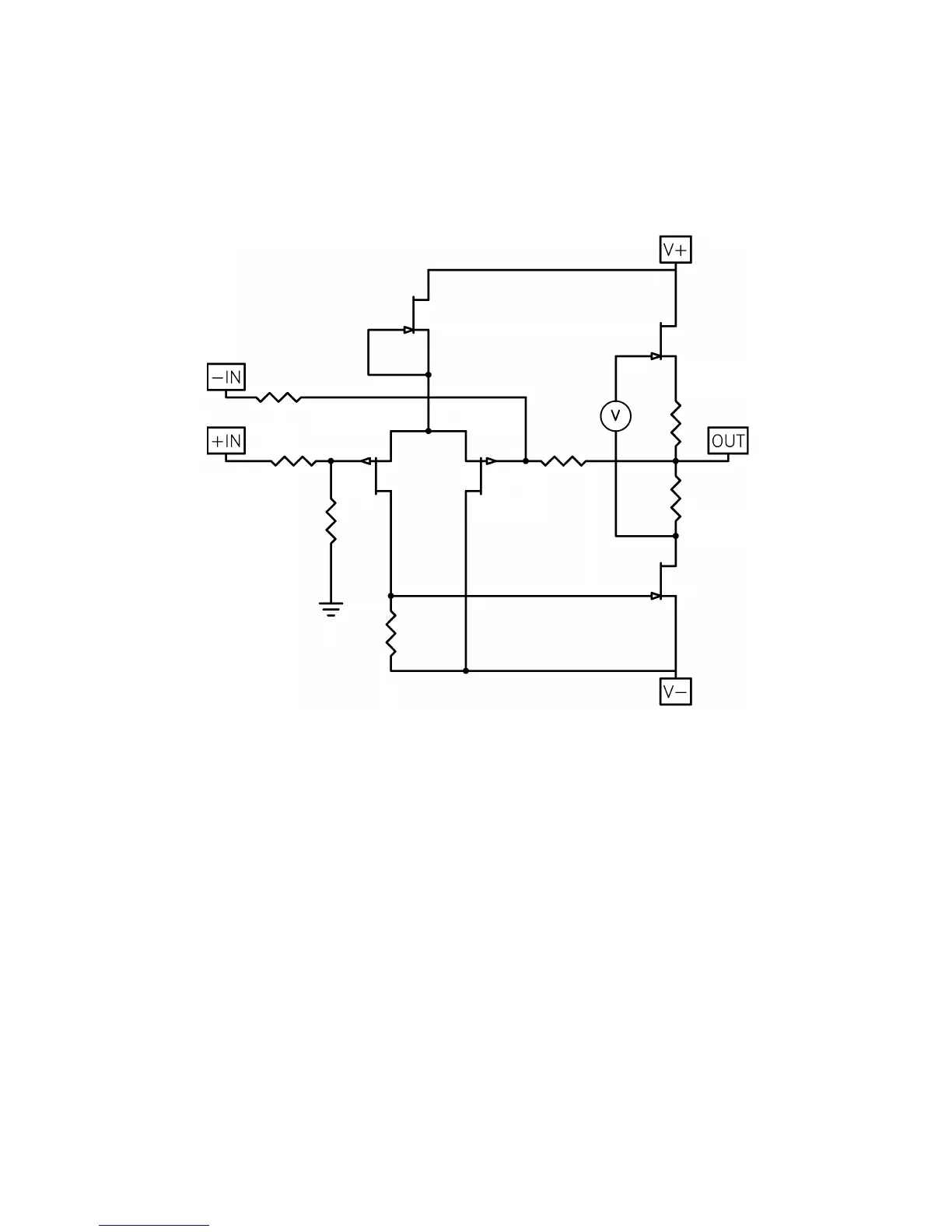
Here is the simplified schematic of the J2. The topology bears a resemblance to
the Aleph J, but is not quite the same.
The most important topological difference is that the output stage current source is
no longer an “Aleph” current source, but a version of the classic “Mu Follower”.
This approach was chosen because the JFETs can take better advantage of
distortion cancellation than Mosfets, but won't do so if the current source is tightly
regulated. This has a little less precision, but lower distortion.
The input stage uses parallel Toshiba 2SK170 and 2SJ109 JFETs for both the
current source and the differential input (the parallels are shown as single in the
drawing). The J2 is a nice blend of parts that are not yet available and parts that
are no longer available.
Being a single-ended Class A circuit, its characteristic is “second harmonic”, and
at 0.02% at 1 watt, it has about half the distortion seen in an Aleph J. Just as
important, it is achieved with a simpler circuit and half as much feedback.
An objectivist might say, “I've got a Carver that measures better than that.”


 To Next Page
 Loading...
