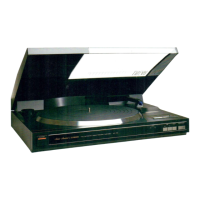
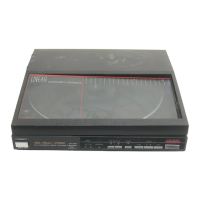
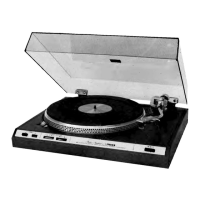
The Fisher MT-250 and MT-1250 are stereo turntables designed for the European market, as indicated by the "EUROPE" designation on the cover. This service manual provides comprehensive information for the maintenance, adjustment, and repair of these models, including detailed specifications, exploded views, parts lists, and circuit diagrams.
Function Description:
The Fisher MT-250/MT-1250 is a belt-driven stereo turntable designed for playing vinyl records. It features a DC servo motor for stable rotation and offers both automatic and manual functions for ease of use. The automatic functions include Start, Stop, Reject, and Repeat, allowing for convenient playback operation. The turntable also incorporates an automatic tonearm return at the end of a record, preventing unnecessary wear on the stylus and record. Manual functions for Start and Stop are also available, providing flexibility for users who prefer more control over playback.
Important Technical Specifications (MT-250):
- Motor: DC Servo
- Drive System: Belt
- Wow and Flutter (WRMS): 0.035 %
- Rumble (DIN 4539B): -70 dB
- Speed Variation: ±1.5 %
- Platter Diameter: 296 mm
- Platter Weight (With Mat): 0.9 kg
- Record Speed Selector: 33-1/3 rpm / 45 rpm
- Tonearm Data:
- Resonance: < 18 Hz
- Effective Length: 130 mm
- Shape: Straight
- Max. Tracking Error: ±2 °
- Cueing: Viscous Damped
- Power Requirements: AC 220 V 50 Hz
- Power Consumption: 10 Watts
- Dimensions (W x H x D): 400 x 99 x 340 mm
- Weight (approx.): 3.3 kg
Usage Features:
The turntable offers a blend of automatic and manual controls to suit different user preferences.
- Automatic Functions: Users can initiate playback with a simple "Start" command, stop it with "Stop," or use "Reject" to lift the tonearm and return it to its rest position. The "Repeat" function allows for continuous playback of a record.
- Manual Functions: For those who prefer direct control, manual "Start" and "Stop" options are available, enabling users to precisely position the tonearm and initiate or end playback.
- Cueing: The viscous damped cueing mechanism allows for gentle lowering and lifting of the tonearm, protecting both the stylus and records from accidental damage.
- Speed Selection: A dedicated switch allows users to select between 33-1/3 rpm and 45 rpm, accommodating different types of vinyl records.
Maintenance Features:
The service manual details various adjustments and procedures crucial for maintaining optimal performance.
- Arm Feed Cord Stringing: Instructions are provided for correctly stringing the arm feed cord, which is essential for the automatic tonearm movement. This involves tying the wire with a spring and making a knot to secure it, as well as removing and re-installing the rail frame from the Unit Plate Assy.
- Turntable Adjustments:
- Stylus Height Adjustment: This procedure ensures the stylus is at the correct height (7.5mm from the turntable surface) for proper tracking and sound reproduction. It involves removing the mat and belt, powering on, pressing a button to move the tonearm, and then turning an adjustment screw.
- Rotation Adjustment: Using a stroboscope sheet, the rotation speed for both 33 rpm and 45 rpm can be adjusted via VR3 and VR2 on the Control PCB, respectively, to ensure accurate playback speed.
- Arm Feed Photointerrupter Sensitivity Adjustment: This adjustment, performed using VR1 on the Control PCB and potentially on the Sensor PCB, ensures the tonearm rises straight up after completing playback, preventing damage. It involves placing a de-centered record, playing it for several revolutions, and then pressing the CUEING button before adjusting VR1.
- Lead-in Adjustment: This adjustment ensures the tonearm correctly lands at the beginning of a record. It involves placing a record, pressing PLAY/STOP, and then turning an adjustment cam to fine-tune the lead-in position. Rotating the cam clockwise moves the lead-in inward, while counter-clockwise moves it outward.
- Parts Identification: Exploded views and detailed parts lists for the cabinet, chassis, and various printed circuit boards (LED P.C.Board, Sensor P.C.Board, Power Switch P.C.Board, Control P.C.Board, Primary P.C.Board) facilitate easy identification and replacement of components.
- Semiconductor Lead Identification: Diagrams are provided for integrated circuits (NJM 7812, NJM 7912, LM 6416E-1971, MN 4049 B, LA 6458 DS), bi-polar transistors (2SA 608, 2SA 984, 2SC 536, 2SC 2274, 2SD 1012), and diodes (DS 442, DSF 10 C, GZA 5.1 Z, GZA 5.6 Z, W 02), aiding in correct component handling and replacement.
- Wiring and Schematic Diagrams: Point-to-point wiring diagrams and schematic diagrams offer a clear understanding of the electrical connections and circuit layout, crucial for troubleshooting and repair.
- IC Signal Flow & Equivalent Circuit: Detailed diagrams for the control IC (LM 6416 E) and voltage regulator ICs (NJM 7812, NJM 7912) provide insight into their internal workings and signal paths, assisting in advanced diagnostics.
- Product Safety Notice: The manual emphasizes the importance of following safety precautions during servicing, particularly regarding components identified with the IEC symbol A. It mandates using only designated replacement parts or those with equivalent ratings to ensure safety and prevent electrical hazards, requiring leakage-current or resistance measurements before returning the product to the customer.

 Need help?

 To Next Page
 General