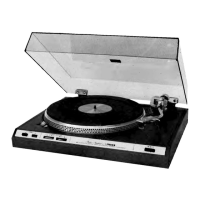
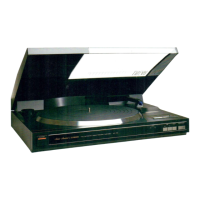
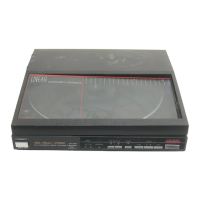
This document is a service manual for the FISHER MT-6130 (EUROPE) Stereo Turntable, providing detailed information for its maintenance and adjustment.
Function Description:
The FISHER MT-6130 is a stereo turntable designed for high-fidelity audio playback. It features a direct-drive auto-return system, meaning the platter is directly driven by a motor, and the tonearm automatically returns to its rest position at the end of a record. This semi-automatic operation enhances user convenience. The turntable is equipped with a stereo tonearm and is designed to play records at two standard speeds: 33 1/3 and 45 rpm.
Important Technical Specifications:
- Type: Direct Drive Auto Return System
- Drive System: Direct Drive
- Motor: DC Brushless Motor
- Speeds: 33 1/3 & 45 rpm.
- Speed Control Range: Variable Range ±4%
- Speed Change: Electronic Type
- Wow & Flutter: Less than 0.04% WRMS
- Signal to Noise Ratio: Better than 60dB
- Turntable Platter: 12 1/8" (308mm) dia. 3 lbs. 3 ozs. (1.5 kg)
- Tone Arm: Static-Balance Type, Auto Return Arm
- Tracking Error: ±1.5°
- Stylus Pressure: 1.2 – 2.0 g
- Tracking Force Range: 0 – 3 g
- Frequency Range: 20 – 20,000Hz
- Channel Separation: Better than 25 dB
- Power Source: AC 110/125/220V 50Hz
- Power Consumption: 12W
- Dimensions: 18-3/4"(W) x 6"(H) x 14-15/16"(D) (475 x 152 x 379mm)
- Weight: 17 lbs. 10 ozs.
The German section of the manual provides additional details on the cartridge and stylus:
- Magnetic System: Fujionkyo ST-26 DL
- Stylus: Spherical Diamond
- Nadelnachgiebigkeit (Stylus Compliance): 15 x 10^-6 cm/p horiz., 13 x 10^-6 cm/p vert.
Usage Features:
The turntable is designed for straightforward operation. The auto-return function simplifies the listening experience by automatically lifting and returning the tonearm at the end of a record. Speed selection between 33 1/3 and 45 rpm is electronic, allowing for easy switching between different record types. The variable speed control range of ±4% allows for fine-tuning of playback speed.
Maintenance Features:
The manual provides several adjustment and maintenance procedures to ensure optimal performance and longevity of the turntable:
- Adjustment of Lifter Height: This involves adjusting the clearance between the disc surface and the stylus tip to approximately 4mm by turning a special screw on the tonearm lifter assembly.
- Adjustment of Auto-Return: The auto-return mechanism can be adjusted by a flat-head screw on the tonearm return lever assembly. The goal is to ensure the auto-return works when the pick-up is 57 to 65mm from the center of the record.
- Adjustment of Height of Tonearm Rest: The height of the tonearm rest can be adjusted by loosening a screw, setting the desired height, and then retightening the screw. It's crucial to ensure the tonearm does not contact the tonearm lifter when the lifter assembly is in the "UP" position.
- Leveling Headshell: If the headshell is inclined, its position can be adjusted by loosening two screws on the tonearm, leveling it, and then securely retightening the screws.
- Regular Lubrication: The direct-drive motor requires lubrication at yearly intervals. Two or three drops of oil should be applied after removing the turntable platter. A critical caution is to avoid oiling the levers of the gear assembly, as this can cause the auto-return to malfunction. If oil accidentally gets on these levers, they should be cleaned immediately with alcohol and a cloth.
- Cartridge Replacement: The manual details the steps for replacing the cartridge, including loosening the knurled screw, detaching the old cartridge, installing the new one according to the manufacturer's instructions, connecting the four colored cables (red for right channel output, green for right channel ground, white for left channel output, blue for left channel ground), and finally adjusting the cartridge position so the stylus tip is 15mm from the center of the spindle.
- Output Cord Handling: A caution is provided regarding unplugging the output cord: always hold the plug itself, not the cord, to prevent damage.
The manual also includes exploded views and schematic diagrams to aid in understanding the internal components and their arrangement, which are essential for service and repair. The parts list provides a comprehensive breakdown of all components, including electrical parts and screws, with their respective part numbers and quantities.

 Need help?

 To Next Page
 General