
 Need help?
Do you have a question about the FLEMING Schiller BR-102 Plus and is the answer not in the manual?
Instructions for patient movement, environment, and unit wear during blood pressure recording.
Procedure for taking an extra blood pressure measurement outside of scheduled intervals.
How to pause or stop a blood pressure measurement that is currently in progress.
Step-by-step guide for replacing batteries, including warnings and post-replacement actions.
Instructions on how to properly position the blood pressure cuff on the arm for accurate readings.
Important warnings and cautions regarding cuff use, patient safety, and device handling.
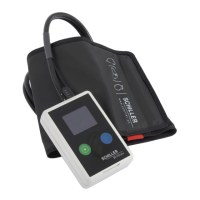
The Schiller BR-102 Plus Ambulatory Blood Pressure Recorder is a discreet, compact, long-term blood pressure monitoring unit designed to provide accurate measurements while allowing patients to maintain their daily routines. It utilizes both auscultatory and oscillometric measurement technologies and incorporates motion-tolerant technology to prevent re-inflation and failed readings.
The primary function of the Schiller BR-102 Plus is to record blood pressure measurements over an extended period, typically 24 or 48 hours, at predetermined intervals. This ambulatory monitoring helps healthcare professionals assess blood pressure fluctuations throughout a patient's normal daily activities and during sleep, providing a more comprehensive picture than single in-office measurements. The device is designed to be worn discreetly, allowing patients to go about their lives undisturbed. Its dual measurement method (auscultatory and oscillometric) enhances accuracy, while motion-tolerant technology minimizes errors caused by patient movement, ensuring reliable data collection without the need for repeated inflations.
During the recording period, several guidelines are provided to ensure accurate measurements. Patients are advised not to move the arm on which the cuff is placed during measurements and to avoid noisy areas when a reading is being taken. If an invalid measurement occurs, the device will immediately initiate a second measurement. The unit must be worn continuously, including overnight. To help secure the tubing, patients should wear a t-shirt or other clothing over it, especially at night. After each measurement, a second measurement will be performed: the cuff inflates again, and the pressure is maintained for about 10 seconds before deflation, preparing the recorder for the next scheduled measurement.
Patients can take an extra measurement at any time by pressing either the green or blue control button to display the measurement screen and pressing it again. To interrupt an ongoing measurement, either control button can be pressed, and the next measurement will then proceed according to the schedule.
The device also features a battery management system. For a 48-hour recording, preventive battery changes are recommended after 24 hours. This involves pressing the blue button for 4 seconds, confirming "Change battery" with another press of the blue button, replacing the batteries with fully charged ones (observing correct polarity), and then pressing the green button to switch the unit back on. The device will then display "Blood pressure measurement Next Meas xx:xx". Patients should make an entry in their patient diary when batteries are changed. The device also provides warnings for low battery, either through an audible beep or a message on the screen ("BATTERY LOW Change battery" or "BATTERY LOW Change battery immediately"). In such cases, patients should confirm the message, replace the batteries, and restart the unit as described above, making a note in their diary. Old batteries should be returned to the surgery for proper disposal.
Proper cuff placement is crucial for accurate readings. The cuff should be placed on the left upper arm, approximately 2cm above the elbow, allowing the forearm to move freely. The red flap, which indicates the microphone's position, should be on the inside of the arm, with the pressure tube pointing towards the shoulder. If needed, tape can be used to secure the tubing to the body. The device itself should be placed in a pouch and secured with the pouch straps. Wearing a t-shirt over the tubing helps keep it secure. It's important not to wrap the cuff too tightly around the arm. A 2cm gap should be left from the end of the cuff to the elbow joint.
Patients are encouraged to make entries in a leaflet diary for any significant events, such as dizziness, palpitations, chest pain, battery changes, or extra measurements.
Several warnings and cautions are provided for patient safety and device longevity. If a patient experiences numbness, chafing, pain, or discomfort in the arm, they should immediately remove the cuff and contact their doctor. There is a danger of strangulation from the hose, so wearing a t-shirt or clothing over the tubing at night is recommended to keep it secure. For patients with special needs, such as children, the elderly, the disabled, or those lacking the capacity for judgment, a caregiver must operate the recorder and monitor the recording.
The unit is not waterproof; therefore, it must not get wet. Patients should remove the recorder and cuff before bathing or showering. To prevent device malfunction, a sufficient distance (at least 30 cm) should be maintained from other electrical/electronic devices, such as smartphones.
 General
| Model | BR-102 Plus |
|---|---|
| Brand | Schiller |
| Recording Speed | 25 mm/s |
| Power Supply | Battery |
| Connectivity | USB |

 To Next Page