EasyManua.ls Logo

Fluke 415B - Page 49

Fluke 415B
92 pages
Print Icon
To Next Page IconTo Next Page
To Previous Page IconTo Previous Page
Loading...
41
5B
c.
Repeat the output
resistance
measurement
at the
rear OUTPUT
connector.
With
ali
OUTPUT
VOLT-
AGE dials
set to zero,
the
resistance
should be
approximately
2 kilo
ohms.
4-41.
STANDBY
POWER.
This
procedure
measures
power consumption
in the
STDBY/RESET
position.
It
reveals possible
gross faults,
such
as wiring
errors
and shorted
components in
the auxiliary
supply, 125
volt regulator and
error
amplifier.
a. Connect the Model
415B through
a Variac to
a 115
volt, 60 Hz, power
line
with
a wattmeter
or an
ammeter
in series with the
ac
line.
Set the Variac
to zero
output.
b.
Set the
Model
415B controls
as follows:
OUTPUT VOLTAGE
dials
POWER
POLARITY
HIGH VOLTA
GE
All to zero
ON
Negative
STDBY/RESET
d. Slowly
increase
the output
of
the
Variac.
The
STDBY/RESET
light
should come
on
approximately
60 seconds after
the line
power
reaches
103 volts.
At
115
volts
ac
the
unit
should draw
a nominal 25
watts
(0.
36
amperes);
power
consumption
should
be no
greater
than 35
watts.
4-42. 125
VOLT
SUPPLY
CHECK.
A measurement
of
ripple
on the 125 volt
supply at
low and high
line
voltage
reveals
quickly
not only the
ac
superimposed
on the dc
output
but also
the capability
of the circuit
to
regulate.
The
value of the
output
voltage
should
also be
measured.
NOTE!
The
following
checks must
be
done with
the
top cover removed
and the interlock
disabled,
a.
Set
the
controls of
the Model
415B
as follows:
OUTPUT
VOLTAGE
All to
zero
dials
HIGH
VOLTAGE
STDBY/RESET
POWER
ON
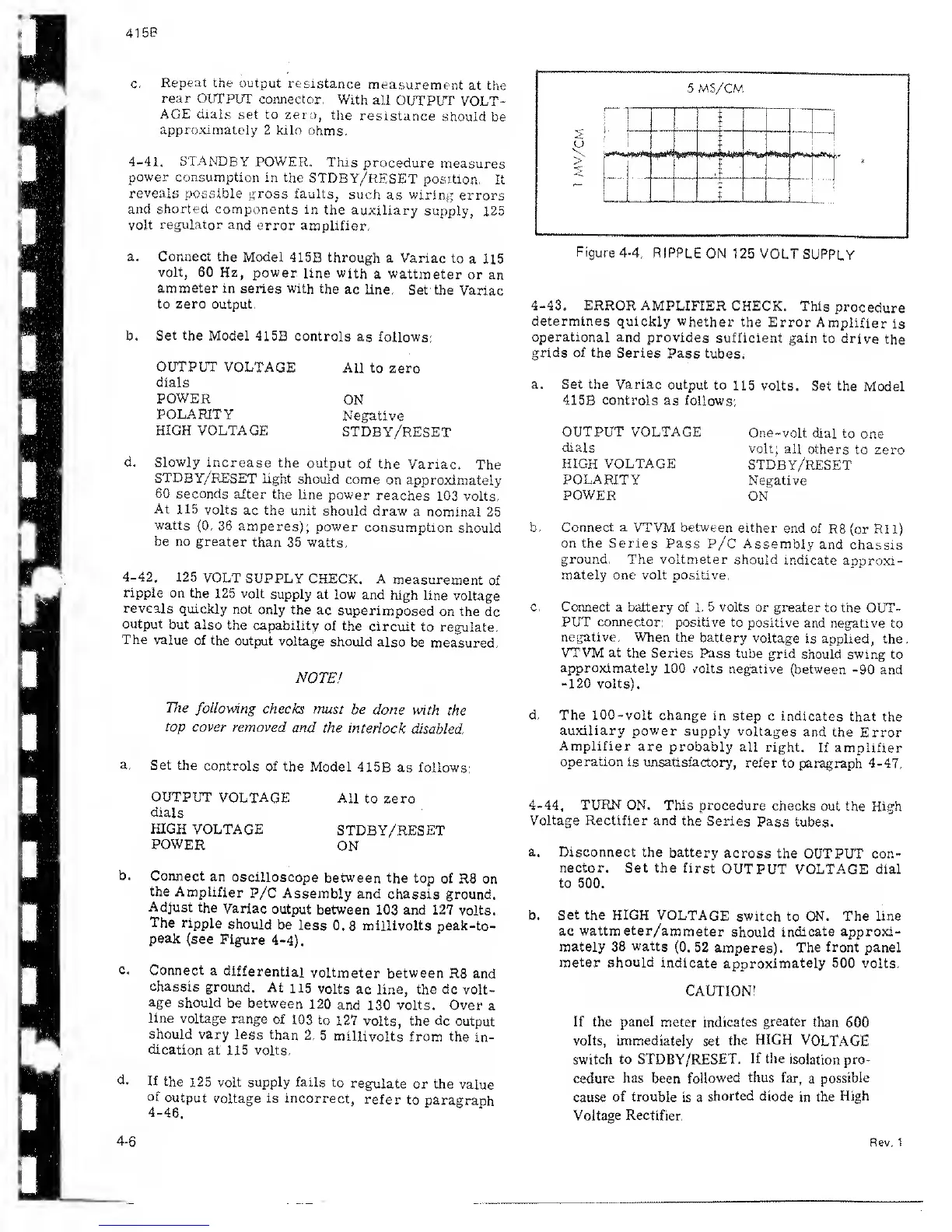
b.
Connect an
oscilloscope
between the top
of R8
on
the
Amplifier
P/C
Assembly and
chassis ground.
Adjust
the
Variac
output
between
103 and 127
volts.
The
ripple
should
be
less
0.
8
millivolts peak-to-
peak
(see
Figure
4-4).
c.
Connect a
differential
voltmeter
between R8 and
chassis
ground.
At
115
volts
ac
line,
the
dc
volt-
age
should
be between
120
and
130
volts.
Over
a
line voltage
range
of
103 to
127
volts, the
dc
output
should
vary less
than 2.
5
millivolts
from the
in-
dication
at 115 volts.
d
-
the
125 volt supply fails
to
regulate
or the
value
of
output
voltage
is
incorrect,
refer
to paragraph
4-46.
5 MS/CM
Figure
4-4.
R IPPLE ON
1 25 VOLT
SUPPLY
4-43.
ERROR AMPLIFIER
CHECK.
This
procedure
determines
quickly whether the
Error
Amplifier
is
operational and
provides
sufficient gain
to drive
the
grids of the
Series
Pass tubes.
a. Set
the
Variac output
to
115 volts.
Set the
Model
415B
controls
as follows:
OUTPUT VOLTAGE
dials
HIGH VOLTAGE
POLARITY
POWER
One-volt
dial to
one
volt;
all
others to zero
STDBY/RESET
Negative
ON
b. Connect a VTVM between
either
end of
R8 (or Rll)
on the
Series
Pass
P/C Assembly
and chassis
ground.
The
voltmeter
should
indicate approxi-
mately one volt
positive.
c.
Connect a battery of 1.
5
volts or greater
to the OUT-
PUT connector:
positive to
positive and
negative to
negative. When
the battery
voltage
is applied,
the.
VTVM at
the Series Pass tube
grid
should swing to
approximately 100
volts negative
(between
-90
and
-120
volts).
d.
The 100-volt change
in step
c indicates
that the
auxiliary
power supply
voltages
and the
Error
Amplifier
are probably all
right.
If amplifier
operation is
unsatisfactory,
refer to paragraph 4-47.
4-44. TURN ON. This procedure
checks out the High
Voltage
Rectifier and the
Series
Pass tubes.
a.
Disconnect the battery
across the
OUTPUT
con-
nector. Set the first
OUTPUT VOLTAGE dial
to 500.
b. Set the HIGH
VOLTAGE
switch to ON. The line
ac wattmeter/ammeter
should
indicate
approxi-
mately
38 watts
(0. 52
amperes).
The
front
panel
meter should
indicate
approximately
500
volts.
CAUTION!
If the panel
meter indicates
greater
than
600
volts, immediately
set
the
HIGH
VOLTAGE
switch
to STDBY/RESET.
If the
isolation pro-
cedure has
been
followed
thus
far,
a
possible
cause
of trouble
is a
shorted
diode
in
the
High
Voltage Rectifier.
4-6
Rev. 1

Related product manuals