415B
4-45.
Assembly
Troubleshooting
4-46.
125
VOLT
REGULATOR. If the 125 volt
supply
fails to regulate
or the value
of
the
output voltage
is
incorrect,
proceed as follows:
a. With a VTVM
measure the unregulated
output of
the auxiliary
supply: junction of R3 and
R4 on the
Series
Pass P/C Assembly. At a line
voltage of
115
volts, the dc
output should be
170
to 210 volts.
b.
Connect
a differential voltmeter between the
cathode
of
CR2 on the Amplifier
P/C
Assembly
and chassis
ground.
Measure
the
output
of the voltage reference
tube,
VI, Voltage should be
between
83. 3
and 85.
05
volts and
should remain constant over a
line voltage
range of
103 to 127 volts.
c. With a differential
voltmeter, measure the
voltage
across zener diode
CR1 on
the
Amplifier
P/C
As-
sembly. Voltage
should be 10.
8
to
13.
2
volts dc.
d.
In
a
properly operating 125
volt regulator, the
bases of
Q4
and
Q5
should be at the same voltage
(83 volt
reference).
If the bases are at
the same
voltage but the
supply
will
not regulate,
CR2 or
CR3 could
possibly be shorted. Eliminate
this
possibility with an
ohmmeter check.
If
the supply
will not regulate and
CR2 and CR3 are not shorted,
0. 6 volts
should appear between the
bases of
Q4
and
Q5.
c. Replace the removed
transistor,
Q1
or
Q2.
Meas-
ure the voltage at the
summing
junction
(front of
R25). This should
be
approximately
2.5 volts
positive and verifies that
reference
current
flows
through the
reference divider,
R25,
and
CR4.
d. Repeatedly
apply the
1.
5 volt
battery
to
the
output
connector in the same manner
as in the
check
pro-
cedure (paragraph
4-43),
and measure
the
transistor
voltages
to determine
where
the voltage
transition
stops.
Start from
Q1
on the
Series
Pass
P/C As-
sembly and proceed toward
Q7 on the
Amplifier
P/C Assembly.
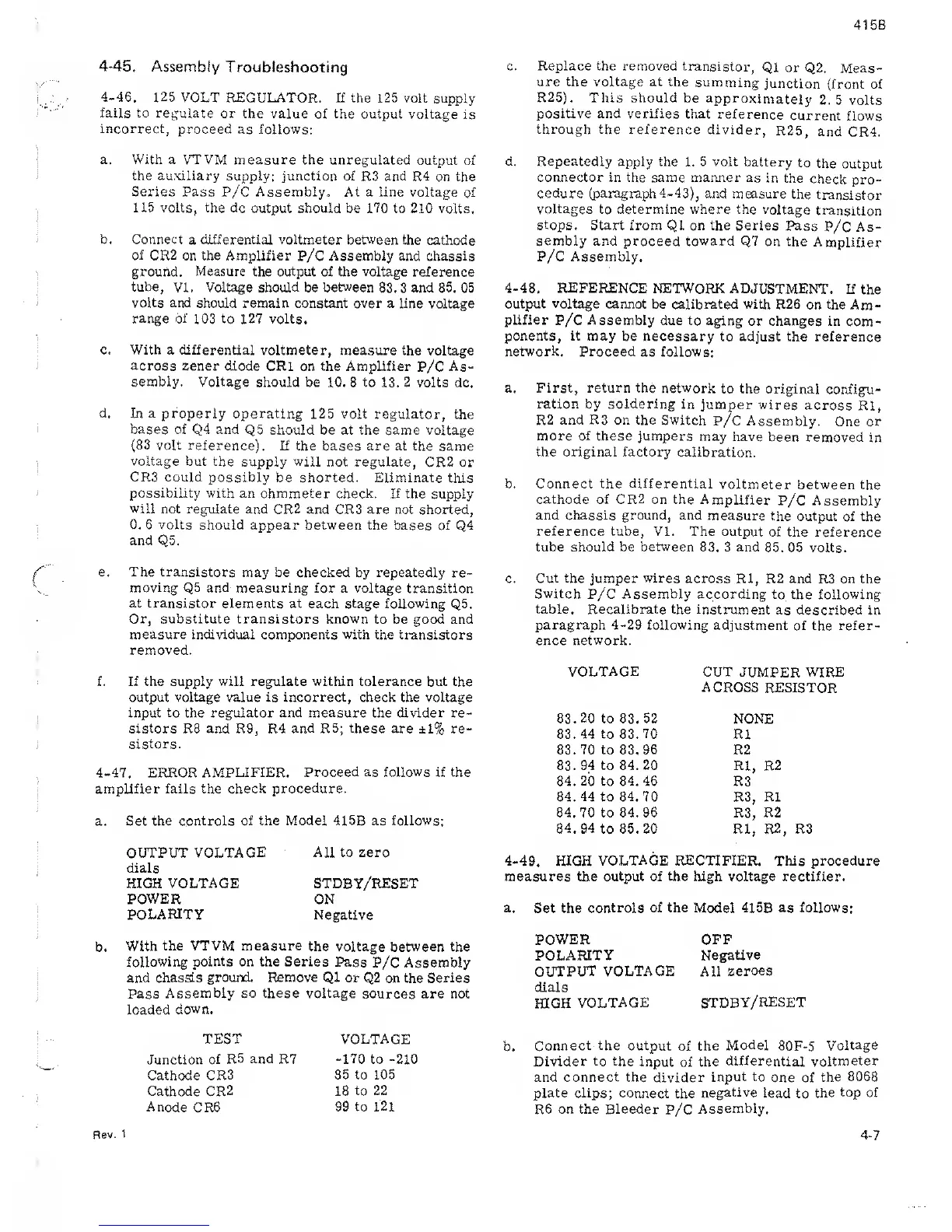
4-48. REFERENCE
NETWORK ADJUSTMENT.
If
the
output voltage cannot
be calibrated with
R26 on the Am-
plifier
P/C
Assembly
due to aging
or changes in
com-
ponents, it may
be necessary
to
adjust
the reference
network. Proceed
as follows:
a. First, return the
network
to the original
configu-
ration by
soldering
in
jumper
wires across
Rl,
R2
and R3 on the
Switch
P/C Assembly.
One or
more
of
these jumpers
may have
been removed
in
the original factory
calibration.
b. Connect the
differential
voltmeter
between the
cathode of CR2 on the
Amplifier
P/C Assembly
and
chassis
ground, and
measure
the output of the
reference tube, VI. The output
of the
reference
tube should be between 83.
3
and
85. 05
volts.
e. The transistors
may
be checked
by repeatedly re-
moving
Q5
and
measuring for a voltage transition
at transistor elements
at each stage
following
Q5.
Or, substitute transistors known to
be good and
measure
individual components with the transistors
removed.
c.
Cut the jumper wires across Rl,
R2 and
R3
on the
Switch
P/C
Assembly according
to. the following
table. Recalibrate the instrument
as described in
paragraph
4-29
following adjustment
of the refer-
ence
network.
f. If the supply
will
regulate
within
tolerance but the
output voltage value is incorrect, check the voltage
input
to
the regulator
and measure
the divider re-
sistors R8 and R9, R4
and
R5;
these
are
±1%
re-
sistors.
4-47. ERROR
AMPLIFIER.
Proceed as follows if the
amplifier
fails the check
procedure.
a. Set the
controls of the Model
415B
as follows:
OUTPUT
VOLTAGE All to zero
dials
HIGH
VOLTAGE
STDBY/RESET
POWER
ON
POLARITY
Negative
b.
With
the VTVM measure
the voltage between the
following
points on the Series
Pass
P/C Assembly
and chassis
ground. Remove
Q1 or
Q2 on the
Series
Pass
Assembly
so these voltage
sources are
not
loaded
down.
VOLTAGE CUT
JUMPER WIRE
ACROSS
RESISTOR
83.20 to 83.52
NONE
83.44 to 83.70
Rl
83.70 to 83.96
R2
83. 94 to
84.20
Rl,
R2
84.
20
to
84.46
R3
84.44 to 84.70
R3, Rl
84.70 to 84.96 R3, R2
84.94 to 85.20 Rl,
R2, R3
4-49. HIGH
VOLTAGE
RECTIFIER. This procedure
measures the output of the high voltage rectifier.
a.
Set the
controls of the
Model
41
5B
as follows:
POWER OFF
POLARITY Negative
OUTPUT
VOLTAGE
dials
All
zeroes
HIGH
VOLTAGE STDBY/RESET
TEST VOLTAGE
Junction
of R5
and
R7
-170
to
-210
Cathode CR3
85 to 105
Cathode
CR2
18
to 22
Anode
CR6
99 to
121
b.
Connect
the
output
of
the
Model
80F-5
Voltage
Divider
to the
input
of
the
differential voltmeter
and connect the
divider
input to
one of
the
8068
plate clips; connect
the
negative
lead
to
the
top
of
R6
on the Bleeder
P/C
Assembly,
Rev.
t
4-7


 To Next Page
 Loading...