EasyManua.ls Logo

Fluke 6062A - Page 41

Fluke 6062A
86 pages
Print Icon
To Next Page IconTo Next Page
To Previous Page IconTo Previous Page
Loading...
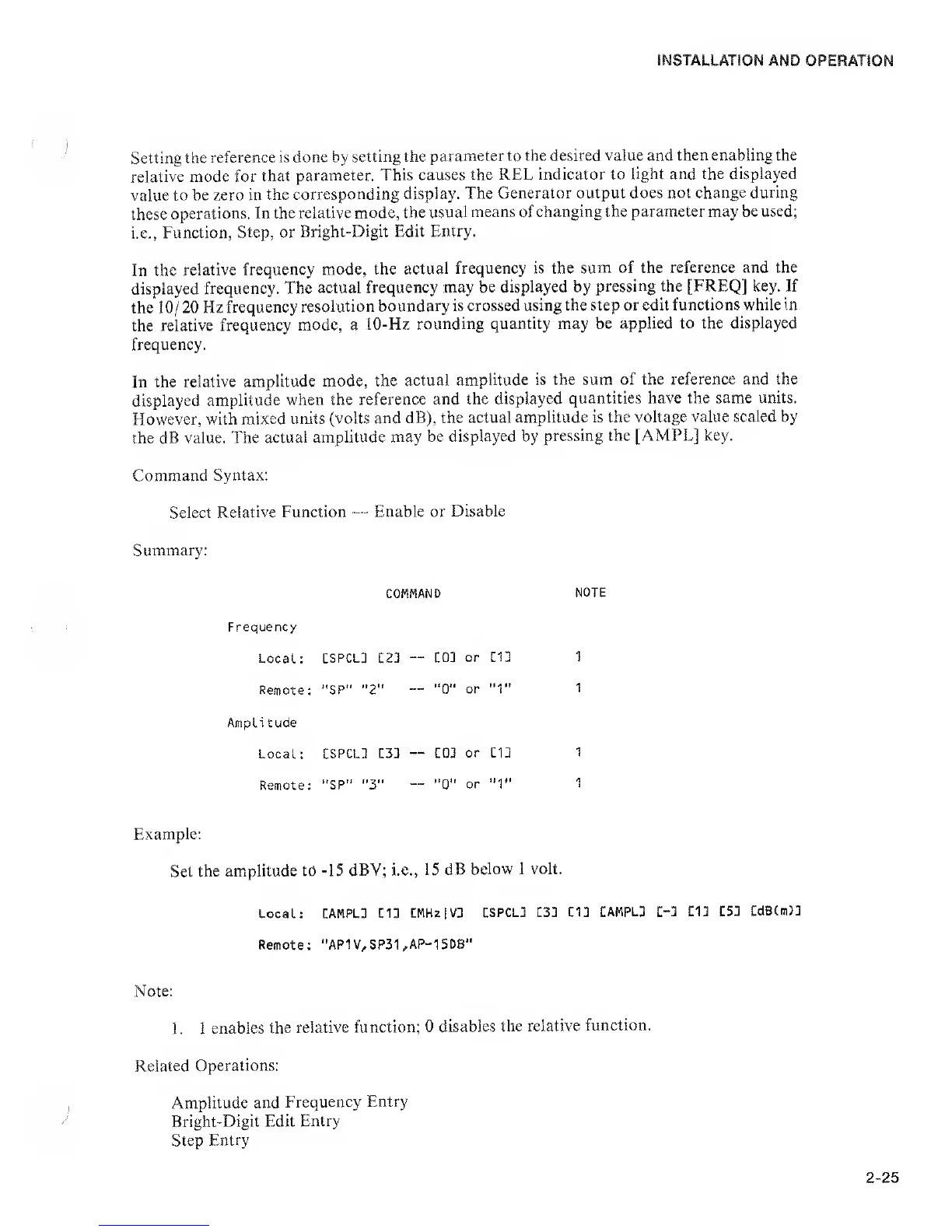
Setting the
reference is
done by
setting the
parameter to the
desired value and then enabling the
relative mode
for that
parameter.
This causes the
REL indicator to
light and the displayed
value
to be zero in
the
corresponding
display. The
Generator output does not
change during
these
operations. In
the relative
mode, the
usual means
of
changing the parameter may be used;
i.e,,
Function, Step, or
Bright-Digit Edit
Entry.
In the
relative
frequency mode,
the
actual frequency is the
sum of the reference
and the
displayed
frequency. The
actual
frequency may
be displayed by
pressing the [FREQ] key. If
the
10/
20 Hz
frequency
resolution
boundary is crossed
using the step or edit
functions while
in
the
relative frequency
mode, a
10-Hz
rounding quantity may
be applied to the
displayed
frequency.
In the
relative amplitude
mode, the
actual
amplitude is the sum
of the reference and the
displayed
amplitude when
the reference
and the displayed
quantities
have the same units.
However, with
mixed units (volts
and dB), the
actual
amplitude is the voltage value
scaled
by
the dB value.
The
actual amplitude may
be displayed by
pressing the
[AMPL] key.
Command
Syntax:
Select
Relative Function
Enable or
Disable
Summary:
COMMAND
NOTE
Frequency
Local:
CSPCL3 ZZl
CO] or C13
1
Remote: "SP”
”2"
"0"
or
"1”
1
Amplitude
Local: CSPCL3 C33
C03
or C13
1
Remote:
"SP"
”3"
"0"
or
"1"
1
Example:
Set
the
amplitude to
-15
dBV; i.e.,
15 dB
below 1 volt.
Local: CAMPL3 C13
CMHzlW
CSPCL3 C33 C13
CAMPL3
C“3
C13 C53
CdB(m)3
Remote;
"AP1V^SP31,AP“15D8"
Note:
1. I
enables
the relative
function; 0
disables
the relative
function.
Related
Operations:
Amplitude and
Frequency
Entry
Bright-Digit Edit
Entry
Step
Entry

Related product manuals