The Generator
implements
a subset
of
IEEE-488 Interface functions
defined by
the IEEE
Standard
488-
1978. Table
2-9
summarizes the IEEE-488 Interface
functions
implemented.
2-43.
Address Mode
In the address mode,
the Generator may be operated
from local (using the
front panel keys) or
from remote
(using the IEEE-488 Interface).
The following paragraphs
describe the
operation
of the Generator in both
states and transitions
between the states.
The available IEEE-488
messages
and their descriptions
for the address
mode of operation
are
presented
in Table
2-10.
2-44.
LOCAL
OPERATION
The Generator
powers up in
the local mode. When
in local
mode, the following
conditions are
present:
The
front panel indicator
REM, is
not lit.
Device trigger (GET),
device clear (DCL),
and selected device clear
(SDC) interface
messages are ignored.
All device-dependent
messages are ignored.
If the data
output was requested while
the Generator
was in the remote
mode, the data
output
of a talker may
be sent.
2-45.
GOING
FROM LOCAL TO REMOTE
The Generator
switches from local
to remote when
the “my listen
address message”
(MLA) is
received,
and the Remote
Enable (REN) signal
is true.
2-46.
REMOTE
OPERATION
When in the
remote mode, the following
conditions
are present:
The front
panel REM indicator
is lit.
Device trigger
(GET), device
clear (DCL), and selected
device clear
(SDC) interface
messages
are processed.
All
device-dependent
messages are processed
during the remote mode.
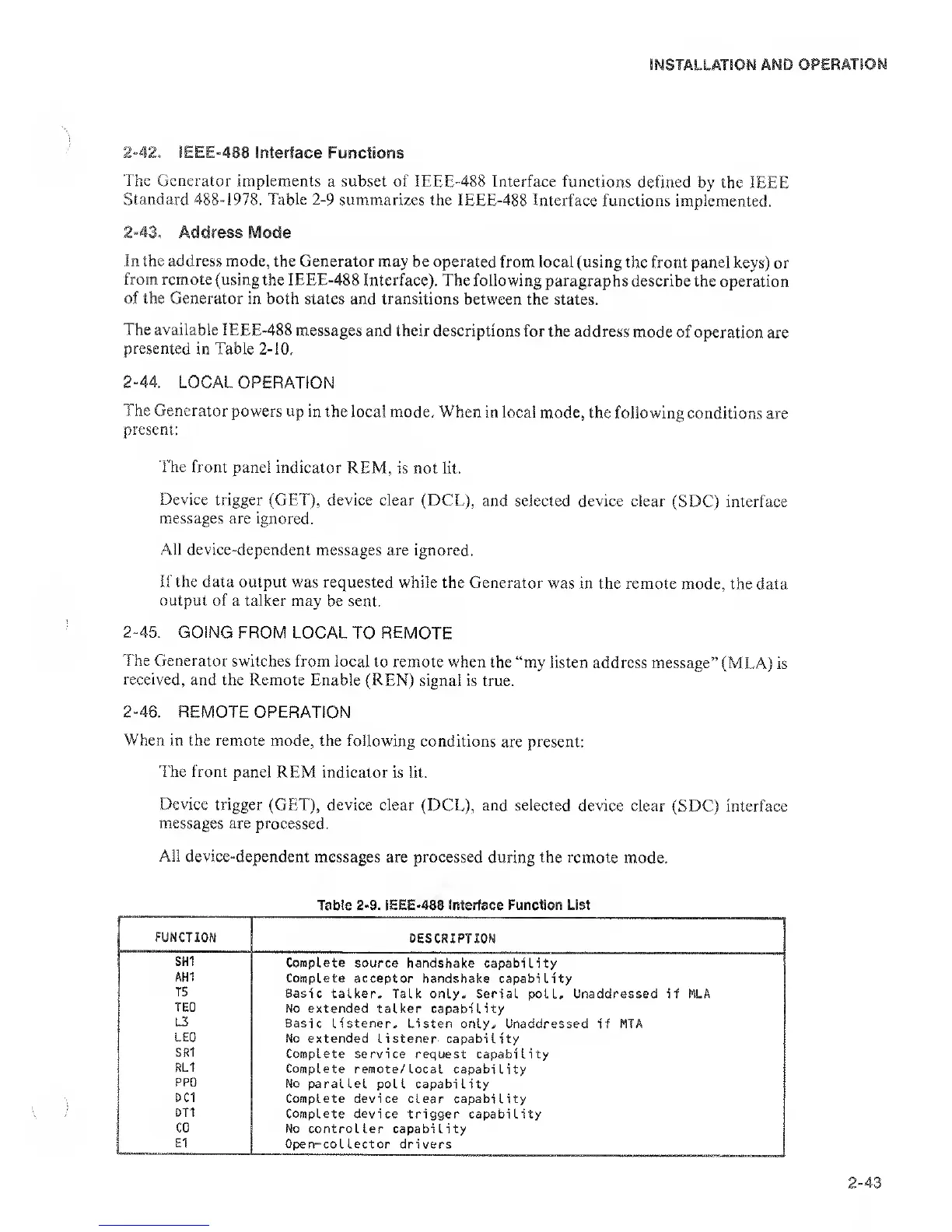
Table
2-9.
IEEE-488 Interface
Function List
FUNCTION
DESCRIPTION
SH1
Complete source handshake capability
AH1
Complete acceptor
handshake capability
T5
Basic
talker> Talk only. Serial poll. Unaddressed if MLA
TEO
No extended talker capability
L3
Basic listener.
Listen only. Unaddressed
if
MTA
LEO
No extended
listener capability
SRI
Complete service request capability
RL1
Complete
remote/Local capability
PRO
No parallel
poll capability
DC1
Complete device clear capability
DT1
Complete
device trigger capability
CO
No controller
capability
El
Open-coL lector drivers


 To Next Page
 Loading...