2-52.
NUMERIC
DATA SYNTAX
There are four
types of numeric
data: Boolean,
unsigned
integer,
floating point,
and trigger
string.
The following
paragraphs describes
each of
the four numeric
data formats.
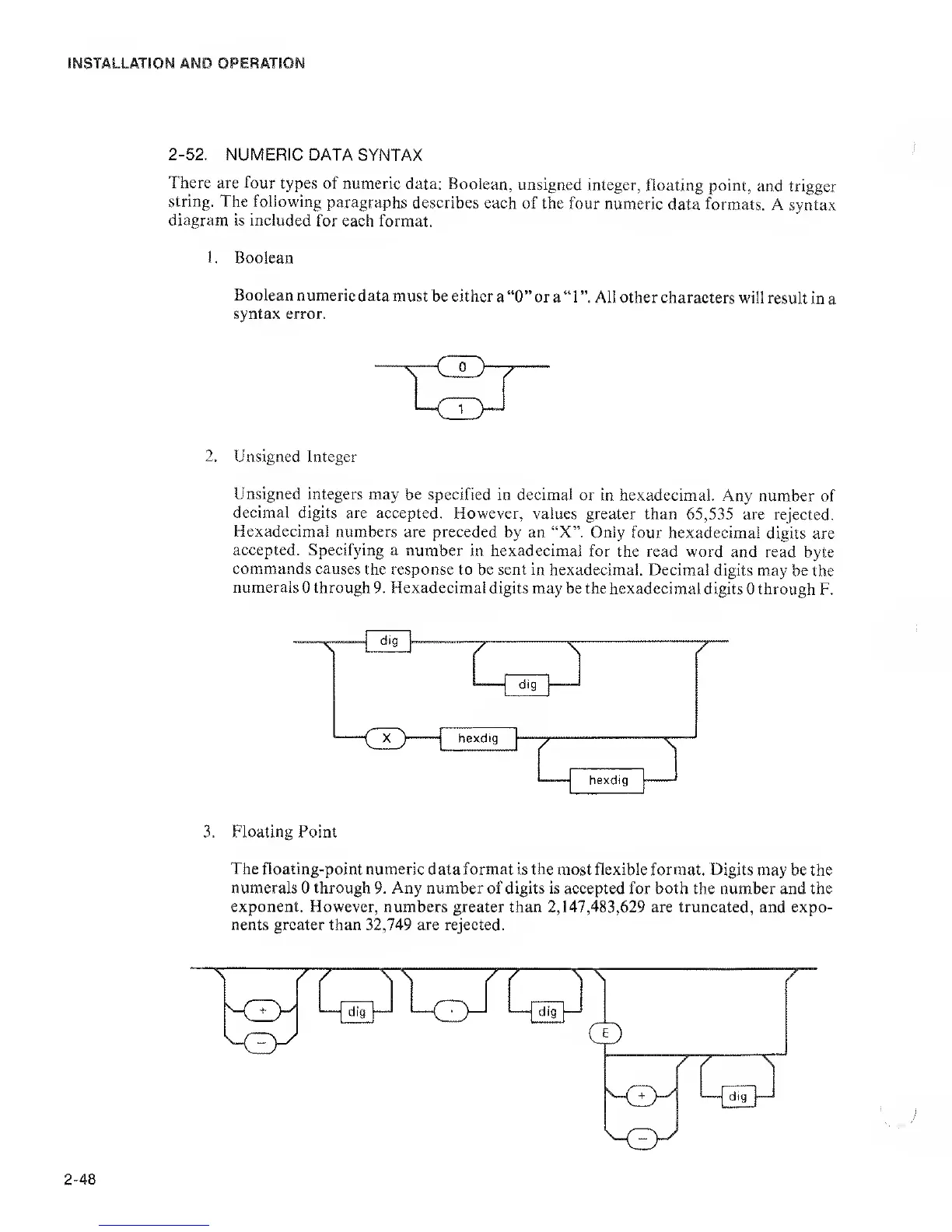
A syntax
diagram
is
included
for each format.
1.
Boolean
Boolean
numeric data
must be either
a
“0”
or a ‘T
All other characters
will result
in
a
syntax error.
7
"
2.
Unsigned Integer
Unsigned
integers may be
specified in decimal
or in hexadecimal.
Any number of
decimal digits are accepted.
However, values
greater than
65,535 are rejected.
Hexadecimal
numbers are preceded
by an “X”. Only
four hexadecimal
digits are
accepted. Specifying a number
in hexadecimal
for the read word
and read byte
commands causes
the response to be sent in
hexadecimal. Decimal
digits may be
the
numerals
0 through 9. Hexadecimal
digits may be the
hexadecimal digits
0
through
F.
3.
Floating Point
The floating-point
numeric data format is the most flexible format. Digits
may be the
numerals 0 through 9. Any number
of digits
is
accepted for both the number and the
exponent. However,
numbers greater than
2,147,483,629
are truncated, and expo-
nents greater than 32,749 are rejected.
2-48


 To Next Page
 Loading...