Need help?
Do you have a question about the Fly Wing H1-Heli and is the answer not in the manual?
Emphasizes flying in open areas, maintaining visual line of sight, and respecting altitude limits.
Covers essential checks like blades, linkages, power supply, and helicopter self-inspection.
Covers weather, environment, signal interference, and general flight procedures.
Details manual control during emergencies and limitations of GPS mode.
Emphasizes adult use, legal flying fields, and operator liability for product use.
Covers reading the manual, proper operation, and avoiding potential hazards.
Introduces the H1 system with its IMU, damping sponge, and control algorithms.
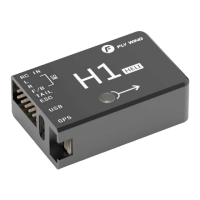
Details the main controller, GPS, IMU, barometer, compass, and their functions.
Describes PWM outputs, receiver input, and various connectivity options.
Lists and describes the Pin Port, USB Port, GPS Port, and LED indicator.
Mentions swash plate types and explains GPS/GLONASS, compass, and calibration needs.
Covers ensuring modules are complete and watching tutorial videos for guidance.
Details transmitter setup, compass calibration, connection checks, and initial flight test.
Lists required equipment and compatible device types for the system.
Provides the download link, OS requirements, and installation steps for the software.
Details proper placement and orientation for the main controller and GPS module.
Specifies environmental and interference avoidance for GPS mounting.
Covers orientation, vibration, waterproofing, and secure mounting of components.
Explains BEC, low voltage return, battery connections, and grounding.
Details connecting receiver, ESC, and battery, and setting parameters.
Illustrates and explains incorrect wiring scenarios to prevent damage.
Specifies transmitter features like SBUS, channels, and airplane mode.
Details binding, channel assignments, and failsafe configuration.
Guides through connecting the H1 to the computer and selecting the correct helicopter model.
Covers transmitter range calibration, tail servo neutral position, and swash plate leveling.
Details selecting swash plate type and adjusting servos for proper leveling.
Explains setting zero, positive, and negative collective pitch angles.
Guides through tail servo type selection and stroke calibration.
Explains why and how to calibrate the compass and avoid interference.
How to view and correct error messages displayed by the software.
Adjusting swash plate leveling and collective pitch angles for optimal performance.
Adjusting swash gain, tail gain, and other sensitivity settings for flight.
Important notes for performing compass calibration in suitable environments.
Step-by-step guide for calibrating the compass using the adjustment software.
Explains how the flight control detects and manages low battery voltage.
Describes GPS, 3D, and Home modes and their operational differences.
Explains route training, auto cruise, and different route patterns.
Details out-of-control, one-key, and low-voltage return procedures.
Explains how low voltage triggers return and manual override during landing.
Introduces one-key normal/invert mode switching and its requirements.
Differentiates between novice and advanced inverted flying modes.
Explains the color and flash patterns of the flight controller's LED.
Details the process of preparing and unlocking the helicopter for flight.
Describes the steps to start the motor, take off, and hover the helicopter.
Explains control stick movements and legal flying limitations.
Addresses problems like compass errors, low throttle, GPS issues, and servo behavior.
Lists detailed technical specs like helicopter type, battery, receiver, power, size, and performance limits.
Provides QR codes for videos and a link to the official website for the latest manual.
 General
| Brand | Fly Wing |
|---|---|
| Model | H1-Heli |
| Category | Controller |
| Language | English |

 To Next Page