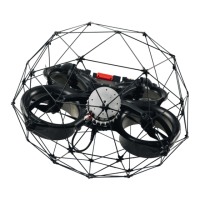
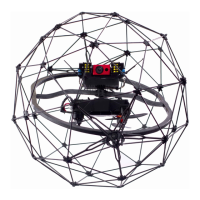
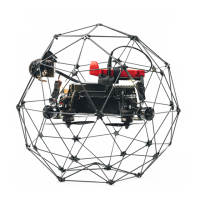
ELIOS 3
3 – ELIOS 3 System specifications
1.3 Environmental Awareness
Flight in unsafe environmental conditions might lead to accidents or damage to the
equipment
1. Do not fly close to people.
2. ELIOS 3 is not waterproof. Do not fly under heavy rain/snow or in very humid
environments. Moisture can cause damage to the drone’s electronics.
3. Store the ELIOS 3 system in a dry environment that is protected from sunlight and kept
between 0°C and 30°C.
4. Mechanical parts may deteriorate more rapidly in dusty, sandy, or corrosive environments.
Clean all mechanical parts thoroughly to remove dust after each flight.
5. The propellers may blow harmful dust, vapor, or gasses towards you. Cover this topic in
your risk assessment, and if necessary, have yourself and surrounding personnel wear eye
protection and respiratory protection.
6. The cage protects the drone from impacts, but small objects can penetrate the cage and
cause damage to the drone and its propellers or create high velocity projectiles. In flight,
avoid protruding objects and/or any falling objects. In case of doubt about whether such
precautions are needed, performing a risk assessment is recommended and eye
protection MUST be worn.
7. Flying in low air density environments such as in a combination of high altitude, high
temperature, and high humidity, will reduce flight time, control authority and collision
resilience. Do not fly at density altitudes over 5000m.
8. The wind may have severe effects on ELIOS 3. With the wind higher than 5m/s when flying
in ASSIST mode, Flyability cannot guarantee ELIOS 3’s ability to hold its position without
pilot input on the sticks . With the wind above 7m/s, Flyability cannot guarantee the
stability or flying capability of ELIOS 3.
9. Very cold temperatures lead to reduced flight times. Do not fly in temperatures below 0°C.
If you need to fly in an environment below 10°C, heat the batteries to 25°C prior to the flight
and observe the safety practices while flying that are described in the Battery Safety
Guidelines.
10. Hot temperatures—above 40°C—will interfere with battery performance. The pilot should
observe the safe practices regarding the battery described in the Battery Safety Guidelines.
11. Motor performance is automatically reduced to avoid overheating. For this reason, the
collision tolerance of the drone cannot be guaranteed above 50°C. Flyability cannot
guarantee the drones flight capability and stability if not used in temperatures between
0°C to 50°C.
12. The output power of the lighting system will automatically be reduced in high
temperature environments.
13. The electronics and battery are cooled down by the airflow generated by the propellers.
Leaving the drone on without flying will eventually make the electronics and sensors
overheat and shutdown.
14. After a flight in an environment above 40°C, use gloves for changing the battery or wait for
at least 10 minutes for the drone to cool down in a zone where the temperature is below
30°C.
15. It is not recommended to operate the aircraft close to power lines, power transformers, or
other areas with high electromagnetic disturbances since these may cause severe effects
on the sensors and transmission system, impacting the aircraft’s stability and flying
capability.
ORIGINAL INSTRUCTIONS
Page 11 of 24


 To Next Page
 Loading...