This document is the user manual for the FLYSURFER PEAK5 kite, a single-skin kite designed for kiteboarding. It provides comprehensive information on safety, setup, handling, launching, landing, safety systems, emergencies, packing, kite care, assembly of the B-Safe system, maintenance, trimming, and repair.
Function Description
The FLYSURFER PEAK5 is a single-skin kite designed for kiteboarding, offering a unique combination of stability, drift, and light wind handling. Its single-skin concept, coupled with hybrid wingtip technology, aims to provide high buoyancy, reduced weight, and efficient depower. The kite is intended for riders weighing between 40-120kg. It features a B-Safe System for enhanced safety and a Camber Trim System for adjusting the angle of attack and profile camber, allowing riders to fine-tune the kite's flying characteristics.
Important Technical Specifications
- Kite Type: Single-Skin Kite
- Weight Range: Designed for riders weighing 40-120kg.
- Material: Utilizes TX-Light fabric for the main body and 44g/m² DLX+ cloth for the leading edge, offering a balance of durability, light weight, and UV-resistant properties.
- Safety Systems:
- Frontline Safety (FLS): Standard setting for all PEAK5 kites. When triggered, the control bar moves up to a stopper knot, flagging out the kite along the FLS-Line.
- B-Safe System (5th line): An optional safety system that can be converted from the standard FLS. It involves a 5th line that, when triggered, allows the control bar to move along the B-Safe line towards the kite, causing it to fall powerless. The necessary lines for this conversion are included.
- Control Bar Compatibility: Recommended for use with FLYSURFER Control Bars (e.g., CONNECT2 Control Bar) to ensure proper functionality of the safety systems.
- Mixer System: Features a two-ring camber trim system for precise control over the kite's bridle levels, angle of attack, and profile camber.
- Little Connection Lines (LCL): Predetermined overload weak points that prevent canopy damage and allow for quick replacement of bridle lines.
Usage Features
- Setup:
- Securing the Kite: Involves folding the kite in the middle, letting tips flow downwind, and weighing down the front third of the top sail to prevent flapping. Opening deflate valves can also help.
- Sorting the Bridle: Instructions are provided for untangling bridle lines, including rolling lines onto the bar and undoing knots or loops.
- Launching:
- Self-launching: Involves positioning the kite 15-30 degrees downwind, with an assistant holding the leading edge. The kite is then released and steered into the wind window.
- Edge of the Wind Window Launch: Requires an assistant to position the kite at the edge of the wind window, ensuring lines are clear and the kite is stable before launching.
- Landing:
- With an Assistant: The safest method, where an assistant holds the leading edge while the kite is lowered to the edge of the wind window.
- Without an Assistant (Self-landing): Can be done by flying the kite down to the edge of the wind window and steering it down hard to collapse it. The B-Safe system can also be used for self-landing by activating the quick release, causing the kite to fall powerless.
- Relaunch:
- Reverse Launch: Involves pulling on leader lines to flip the kite over and relaunch it from the leading edge.
- One Line Relaunch: Pulling a steering line to make the kite peel to the side of the wind window and then fly up.
- Emergencies:
- Overflying: Corrected by powering up the kite or pulling leader lines.
- Frontstall (Center Collapse): Activate quick release before the kite reopens to prevent excessive power.
- Backstall (Backwards Flying): Recovered by depowering (pushing the bar away) or short, effective pulls on the adjuster in light winds.
- Drifting Away: Abandon kite and swim to shore if possible; otherwise, stay with the kite for visibility.
- Bridle Line Entanglement: Avoid unnecessary swimming; a line knife is recommended.
- Reactivating the Kite: After a quick release, the kite can be reassembled by working up the safety endline, securing it to the harness hook, resetting the quick release, and then re-hooking the chickenloop.
Maintenance Features
- Kite Care:
- Drying: Always dry the kite away from direct sunlight and in a well-ventilated area to prevent mildew and preserve material integrity.
- Rinsing: Rinse the kite with fresh water after use in saltwater and dry in the shade.
- Check: Regularly inspect all parts for wear, especially wearing parts, and replace damaged components.
- Packing Up:
- Wind lines around the bar, secure them, and lay bridle lines between the folded kite.
- Fold the kite in half (tip on tip), ensuring the bridle is inside.
- Lay the bar on top of the kite, away from the tips.
- Roll up the kite around the bar, avoiding sharp objects.
- Repairing the Cloth:
- Small tears can be temporarily repaired with spinnaker repair tape from the inside of the kite.
- A special binding agent for X-Light Cloth is available from Flysurfer.
- Professional repair services are offered for larger damages, including canopy part replacement.
- For tears close to a seam (less than 5cm), sewing is recommended.
- Replacing Sparepart Lines and Pulleys:
- Sparepart lines (yellow lines through the mixer pulley system) should be replaced after approximately 100 hours of use to prevent fraying.
- Pulleys should be changed after about 250 hours of use.
- Before replacement, perform a mixertest to note current trim settings.
- Instructions include making a larks head knot, putting the pulley through the loop, and tightening the knot.
- It's recommended to exchange only one side at a time, using the other side as a template.
- Trimming:
- Mixer: Bridle levels are controlled by the mixer, which modulates the angle of attack and profile camber.
- Camber Trim System: Allows adjustment of the C-Level and Z-Level lines to correct line length changes over time and maintain performance.
- Optimizing Trim: Steering (back) lines shorten over time. Floaters on the back line can be shortened or extended to adjust trim.

 Need help?
 General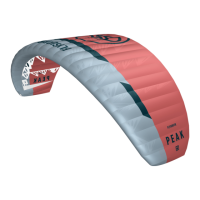

 To Next Page