For additional important safety
information on the proper use of
seat belts, child seats and infant
seats, please read the entire
Seating and safety restraints
chapter in this owner’s guide.
How does the air bag
supplemental restraint system
work?
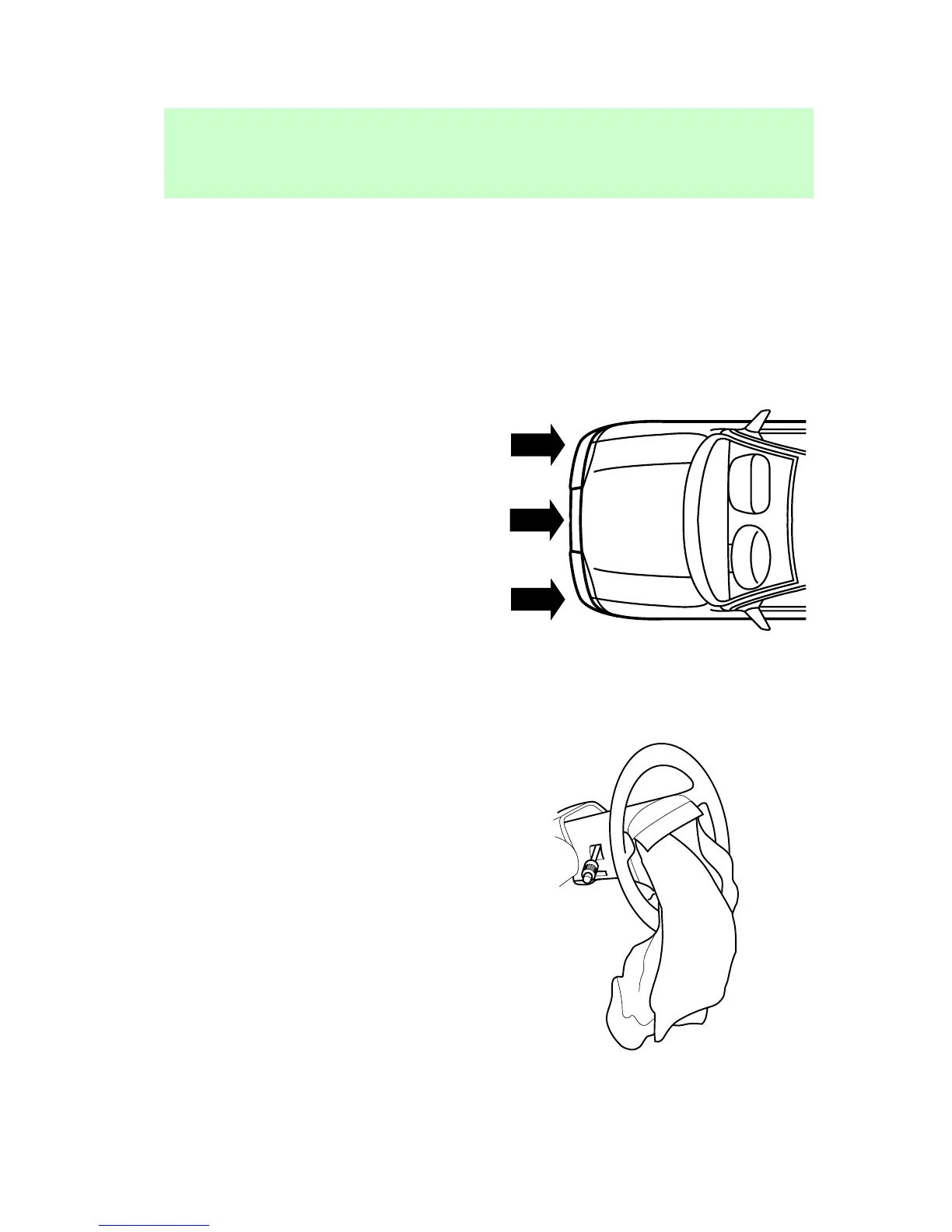
The Air Bag Supplemental
Restraint System is designed to
activate when the vehicle sustains
sufficient longitudinal (lengthwise)
deceleration that is equal to or
greater than hitting an immovable
barrier head on at a range of about
12–24 km/h (8–14 mph).
The fact that the air bags did not
inflate in a collision does not mean
that something is wrong with the
system. Rather, it means the forces
were not of the type sufficient to
cause activation.
If the vehicle experiences
sufficient longitudal deceleration,
the system is activated and the air
bags inflate rapidly. After the air
bag inflates, it will quickly deflate.
This occurs so quickly that some
people may not even realize that
the air bag inflated.
After the air bag deployment, you
may notice a smoke-like, powdery
residue or smell the burnt
propellant (which is used to
lubricate the air bag) or sodium
compounds, such as sodium
carbonates (e.g., baking soda) that
result from the combustion process
eco_how_work
Seating and safety restraints
55



 To Next Page