Maintenance procedures 1•17
1
OHV engines
1 This operation should be carried out with
the engine cold and the air cleaner and rocker
cover removed.
2 Using a ring spanner or socket on the
crankshaft pulley bolt, turn the crankshaft in a
clockwise direction until No 1 piston is at TDC
on its compression stroke. This can be
verified by checking that the pulley and timing
cover marks are in alignment and that the
valves of No 4 cylinder are rocking. When the
valves are rocking, this means that the
slightest rotation of the crankshaft pulley in
either direction will cause one rocker arm to
move up and the other to move down.
3 Numbering from the thermostat housing
end of the cylinder head, the valves are
identified as follows.
Valve No Cylinder No
1 Exhaust 1
2 Inlet 1
3 Exhaust 2
4 Inlet 2
5 Exhaust 3
6 Inlet 3
7 Exhaust 4
8 Inlet 4
4 Adjust the valve clearances by following the
sequence given in the following table. Turn
the crankshaft pulley 180º (half a turn) after
adjusting each pair:
Valves rocking Valves to adjust
7 and 8 1 (Exhaust), 2 (Inlet)
5 and 6 3 (Exhaust), 4 (Inlet)
1 and 2 7 (Exhaust), 8 (Inlet)
3 and 4 5 (Exhaust), 6 (Inlet)
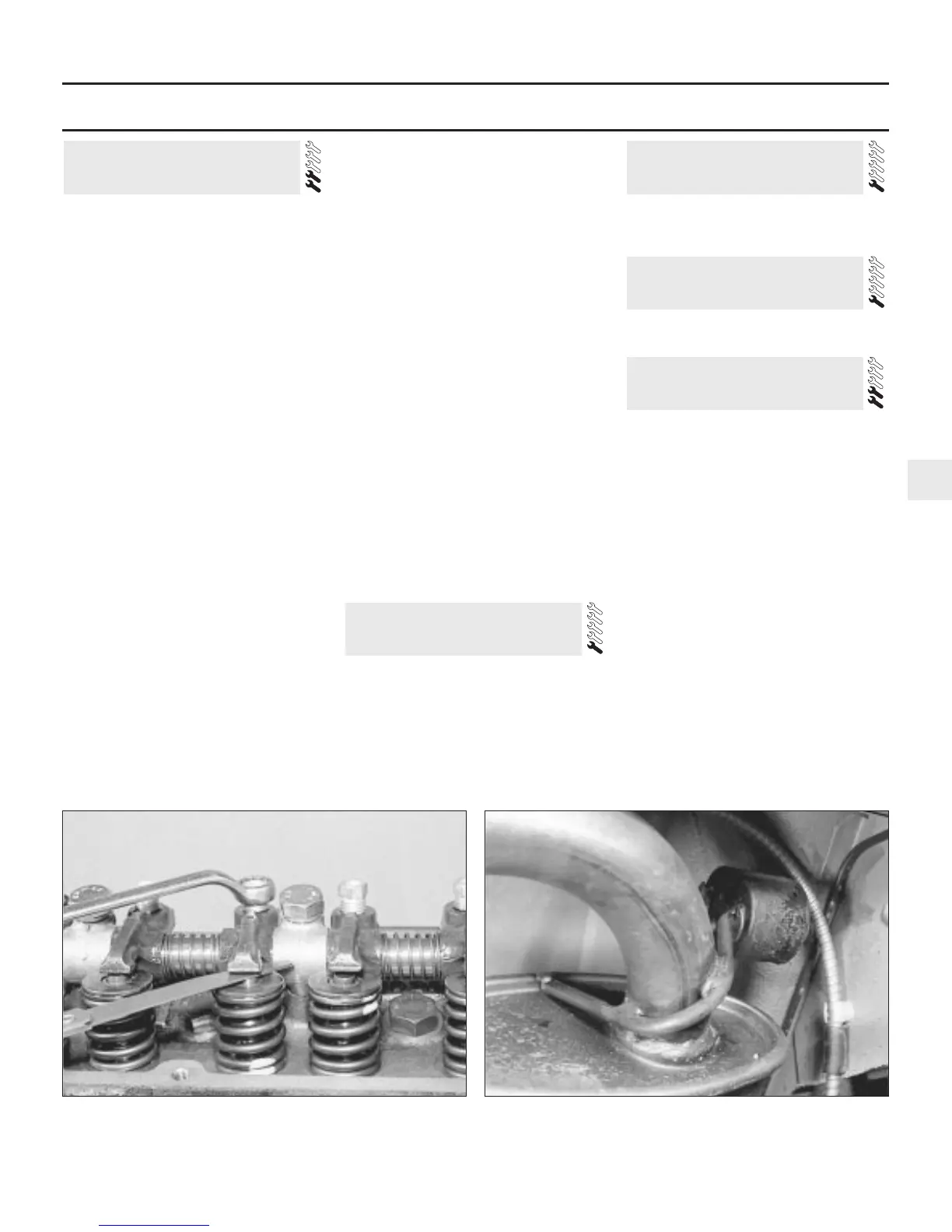
5 The clearances for the inlet and exhaust
valves are different (see Specifications). Use a
feeler blade of the appropriate thickness to
check each clearance between the end of the
valve stem and the rocker arm. The gauge
should be a stiff sliding fit. If it is not, turn the
adjuster bolt with a ring spanner. These bolts
are of stiff thread type and require no locking
nut. Turn the bolt clockwise to reduce the
clearance and anti-clockwise to increase it
(see illustration).
6 Refit the air cleaner and rocker cover on
completion of adjustment.
HCS engines
7 The procedure is as described previously
for OHV engines, but note that the valve
arrangement has been altered and is now as
shown below. Take care not to overtighten the
rocker cover bolts on refitting, as this can
result in leaks.
Valve No Cylinder No
1 Exhaust 1
2 Inlet 1
3 Exhaust 2
4 Inlet 2
5 Inlet 3
6 Exhaust 3
7 Inlet 4
8 Exhaust 4
With the vehicle raised on a hoist or
supported on axle stands (see “Jacking and
Vehicle Support”), check the exhaust system
for signs of leaks, corrosion or damage and
check the rubber mountings for condition and
security (see illustration). Where damage or
corrosion are evident, renew the system
complete or in sections, as applicable, using
the information given in Chapter 4, Part E.
Check the tightness of the turbocharger-to-
exhaust manifold securing nuts using a torque
wrench.
The procedure is as described for RS Turbo
models in Section 15.
1 Spring back the retaining clips or undo the
screws as appropriate and lift off the
distributor cap.
2 Withdraw the rotor arm from the distributor
shaft.
3 On the Bosch distributor disconnect the
contact breaker points LT lead at the spade
connector. On the Lucas distributor ease the
contact breaker spring arm out of the plastic
insulator and slide the combined LT and
condenser lead out of the hooked end of the
spring arm.
4 Undo the retaining screw and withdraw the
contact breaker points from the distributor
baseplate. Take care not to drop the screw
and washer inside the distributor during
removal and refitting. If possible use a
magnetic screwdriver, or alternatively, retain
the screw on the end of the screwdriver using
a dab of grease.
5 Wipe clean the distributor cam, then apply
a trace of high-melting-point grease to the
four cam lobes. Also, on OHV engines apply
two drops of light oil to the felt pad at the top
of the distributor shaft.
25 Contact breaker points
renewal
24 Spark plug renewal
23 Turbocharger-to-manifold
nut check - RS Turbo models
22 Exhaust system check
21 Valve clearance adjustment -
OHV and HCS engines
21.5 Valve clearance adjustment 22.1 Exhaust silencer mounting
Every 12 000 miles or 12 months


 To Next Page
 Loading...