1 A conventional vee drivebelt is used to
drive both the alternators and water pump
pulleys on OHV and HCS engines, and the
alternator pulley only on CVH engines, power
being transmitted via a pulley on the engine
crankshaft.
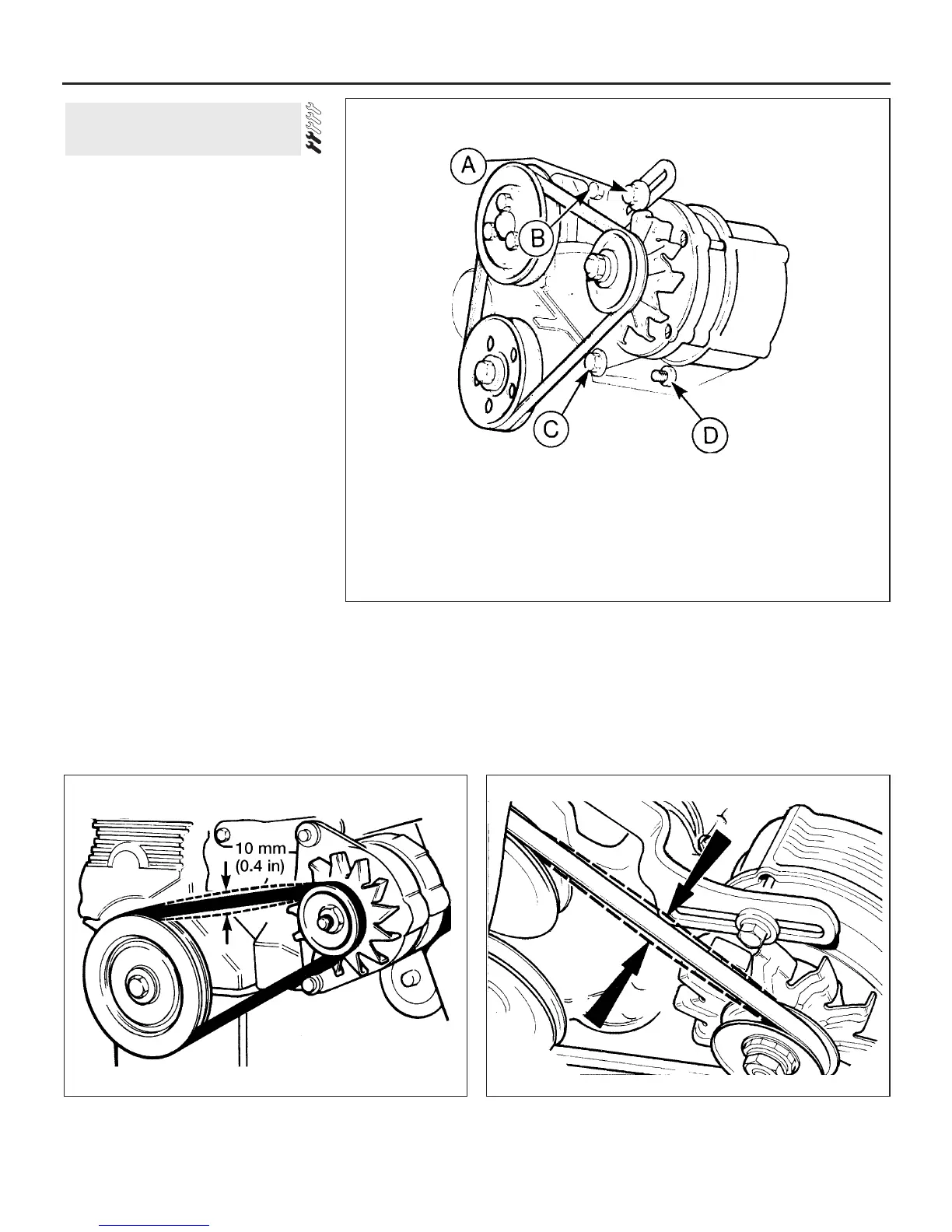
2 To remove the drivebelt, slacken the
alternator mounting bolts and the bolts on the
adjuster link and push the alternator in
towards the engine as far as possible (see
illustration).
3 Withdraw the belt from the pulleys. In some
instances it may also be necessary to remove
the adjuster link-to-alternator bolt to avoid
straining the drivebelt.
4 Fit the belt by slipping it over the pulley
rims. If necessary remove the adjuster link-to-
alternator bolt, if not already done, to avoid
straining the belt. Never be tempted to
remove or refit the drivebelt by prising it over
a pulley rim otherwise the pulley or the
drivebelt internal webbing will be damaged.
5 To tension the belt pull the alternator away
from the engine until the belt is fairly taut, and
tighten the adjuster link-to-alternator bolt.
Check that the total deflection of the belt,
using finger pressure at a point midway
between the alternator and crankshaft or
water pump pulleys, is 10 mm (0.4 in) (see
illustrations). A little trial and error may be
necessary to obtain the correct tension. If the
belt is too slack, it will slip in the pulleys and
soon become glazed or burnt. This is often
indicated by a screeching noise as the engine
is accelerated, particularly when the
headlights or other electrical accessories are
switched on. If the belt is too tight the
bearings in the water pump and/or alternator
will soon be damaged.
6 Once the tension is correct, tighten the
remaining adjuster link bolt, front mounting
bolt and rear mounting bolt in that order.
7 If a new belt has been fitted the tension
should be rechecked and adjusted again if
necessary after the engine has run for
approximately ten minutes.
20 Alternator drivebelt check
1•16 Every 6000 miles or 6 Months
20.5a Drivebelt tension checking point - CVH engines 20.5b Drivebelt tension checking point - OHV engines
20.2 Alternator mounting and adjuster link bolts
A Adjuster link-to-alternator bolt
B Adjuster link-to-engine bolt
C and D Alternator mounting bolts


 To Next Page
 Loading...