1•20 Every 12 000 miles or 12 Months
Carry out this check in both directions. If a
clicking noise is heard, this indicates wear in a
driveshaft joint, in which case, the complete
driveshaft must be renewed (see Chapter 8).
Check the operation and
performance of the braking
system
12 Make sure that the vehicle does not pull to
one side when braking, and that the wheels
do not lock prematurely when braking hard.
13 Check that there is no vibration through
the steering when braking.
14 Check that the handbrake operates
correctly, without excessive movement of the
lever, and that it holds the vehicle stationary
on a slope.
15 Test the operation of the brake servo unit
as follows. With the engine off, depress the
footbrake four or five times to exhaust the
vacuum. Start the engine, holding the brake
pedal depressed. As the engine starts, there
should be a noticeable “give” in the brake
pedal as vacuum builds up. Allow the engine
to run for at least two minutes, and then
switch it off. If the brake pedal is depressed
now, it should be possible to detect a hiss
from the servo as the pedal is depressed.
After about four or five applications, no further
hissing should be heard, and the pedal should
feel considerably firmer.
Cooling system draining
1 It is preferable to drain the system when the
coolant is cold. If it must be drained when hot,
release the pressure cap on the thermostat
housing (or expansion tank on later models)
very slowly, having first covered it with a cloth
to avoid any possibility of scalding. Having
relieved the pressure, remove the cap.
2 Set the heater control to the maximum heat
position.
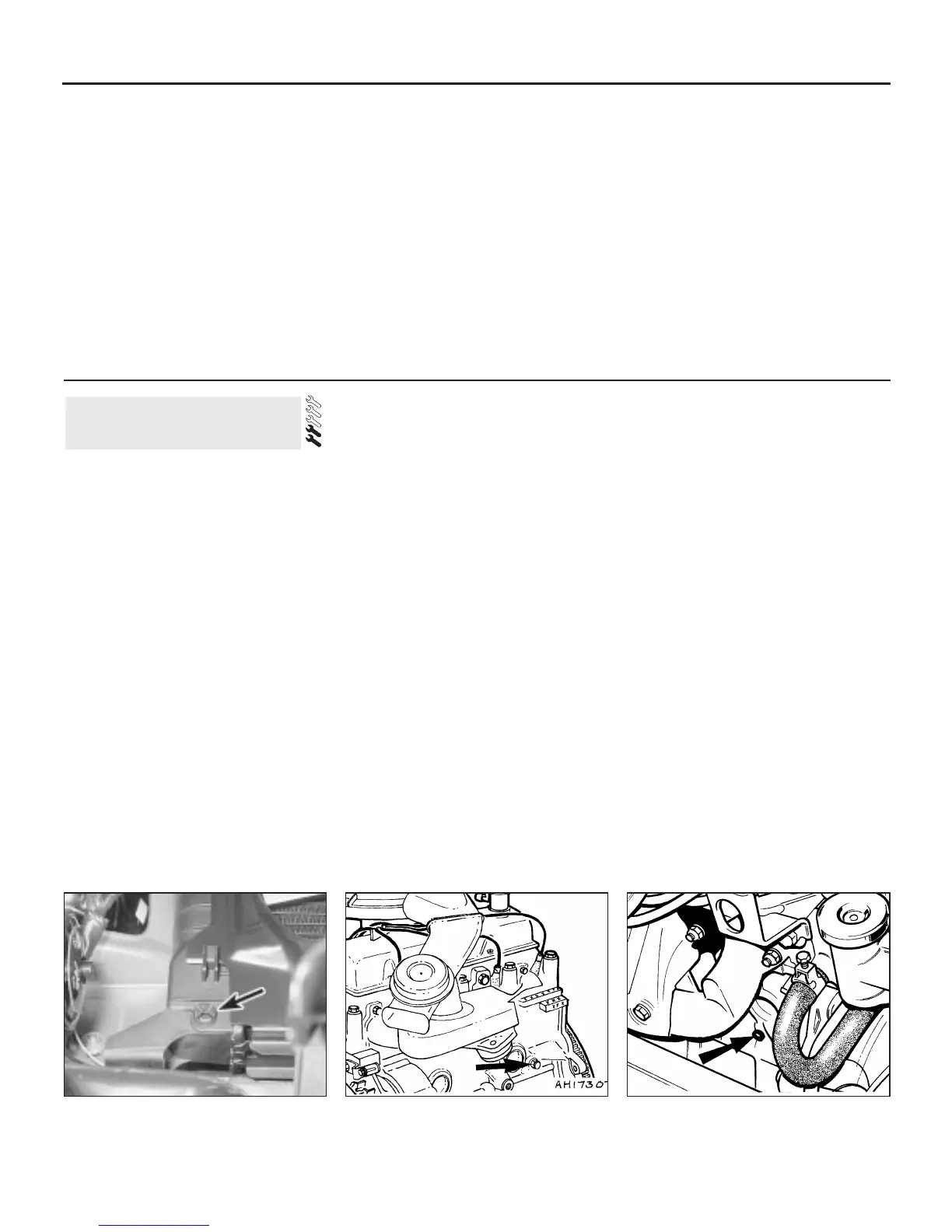
3 Check to see if a drain plug is fitted to the
lower left-hand side of the radiator. If so,
place a suitable container beneath the
radiator, unscrew the plug and allow the
coolant to drain (see illustration).
4 If a drain plug is not fitted, place the
container beneath the radiator bottom hose.
Slacken the clip, release the hose and allow
the coolant to drain.
5 A cylinder block drain plug is also fitted to
certain models on the forward facing side of
the cylinder block, towards the flywheel end.
Where this is the case, unscrew the plug and
allow the cylinder block to drain into the
container (see illustrations).
Cooling system flushing
6 Providing that the correct mixture of
antifreeze and water has previously been
maintained in the system, then no flushing
should be necessary and the system can be
refilled immediately as described in the
following paragraphs.
7 Where the system has been neglected
however, and rust or sludge is evident at
draining, then the system should be flushed
through using a cold water hose inserted into
the thermostat housing (thermostat removed -
see Chapter 3). Continue flushing until the
water flows clean from the disconnected
bottom hose, radiator drain plug and cylinder
block drain plug, as applicable. If, after a
reasonable period the water still does not run
clear, the radiator can be flushed with a good
proprietary cleaning system.
8 If the radiator is suspected of being
clogged, remove and reverse flush it as
described in Chapter 3.
9 When the coolant is being changed, it is
recommended that the overflow pipe is
disconnected from the expansion tank and
the coolant drained from the tank. If the
interior of the tank is dirty, remove it and
thoroughly clean it out.
10 After draining or flushing, reconnect all
disconnected hoses and refit the drain plugs
where applicable.
Cooling system filling
11 Using the correct antifreeze mixture (See
following sub-Section) fill the system through
the thermostat housing filler neck slowly until
the coolant is nearly overflowing. Wait a few
moments for trapped air to escape and add
more coolant. Repeat until the level does not
drop and refit the cap. Pour similar strength
coolant into the expansion tank up to the
“MAX” mark and fit the cap.
12 On later models with a screw type pressure
cap on the expansion tank, fill the system in the
same way, but through the expansion tank
rather than the thermostat housing.
13 On all models start the engine and run it to
normal operating temperature then switch off.
Once it has cooled, check and carry out any
final topping-up to the expansion tank only.
Antifreeze mixture
14 Never operate the vehicle with plain water
in the cooling system. Apart from the danger
of freezing during winter conditions, an
important secondary purpose of antifreeze is
to inhibit the formation of rust and to reduce
corrosion.
15 The coolant must be renewed at the
intervals specified. Although the antifreeze
properties of the coolant will remain
indefinitely, the effectiveness of the rust and
corrosion inhibitors will gradually weaken.
33 Coolant renewal
33.3 Radiator drain plug location
(arrowed)
33.5a Cylinder block drain plug location
(arrowed) - OHV engines
33.5b Cylinder block drain plug location
(arrowed) - CVH engines
Every 24 000 miles or 2 years


 To Next Page
 Loading...