The provided document is a "Posture Guide" for F-FORM Seating, detailing the features and adjustments of their office chairs. It serves as a user manual to help individuals properly set up their chairs for optimal ergonomic support and posture.
Function Description
The F-FORM chairs are designed to provide ergonomic support, promoting good posture and preventing discomfort or repetitive strain injuries during prolonged sitting. The various adjustable components allow users to customize the chair to their individual body dimensions and preferences, ensuring a comfortable and supportive seating experience. The guide emphasizes dynamic movement and proper alignment of the body, particularly the spine, hips, knees, shoulders, and forearms.
Usage Features
The F-FORM chairs offer a comprehensive range of adjustments, primarily controlled by "Under Seat Buttons," a "Backrest Ratchet System," a "Tension Lever," and "Armrest Buttons." Two types of headrests, "Exec headrest" and "Ergo headrest," are also mentioned with their respective adjustments.
These buttons control three primary adjustments:
-
Seat Height:
- Function: Adjusts the vertical position of the seat.
- Usage: To raise the seat, the user lifts their weight off the chair and pulls up the front button located under the right-hand side of the chair. To lower the seat, the user sits on the chair and the chair will descend.
- Ergonomic Aim: The guide recommends positioning the seat so that the knees are slightly lower than the hips and the feet are flat on the floor.
- Locking: The seat height is locked by lowering the button back to its neutral position.
-
Seat Slide (Seat Depth):
- Function: Adjusts the horizontal depth of the seat.
- Usage: The user lifts the seat slide button to adjust the depth. The seat can be moved backward or forward.
- Ergonomic Aim: The guide suggests leaving approximately 2cm between the seat and the back of the knees to ensure proper circulation and comfort.
- Locking: The button is pushed back down to lock the seat's position.
-
Backrest Tilt:
- Function: Controls the angle of the backrest and its movement.
- Usage: The guide recommends using the backrest in "free-float mode" with tension control for dynamic movement. However, the backrest angle can be locked by lifting the rear button under the left side of the seat, leaning back to the desired position, and then lowering the button to lock it.
- Dynamic Movement: The free-float mode encourages movement, which is beneficial for spinal health.
Backrest Ratchet System
- Backrest and Lumbar Height:
- Function: Adjusts the vertical height of the backrest and the integrated lumbar panel.
- Usage: The F-Form's back height adjustment operates on a ratchet system. The backrest is raised or lowered by lifting or lowering it. Each "click" signifies a lockable setting. To drop the backrest to its lowest height, the user lifts it to the top and then lowers it. The lumbar panel can also be adjusted independently by sliding it up or down.
- Ergonomic Aim: Proper backrest height ensures support for the entire back, particularly the lumbar region.
Tension Lever
- Tension Control:
- Function: Adjusts the resistance of the backrest tilt when in free-float mode.
- Usage: The tension lever, located at the front right of the chair, is pulled out and turned. Turning it forwards increases tension (more resistance), while turning it backwards reduces tension (less resistance).
- Ergonomic Aim: The goal is to achieve a "gentle resistance" that supports the user's body weight without requiring excessive effort to maintain posture or allowing the user to "fly backwards." This promotes dynamic sitting while providing adequate support.
The armrests offer multiple adjustment points to prevent repetitive strain injuries and ensure proper arm and shoulder alignment.
Headrests
Two types of headrests are mentioned, each with specific adjustments:
-
Exec Headrest:
- Function: Provides head and neck support.
- Usage: Lift or lower to position.
-
Ergo Headrest:
- Function: Provides head and neck support with additional tilt functionality.
- Usage: Lift or lower and tilt to position.
Important Technical Specifications (Implied)
While specific numerical technical specifications (e.g., weight capacity, dimensions) are not provided in the document, the detailed adjustment mechanisms imply certain design considerations:
- Ratchet System: Used for backrest height, indicating a robust and secure locking mechanism for vertical adjustments.
- Gas Lift Mechanism: Implied for seat height adjustment, allowing smooth vertical movement.
- Multi-functional Controls: The presence of multiple buttons and levers suggests a sophisticated control system for precise adjustments.
- Durable Construction: The focus on ergonomic support and dynamic movement implies the use of durable materials and construction to withstand regular use.
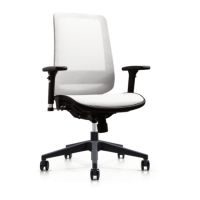
- Mesh Backrest: The images clearly show a mesh backrest, which typically offers breathability and conforms to the user's back.
Maintenance Features
The document does not explicitly detail maintenance features. However, the nature of office chairs generally implies:
- Regular Cleaning: Wiping down surfaces and vacuuming fabric/mesh components.
- Inspection of Moving Parts: Periodically checking the functionality of levers, buttons, and the gas lift.
- Lubrication (if applicable): Some moving parts might benefit from occasional lubrication, though this is not specified.
The F-FORM Posture Guide is a user-centric manual designed to empower users to achieve optimal ergonomic settings for their office chairs, thereby promoting comfort, health, and productivity.

 Need help?
 General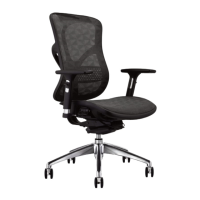

 To Next Page