EasyManua.ls Logo

FormFactor ACP40-GSG Series - User Manual

FormFactor ACP40-GSG Series
4 pages
Print Icon
To Next Page IconTo Next Page
Loading...
PN 153-231-B www.formfactor.com ACP40-GSG-xxx Probes • 1
Quick Reference Guide
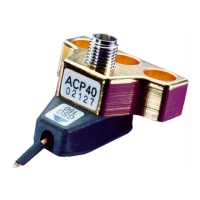
ACP40-GSG-xxx Probes
The ACP40-GSG-xxx probe features include:
Standard Pitch: 100, 125, 150, 200 and 250μm
40 GHz Ground-Signal-Ground footprint microwave probe with Air Coplanar tip and 2.92mm
(K™ compatible) precision coaxial connector
XXX defines the pitch (center-to-center spacing between adjacent probe fingers).
Your calibration kit coefficient definitions are found on the inside of the probe box lid.
Probe Handling/Installation
Before mounting, inspect the probe for signs of dirt or visible wear. Use a
positioner with a standard 3-pin microwave mount. Use the middle (guide)
pin to align the probe and two mounting screws to snug-tighten the probe
(use 9/64 Contact Substrate (PN 005-018) to planarize the probe using the
positioner planarization adjustment.
Use high-performance microwave cable with 2.92mm (K™ compatible)
connectors.
When connecting RF connectors, carefully mate the connectors and tighten them by rotating only the male connector nut.
Use an 8 in-lb calibrated torque wrench to tighten the connectors.
Use the positioner cable clamp to relieve cable strain on the probe. Do not overtighten the clamp.
When unused, always cover the probe precision connector with the plastic cap supplied with the probe.
Probe Viewing
Always observe the probe tips when making the contact with the DUT. With the microscope focused
on the DUT and the probe tips safely raised, the probe tips appear out of focus.
Use the x- and y-axis knobs to position the probe tip above the DUT contacts. Use the z-axis knob to
bring the probe tips down to the device.
Before making contact, make sure that the probe station chuck is in the contact position and that the
platen arm is fully down.
When contacting a device, watch the probe tips through the microscope. Do not use electrical
readout as a substitute for microscope viewing. Observe contact and skating, then look for electrical readout.
Positioner Arm Planarization
The probe tip itself is planarized with high precision. However, it may still be
necessary to planarize the positioner arm to conform the probe tip plane to the
plane of the device being probed.
CAUTION
Use care when installing or handling the probe. Do not touch, bump or snag the probe tip.
Do not bend or flex the microwave absorber.
!
Cable clamp
Positioner arm planarization
adjustment knob

Question and Answer IconNeed help?

Do you have a question about the FormFactor ACP40-GSG Series and is the answer not in the manual?

Overview

The ACP40-GSG-xxx probe is a high-performance microwave probe designed for on-wafer measurements, particularly above 10-15 GHz. It features a Ground-Signal-Ground (GSG) footprint and an Air Coplanar tip, making it suitable for precise electrical characterization of devices. The "xxx" in the model name denotes the pitch, which is the center-to-center spacing between adjacent probe fingers. Available standard pitches include 100, 125, 150, 200, and 250 μm, offering flexibility for various device layouts.

Technical Specifications:

  • Frequency Range: The probe is rated for up to 40 GHz, enabling high-frequency measurements.
  • Connector Type: It utilizes a 2.92mm (K™ compatible) precision coaxial connector for reliable signal integrity.
  • Pitch Options: Standard pitches are 100, 125, 150, 200, and 250 μm.
  • Overtravel: Designed for a nominal overtravel (downward movement after initial touchdown) of 50-75 μm, resulting in a skate (forward movement) of about 20-30 μm. It can tolerate up to 250 μm of overtravel for contact on extremely non-planar surfaces, though this may reduce probe life.

Usage Features:

  • Installation: The probe requires a positioner with a standard 3-pin microwave mount. The middle (guide) pin aids in alignment, and two mounting screws secure the probe. Planarization is achieved using a 9/64 Contact Substrate (PN 005-018) and the positioner's planarization adjustment.
  • Cable Connection: High-performance microwave cables with 2.92mm (K™ compatible) connectors are recommended. When connecting RF connectors, users should carefully mate them and tighten only the male connector nut using an 8 in-lb calibrated torque wrench to prevent damage. A positioner cable clamp should be used to relieve cable strain on the probe, ensuring it is not overtightened.
  • Probe Viewing and Contact: Always observe the probe tips through a microscope when making contact with the Device Under Test (DUT). With the microscope focused on the DUT and the probe tips raised, the tips will appear out of focus. The x- and y-axis knobs are used to position the probe tip, and the z-axis knob brings them down to the device. Before contact, ensure the probe station chuck is in the contact position and the platen arm is fully down. Electrical readout should not substitute microscope viewing for observing contact and skating.
  • Planarization: The probe tip is precisely planarized. However, it may be necessary to planarize the positioner arm to align the probe tip plane with the device plane. This is achieved by adjusting the positioner arm planarization knob. Proper planarization ensures that each probe finger leaves marks of the same size and depth on the contact substrate.
  • Making Contact: The proper amount of overtravel for calibration on Impedance Standard Substrates (ISS) can be set using alignment marks on the ISS. Initial contact with the edge of the probe tips should occur at the midpoint between the outer flat edge and the internal apex. With proper skate, the probes will end up at the midpoint between the internal apex and the flag points.
  • Calibration: For best measurement accuracy above 10-15 GHz, the LRRM (Line-Reflect-Reflect-Match) calibration routine with automatic load inductance determination, as implemented in FormFactor WinCal software, is recommended. If SOLT (Short-Open-Load-Thru) calibration is chosen, calibration kit definitions are found inside the probe box lid. A 1ps delay for the Thru standard on the ISS 101-190 should be used. For network analyzers that do not support lumped inductance models, parasitic inductors for Short and Load standards should be modeled as short pieces of transmission line, assuming a maximum impedance of 500 ohms and calculating Td (delay) using the formula Td = L/Zo.
  • Verification: Probe performance can be verified using the Probe Test feature of FormFactor's WinCal™ software. This involves an active cable calibration in the VNA and measurements of ISS Short, Open, and Load standards to provide insertion and return loss for the probe. For calibration verification, S11 of an open standard and an open-ended transmission line on the ISS (PN 101-190) can be measured.

Maintenance Features:

  • Cleaning: Probe tips and connectors should be cleaned occasionally or when contact problems are suspected. Users should follow microwave cable and network analyzer manufacturer instructions for cleaning precision microwave connectors. Additional information is available on www.formfactor.com.
  • Storage: When not in use, the probe's precision connector should always be covered with the supplied plastic cap to protect it.
  • Troubleshooting:
    • Probe pulled to the side: This can be caused by cable strain. The solution is to use the positioner cable clamp to strain-relieve the probe.
    • Intermittent electrical contact: Possible causes include a dirty/contaminated probe tip, dirty RF connectors, insufficient probe overtravel, or a non-planarized positioner arm. Solutions involve cleaning the probe tip and RF connectors, adjusting overtravel, and planarizing the positioner arm.
    • Poor calibration accuracy: If SOLT calibration is used above 10GHz, the cal kit is not defined correctly, or there's a poor connection in the system. The solutions are to use LR(R)M calibration, verify cal kit definitions, and check/retighten RF connections.
    • Poor calibration repeatability: This can be due to a defective cable or large temperature variations in the lab. Solutions include checking the cable using VNA transmission calibration and switching to a controlled temperature lab.

Accessories:

  • PN 101-190: Calibration ISS
  • PN 101-162: Precision microwave cable with 2.92mm (K™ compatible) coaxial connectors
  • PN 005-016: Verification ISS
  • PN 005-018: Contact substrate

FormFactor ACP40-GSG Series Specifications

General IconGeneral
BrandFormFactor
ModelACP40-GSG Series
CategoryMeasuring Instruments
LanguageEnglish