
 Need help?
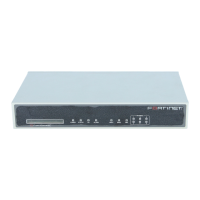
Do you have a question about the Fortinet FortiGate FG-80C and is the answer not in the manual?
Obtain the correct format images for FG80C, FG80CM, or FW80CM models from provided FTP links.
Set up a TFTP server and place the downloaded firmware and format images in the root directory.
Load the pre-format image via console and select the pre-format option in the Opencard Mode Selection Menu.
After pre-formatting, load and run the F1-format image to complete the partition re-formatting process.
Load the desired FortiOS image (e.g., 4.0MR3 patch 12) onto the formatted FortiGate device.
This document outlines a critical issue affecting certain FortiGate 80C series devices and provides a comprehensive resolution involving re-formatting the flash storage. The core problem stems from an incorrect partition of the flash storage device, leading to potential boot-up failures. Specifically, devices reporting a flash disk capacity of 7636MB instead of the expected 7640MB possess a hidden 4MB partition. This hidden partition can interfere with the FortiGate's ability to locate and load the operating system image, thus preventing successful boot-up.
The affected FortiGate models include the FG-80C (with part numbers P05403-05-xx or higher), FG-80CM (P05446-05-xx or higher), and FW-80CM (P05405-06-xx or higher). Users can identify their device's part number either by checking the physical label on the bottom of the unit or by using the "get system status" command via the command-line interface (CLI). The CLI output will display the "System Part-Number," which can then be cross-referenced with the affected range.
To diagnose the issue, users can observe the boot-up sequence. If the device reports a boot device capacity of 4MB or 7636MB, it indicates an incorrect partition or the presence of the problematic hidden partition, respectively, suggesting a potential boot failure. A correct boot-up should report a capacity of 7640MB.
The resolution involves a multi-step process designed to re-format the flash file system and eliminate the hidden partition. This procedure, which takes approximately 10 minutes, requires console access to the FortiGate and a local TFTP (Trivial File Transfer Protocol) server connected to the internal1 port of the FG80C. During this operation, the device will be out of service.
Before initiating any format procedures, it is crucial to ensure that configuration backups are taken to prevent data loss. The first step in the resolution is to download the appropriate format image specific to the hardware model. These images, such as FGT_80C-FORMAT.3.0.0.1001.out, FGT_80CM-FORMAT.3.0.0.1012.out, or FWF_80CM-FORMAT.3.0.0.1001.out, are available for download from a specified FTP server.
Next, a TFTP server needs to be set up for image upload. While various TFTP servers can be used, SolarWinds offers a suggested free tool. The downloaded format image and the desired FortiOS image (e.g., FortiOS 4.0MR3 patch 12) must be saved into the TFTP server's root folder. It is also important to ensure that any external USB drives are removed from the USB port, as their presence can interfere with the open-card program's functionality.
The re-formatting process begins by loading a "pre-format" image. After connecting the TFTP server to Ethernet port "1" of the FortiGate, users will access the device's console. During the boot-up sequence, they will be prompted to enter a selection from the "Opencard Mode Selection Menu." The user should choose option "1" for "Pre-Format." This involves entering the TFTP server's address, the local address, and the filename of the pre-format image. Once the image is downloaded and verified, the system will prompt to save the image. Selecting "R" to run the image without saving will initiate the pre-format process, which, upon successful completion, will display "Preformat succeeded."
Following the pre-format, the device needs to be powered OFF for five seconds and then powered ON again. This time, during the boot-up sequence, the user will again access the "Opencard Mode Selection Menu" and select option "2" for "F1-Format." Similar to the pre-format step, the TFTP server details and the format image filename will be entered. After the F1-format image is downloaded and verified, selecting "R" to run the image will initiate the F1-format process. A successful completion will be indicated by "F1 format succeeded" and a reported total capacity of 7000 MB, along with the message "Congratulations! Opencard process succeeded. The device is ready to use now."
Finally, after the F1 format completes, the unit must be powered OFF for five seconds and then powered ON again. During the subsequent boot-up sequence, the user should press any key to display the configuration menu. Using the TFTP upload procedure, as previously done for the format images, the desired FortiOS image (e.g., FortiOS 4.0MR3 patch 12) is then loaded onto the FortiGate's flash storage.
Upon successful completion of all these steps, the FortiGate FG80C will have been re-formatted, and the hidden partition issue, which could lead to boot failures, will be resolved. This comprehensive maintenance procedure ensures the device's proper functioning and prevents future boot-related problems. For any further assistance or issues during this process, users are advised to contact their local Fortinet technical support center.
 General
| Firewall Throughput | 3 Gbps |
|---|---|
| Firewall Throughput (IPv6) | 3 Gbps |
| Firewall Throughput (UDP) | 3 Gbps |
| VPN Throughput | 1 Gbps |
| Form Factor | Desktop |
| Weight | 2.1 Kg |
| Power Supply | 100–240V AC |
| Interfaces | 8 x GE RJ45 ports, 2 x GE SFP slots |


 To Next Page