EasyManua.ls Logo

FortrezZ MIMOlite - User Manual

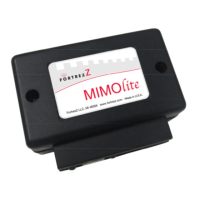
FortrezZ MIMOlite
4 pages
Print Icon
To Next Page IconTo Next Page
Loading...
MIMOlite, Multiple Input – Multiple Output
Wireless Interface/Bridge Module, User Manual
1080 Centre Rd. Ste C
Auburn Hills, MI 48326
www.fortrezz.com
Phone: (248) 481-7092
sales@fortrezz.com
Made in USA
050515
Introduction
The MIMOlite Module is an interface / bridge module, capable of converting a wired or wireless input to a wired or wireless output. The MIMO
is a Z-Wave
TM
Wireless device compatible with other Z-Wave
TM
certified products. MIMOlite comes in a plastic enclosure for indoor use only.
Specifications
Power: 12-16 VDC @~ 300mA
Frequency Range: 908.4MHz (US); 868.4MHz (EU)
Distance Range: Max 100ft line of sight in unobstructed environment
Enclosure Size (L x W x D): 3 3/8" (85mm) x 2 1/2" (64mm) x 1 1/4" (30mm)
Weight: 4 oz (100 gram)
Operating Temperature: -10⁰C (14F) to +70⁰C (158F)
Input Signal 1 (SIG1): Digital or Analog Input, 0 to 16V DC, 16 Hz Max for pulse counting (min. 32
ms high or low time). The trigger levels and hysteresis can be set via the Configuration Command Class. The
input can be a dry contact closure (see open/shorted characteristics in Technical Appendix).
Input Signal Impedance Input impedance for SIG1 is Z=66 ohm at 10KHz. This impedance is = 66 ohm = 34 ohm + j 540uH.
Output Relay 1: SPDT, Max. Switching power of 120W; 10uA to 10A; High Dielectric strength coil-contacts: 1,000 VAC;
Open contacts: 750 VAC; Conforms to FCC Part 68 requirements; Ag + Au clad bifurcated contacts fully sealed.
System Requirement: Any Z-Wave
TM
-enabled network and controller.
Overview
The MIMOlite module provides one analog or digital input and one relay output (isolated dry contacts, NO-COM-NC) and can be controlled by Z-
Wave
TM
. The system includes a program switch for Z-Wave
TM
inclusion/exclusion and a status light (LED) for various indications.
Input SIG1 is an analog input, internally pulled-up to the MIMOlite supply voltage. The system allows trigger conditions to be set based on the
input voltage being inside or outside a user-defined range (configured via Z-Wave). This provides great flexibility for capturing events in a wide
variety of applications. The trigger status of the input can be read via Z-Wave
TM
and/or can be automatically sent to a configured node, typically
the Controller. In addition, a count of the trigger events that have occurred for the input channel is internally recorded (and stored in the ‘pulse
count’) and is available to be requested or automatically sent via Z-Wave. The current triggered/un-triggered status can also be read via Z-
Wave. The SIG1 input can be associated with up to two other Z-Wave
TM
devices, such that an associated device will automatically turn on (or
off) based on the occurrence of a trigger event. Finally, the analog input channel can be configured so that the analog input level (not just binary
trigger status) is periodically sent to up to two other associated nodes.
The output relay is typically commanded via Z-Wave
TM
commands. In addition, the user can configure the input SIG1 trigger condition to be
mapped to the output relay. For example, Relay 1 can be automatically turned on based on Input SIG1 being triggered. The relay activation can
be set via a jumper or via Z-Wave
TM
for either momentary or latched operation - see Installation section.
Warnings and Precautions
* The dry contact relays are not capable of supporting higher-than-specified loads. Exceeding the specified switching power will cause damage to
the unit and may cause damage to property and/or personal injury, including loss-of-life.
* WARNING – Do not attempt to use the relays to switch residential or industrial Alternating Current (AC) lines. The relays are to be
used for low-power load control only. Refer to above electrical specifications for relays.
* Do not store highly flammable items such as oily rags or other combustibles near your MIMOlite.
* Do not apply electrical power to the unit unless the unit is fully assembled.
* Install unit in accordance with electrical codes and regulations. In case you are unsure about any parts of these instructions consult an
electrician or Z-Wave
TM
home automation specialist.
* Disconnect power source before working on or servicing the unit. Failure to do so could result in personal injury.
* WARNING - The MIMOlite must not be used in life support and / or safety applications.
Question and Answer IconNeed help?

Do you have a question about the FortrezZ MIMOlite and is the answer not in the manual?

Summary

Introduction

Specifications

Power

Specifies the power requirements for the MIMOlite module.

Frequency Range

Details the operational frequency bands for US and EU.

Distance Range

Indicates the maximum wireless communication range.

Enclosure Size

Provides the physical dimensions of the module.

Weight

Specifies the weight of the MIMOlite module.

Operating Temperature

Defines the acceptable temperature range for operation.

Input Signal 1 (SIG1)

Describes the digital or analog input characteristics.

Input Signal Impedance

Details the impedance of the SIG1 input at a specific frequency.

Output Relay 1

Specifies the capabilities and ratings of the output relay.

System Requirement

Outlines the necessary Z-Wave network and controller for operation.

Overview

Input SIG1 Functionality

Explains how the analog/digital input can trigger events and send data.

Output Relay Control

Describes how the output relay is controlled via Z-Wave or input triggers.

Warnings and Precautions

General Safety Guidelines

Covers critical safety warnings regarding load limits, AC lines, and placement.

Life Support Application Warning

Explicitly states the device must not be used in life support applications.

Using the MIMOlite in a Z-Wave Network

Network Inclusion and Exclusion

Procedures for adding and removing the MIMOlite from a Z-Wave network.

Device Associations

Details on associating MIMOlite with other Z-Wave devices.

Status Indications

Explanation of LED light patterns for various device states.

Input Analog-to-Digital Characteristics

Voltage Conversion to Sensor Value

Describes the non-linear conversion of input voltage to a Multilevel Sensor value.

Input Configuration

Triggering Configuration Details

Explains how to configure trigger thresholds for the analog input.

Output Configuration

Input-to-Relay Mapping

Configuration for mapping input triggers to output relay actions.

Momentary vs. Latched Relay Operation

Selection and configuration of relay operation modes.

Power Dropout

Power Dropout Indication and Alarms

Details on how power loss is indicated and reported via alarms.

Installation

Jumper and Connection Guide

Instructions for setting jumpers and connecting power, signals, and relays.

Z-Wave Controller Integration

Guidance on programming the MIMOlite into the Z-Wave controller.

Troubleshooting

Controller Compatibility and Support

Information on controller compatibility and where to find support.

Regulatory Information

FCC Compliance Statements

Details FCC compliance, interference, and warning statements.

Industry Canada Statement

Industry Canada Compliance

Covers compliance with Industry Canada regulations and specifications.

Europe

European Certification and WEEE

Notes European certification and WEEE directive compliance.

Limited Warranty

Warranty Terms and Limitations

Outlines the one-year limited manufacturer warranty.

Returns and Refund Policy

Details the process for returning products for exchange or refund.

FortrezZ MIMOlite Specifications

General IconGeneral
ConnectivityZ-Wave
Z-Wave Frequency908.42 MHz (US)
Inputs1
Outputs1
InputDry Contact
OutputRelay Output
Operating Temperature-10°C to 50°C
Humidity0-85% RH (non-condensing)
CertificationsZ-Wave Plus