This document describes the CBY.AC & BF Hand Pallet Truck, an essential piece of equipment for material handling. It provides comprehensive information on its function, technical specifications, usage, and maintenance, ensuring safe and efficient operation.
Function Description
The hand pallet truck is designed for lifting and transporting pallets and other heavy loads within warehouses, factories, and other industrial settings. Its hydraulic system allows for easy raising and lowering of forks, while the robust frame and wheels facilitate smooth movement. The control handle offers three positions: Raise, Drive, and Lower, providing precise control over the lifting and lowering operations. The "Drive Position" is recommended for dragging the forklift, as it reduces rebounding force on the pump core and protects hydraulic sealing kits and piston assembly, thereby prolonging the equipment's life.
Important Technical Specifications
The CBY.AC & BF Hand Pallet Truck comes with the following key specifications:
- Load Capacity: 2000-3000 Kg, making it suitable for a wide range of heavy-duty applications.
- Width of Fork: 550-685 mm, accommodating various pallet sizes.
- Length of Fork: 1100-1220 mm, providing ample reach for different load dimensions.
- Height of Fork: 65-190-200 mm, allowing for versatile lifting heights.
- Net Weight: 74-90 Kg, indicating a sturdy yet manageable design.
- Hydraulic Oil: ISOUG32, with a viscosity of 30cSt and a total volume of 0.41t.
Usage Features
The operation manual emphasizes several features and guidelines for effective and safe use:
- Handle Control: The control handle (119) has three distinct positions: Raise, Drive Position, and Lower. These positions are pre-set at the factory but can be adjusted if necessary.
- Raise Position: When the control handle is in the Raise position and pressurized, the forklift lifts. If it fails to raise, the hexagonal nut (104) should be adjusted counterclockwise.
- Drive Position: This is the recommended position for dragging the forklift. It helps reduce stress on the pump core and protects hydraulic components. If the forklift pressurizes and forces upward in this position, the hexagonal nut (103) and metalloid nut (105) on the drop bolt (103) should be adjusted clockwise until the issue is resolved. If the forklift forces downward, the hexagonal nut (104) and metalloid nut (105) should be adjusted counterclockwise.
- Lower Position: When the control handle is in the Lower position, the forklift lowers. If it does not lower, the hexagonal nut (104) should be adjusted clockwise.
- Buffer Device Adjustment: The manual provides detailed steps for adjusting the buffer device to ensure proper function of the Raise, Drive, and Lower positions.
- Safety Guidelines:
- Operators must thoroughly read the instruction manual and safety notes before operation.
- Personnel unfamiliar with the equipment or without training should not operate the forklift.
- Regular checks of wheels (222, 225, 228, 315), handle welding prat assembly, carrier, and pedal control arm (327) are crucial before operation.
- The forklift should not be used on slopes or to carry personnel.
- Operators must wear gloves for protection.
- During transport, personnel should maintain a 600mm distance from the carrier.
- Attention to the center of gravity is vital to prevent offset or inclination.
- Overloading the forklift is strictly prohibited.
- Operators should exercise caution in special circumstances or locations.
Maintenance Features
Frequent maintenance is crucial for the longevity and optimal performance of the hand pallet truck:
- Oiling:
- Check the hydraulic oil level every 3 months.
- Use ISOUG32 hydraulic oil with a viscosity of 30cSt and a total volume of 0.41t.
- Exhausting Air:
- Air may enter the hydraulic oil during transport or if the pump is upside down, preventing the forklift from raising.
- To exhaust air, pull the control handle (119) to the Lower Position and move the handle welding prat (113) back and forth several times.
- Daily Inspection & Maintenance:
- Regular daily inspections can reduce wear.
- Pay special attention to wheels and wheel shafts for any wrapped threads or lines.
- After transport, all cargo must be unloaded, and the forklift should be lowered to its lowest position.
- Lubricating:
- All bearings and shafts are pre-lubricated before shipment.
- Add oil to these areas monthly or during thorough cleaning.
- Troubleshooting: The manual includes a comprehensive troubleshooting guide for common issues such as the fork not raising to maximum height, not raising at all, not lowering, oil leakage, and relief valve malfunction. It provides reasons for these problems and corresponding solutions, such as adding or changing oil, adjusting nuts, replacing parts, or exhausting air.
- Professional Repair: Personnel without special training are advised not to attempt repairs themselves.

 Need help?
 General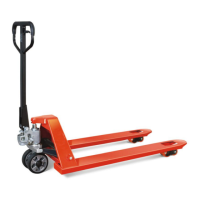

 To Next Page