Make sure before climbing the ladder, that..your shoes are not slippery
and that there is no ice or other slippery substance on the ladder.
Do not step on the very rear portion of the roof where the
fiberglass from the rear walls maps to the roof.
Remember if storing items on the roof, to keep vehicle weights and
weight distribution in mind. Do not store items on the roof that could dam-
age the roof. Some models may not be equipped with a roof mounted stor-
age-rack.
EP
GAS
SYSTEM
GENERAL INFORMATION
The liquid petroleum (LP) gas system
in
your recreational vehicle fur-
nishes the fuel for cooking, heating, and hot water. LP gas can also be
used as an alternate energy source for refrigeration. LP gas is a clean, ef-
ficient, safe form of energy when proper handling and safety precautions
are observed. It enables you to enjoy a comfortable lifestyle where other
forms of energy are not easily utilized.
The gas is stored under extreme pressure in the
tank,
with space in
the
tank
to allow for expansion into vapor. This vapor is reduced in pressure
,
by passing through
a
regulator. This reduction in pressure is a two step
:
process which assures consistent pressure for use, regardless of outside
temperatures, weather, or altitude.
Your LP system is designed to accept either propane or butane. However,
since butane vaporizes at about 32%, it can only be used in areas where
you can be sure of higher temperatures. Propane vaporizes at approximately
-400E There are blends of propane and butane available, which will vary
in the temperature at which it vaporizes. When filling your tank, select
an LP gas that has a boiling point about 40" lower than temperatures you
expect to travel in. Talk to your dealer, or your local LP gas supplier about
what you should be using.
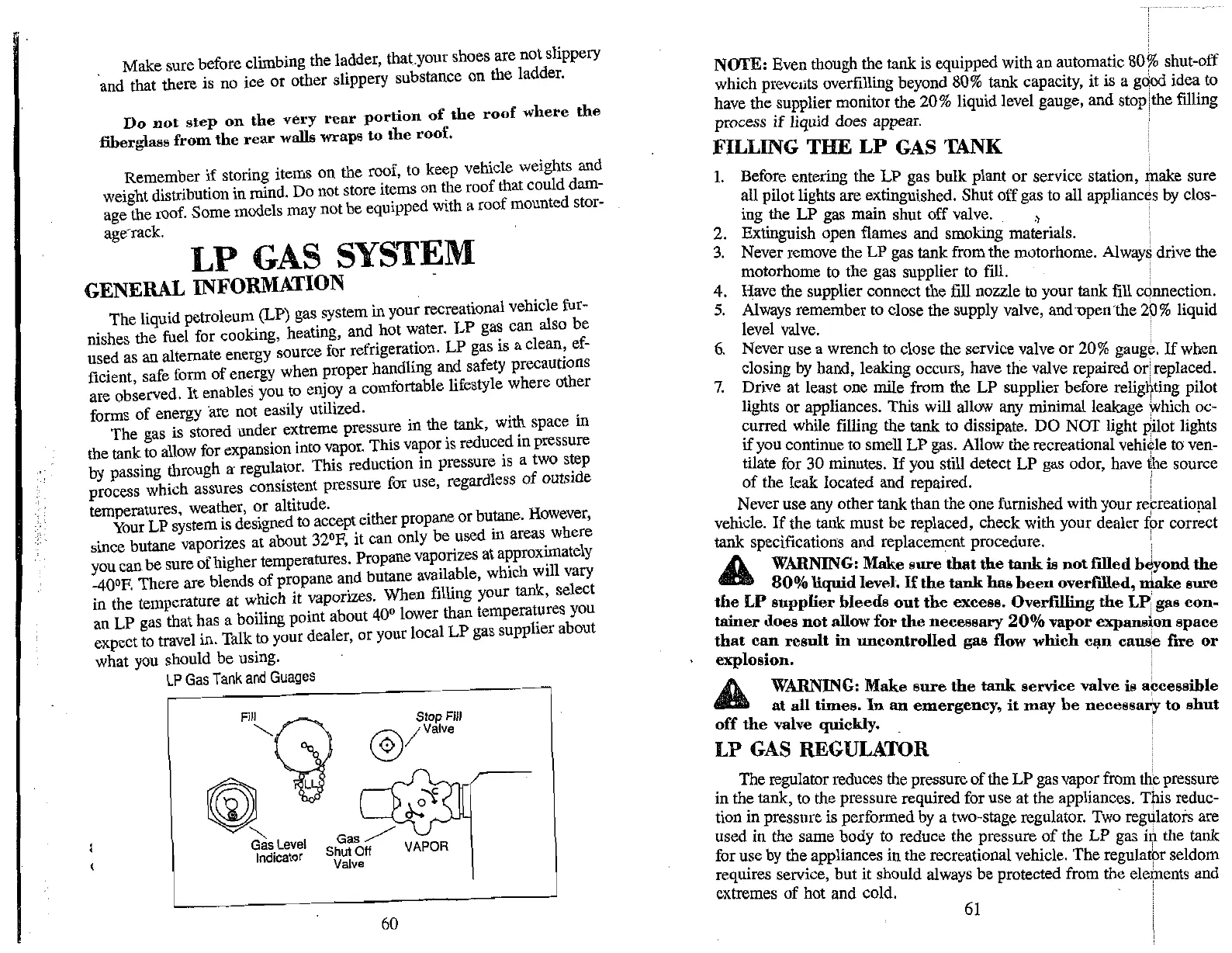
LP
Gas
Tank
and Guages
I
NOTE:
Even though the
tank
is equipped with an automatic
which prevellts overfilling beyond 80% tank capacity, it is
have the supplier monitor the 20% liquid level gauge, and s
process if liquid does appear.
FILLING
THE
LP
GAS
TANK
1.
Before entering the LP gas bulk plant or service station
all pilot lights are extinguished. Shut off gas to all appli
ing the LP gas main shut off valve.
,
2. Extinguish open flames and smoking materials.
3.
Never remove the LP gas tank from the motorhome. A1
motorhome to the gas supplier to fill.
4. Have the supplier connect the fill nozzle to your tank fill connection.
5.
Always remember to close the supply valve, and open the 20% liquid
level valve.
6.
Never use a wrench to close the service valve or 20% gauge. If when
closing by hand, leaking occurs, have the valve repaired or replaced.
7.
Drive at least one mile from the LP supplier before relighting pilot
lights or appliances. This will allow any minimal leakage which oc-
curred while filling the tank to dissipate. DO NOT light pilot lights
if you continue to smell LP gas. Allow the recreational vehicle to ven-
tllate for 30 minutes. If you still detect LP gas odor, have the source
of the leak located and repaired.
Never use any other tank than the one furnished with your recreational
vehicle. If the tank must be replaced, check with your dealer for correct
tank
specifications and replacement procedure.
A
WARNING: Make sure that the
tank
is
not fded beyond the
80%
liquid level. If the
tank
has been overfded, make sure
the
LP
supplier bleeds out the excess. Overfilling the
LP
gas con-
tainer does not
allow
for the necessary
20%
vapor
that can result
in
uncontrolled gas flow which c
explosion.
WARNING: Make sure the
tank
service
a
at dl times.
JJI
an
emergency, it may be
off the valve quickly.
LP GAS
REGULATOR
The regulator reduces the pressure of the LP gas
in the tank, to the pressure required for use at the
tion in pressure is performed by a two-stage regulator. Two regulators are
used in the same body to reduce the pressure of the LP gas in the tank
for use by the appliances in the recreational vehicle. The regulator seldom
requires service, but it should always be protected from the elements and
extremes of hot and cold.
61


 To Next Page
 Loading...