The two stage regulator does not have to work as hard since the second
stage receives consistent pressure rather than inlet pressure which varies.
The result is an efficient safer system that helps to eliminate problems such
as freeze up and pilot outages.
The regulator has been preset by the manufacturer of the regulator, and
adjustment should not be necessary. If adjustment should be required
however, DO
N(TT
attempt to adjust it yourself. Adjustment must be made
with special equipment by a qualified LP gas service technician.
Have the regulator checked annually, or whenever you suspect a prob-
lem. The correct line pressure should he
6%
oz., or
11
inches of water
The high pressure regulator (first stage) is used to reduce the pressure
to approximately 10 to
13
PSI
before sending it along to the low pressure
column.
Because air is required for proper operation of the regulator, it is very
important that the regulator vent is kept clean and free of dirt and debris.
This is why it is necessary to keep the vent facing downward and the
regulator covered to protect it from contamination. A toothbrush can be
used to clean the vent if it becomes clogged by foreign matter.
During cold weather, it is important to keep ice from forming in the
regulator, which will shut off the flow of LP gas to your appliances. Have
the supplier add an hydrous Methanol when filling your tank for use dur-
ing cold weather.
Regulator freeze up can occur in any weather
if
there is moisture in
the tank, or if the tank has been overfilled. Always use moisture-free LP
gas, and make sure the
tank
has not been filled beyond 80% of capacity.
If moisture has entered the
tank,
have the tank purged, or have an hydrous
methanol added
by
an authorized LP supplier.
If you believe a regulator has been damaged or otherwise is not fuuc-
tioning, have it replaced by a competent serviceman.
1
1
WARNING: Never alter the positioning of the regulator.
LP
gas regulators must always be installed with the diaphragm
vent facing downward. Also make sure to keep the regulator cover
in
place
to
minimize vent blockage which could result
in
excessive
gas pressure causing
fm
or explosion. Do not
rely
upon being able
to smell
LP
gas leaks, as the odor may not be sufficiently strong
to detect.
REGULATO'
FREEZE-UP
regulator (second stage). This second stage regulator reduces the pressure
further to 11 inches water column, or
6.35
ounces per square inch.
I
The term regulator freeze-up is a misleading one. Regulators and LP
gas do not freeze. However, the moisture that can be contained in the gas
will
freeze as the gas expands and cools passing through the regulator. This
freezing of the moisture in the gas can build up and partially or totally
block thr ?assage of the gas through the regulator. Freezing can also occur
when outside temperatures are low enough to contribute to the freezing
of the moisture in the gas.
The source of the moisture is varied. It can occur at the refinery or
gas bu& plant, in the cars used to transport the gas, or even within you
own LP
tanks.
Moisture
in
an LP
tank
can occur whenpa
tank
service valve
is left open, allowing moist air to enter and become trapped.
A
two-stage regulator helps to reduce the possibility of freeze-up because
of its larger orifice size, and the fact that heat is transferred througll the
walls of two regulators instead of just one.
There are several steps that can be taken to inhibit or prevent this from
happening:
1. Make sure that your, LP
tank
is free of moisture before refilling.
2.
DO
NCYT
overfill the LP tank.
3.
Make sure to keep the service valve on an empty tank closed.
4.
If freezing has occurred, have your LP dealer purge the LP tank before
refilling.
5.
Add anUhydrous methanol or other approved LP antifreeze or deicing
agent to the LP
tank.
6.
Keep the regulator covered at all times.
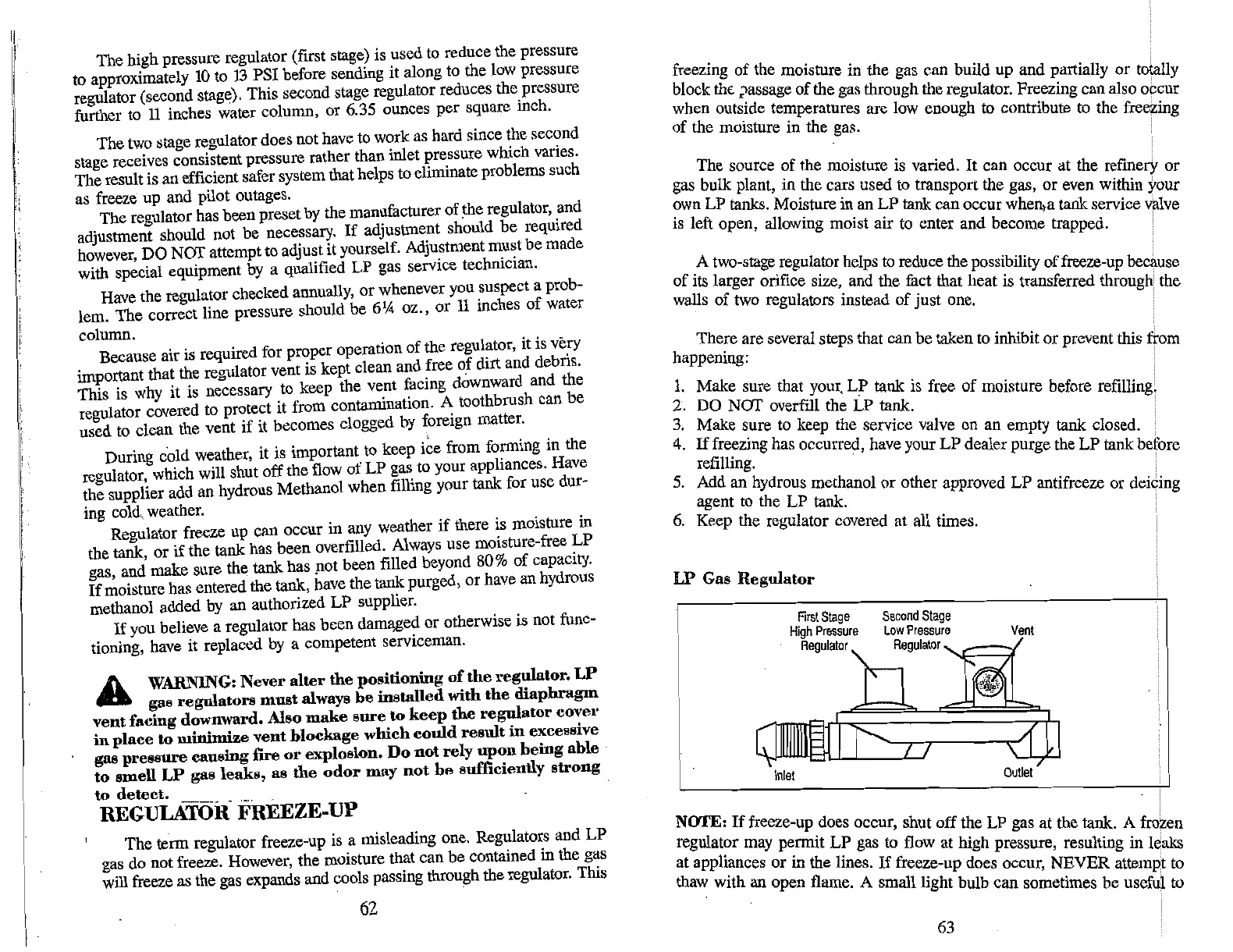
LP
Gas Regulator
First Stage
Second
Stage
High Pressure
Low
Pressure Vent
Inlet Outlet
.
,
NOTE:
If freeze-up does occur, shut off the LP gas at the tank.
A
frozen
regulator may permit LP gas
to
flow at high pressure, resulting in leaks
at appliances or in the lines. If freeze-up does occur,
NEVER
attempt to
thaw with
an
open flame.
A
small light bulb can sometimes be useful to


 To Next Page
 Loading...