
 Need help?
Do you have a question about the Franklin NIV-570 and is the answer not in the manual?
Explains the basic functions of keys like Power, Help, Clear, Back, Enter, etc.
Describes navigation controls for menus and text.
Instructions on how to insert and remove CR-2032 batteries.
Steps for changing batteries when a low battery warning appears.
How to find a specific verse by entering Book, Chapter, and Verse.
How to navigate to the start of a chapter or book.
How to start a search for specific words or phrases in the Bible.
Steps to add up to 50 bookmarks for quick reference.
Instructions for storing names and telephone numbers.
How to set, change, or remove a password for databank security.
Procedure to perform a system reset if the device becomes unresponsive.
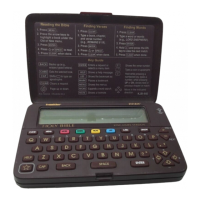
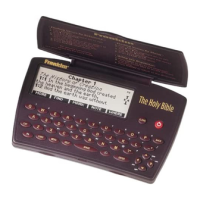
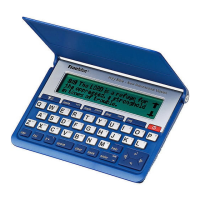
This document describes the Franklin NIV-570 Holy Bible, New International Version, a portable electronic device designed for reading and studying the Bible. It includes a user's guide covering its functions, usage features, and maintenance.
The NIV-570 is an electronic Holy Bible that allows users to read the Old and New Testaments, access an index of popular chapters, view devotional verses, and search for specific words or phrases. It also includes an Organizer with a clock, databank, and calculator.
The device features a "Learn a Verse" function, which presents a verse from either the Old or New Testament for memorization each time the device is turned on. Users can enable or disable this feature through the settings.
The device is turned on or off using the dedicated power button. A help message can be displayed at any screen by pressing the help button. The clear button returns to the Verse Reference screen and clears the calculator. The back button backs up, erases a letter, turns off highlighting in text, and in the Holy Bible, returns to the previous screen.
Direction keys (up, down, left, right arrows) are used to move through menus and text. The space button pages down in menus and dictionary entries, and types a space at the word search screen. After a space, the direction keys can cycle through symbols like - . * ? :.
To read the Holy Bible, users first select either the Old Testament or New Testament from the Bible menu. They can then highlight a book using the direction keys or by typing its initial letters. For books starting with numbers, users hold FN and press the number key, or type Roman numerals (e.g., IIK for 2 Kings). Once a book is selected, users can choose a chapter by highlighting it or typing its number. Numbers are automatically active in the chapter menu.
To navigate within text, space pages down. Holding FN and pressing the up or down arrow pages up or down. Holding FN and pressing the left or right arrow moves to the next or previous verse. Holding CAP and pressing the up or down arrow moves to the start or end of the next or previous chapter.
To go directly to a specific verse, users press CLEAR or the dedicated Bible menu button to reach the Verse Reference screen, then type the Book title, Chapter number, and Verse number. If only a Book title and Chapter number are entered, the device goes to the start of that chapter.
The find button initiates a word search. Users type their search words (up to 35 letters, using space for spaces) and press ENTER. The search results display the number of matches in each book. Users can then highlight a book and press ENTER to view the chapters where matches occur. The device goes directly to the first match in the selected book, with matching words boxed in the text. Holding FN and pressing the left or right arrow navigates to the next or previous match.
After an initial search, pressing MORE repeatedly expands the search to include inflections, synonyms, and similar words.
If a user is unsure of a word's spelling or wants to find prefixes/suffixes, they can use an asterisk (*) as a wildcard. Holding CAP and pressing ? types an asterisk.
Users can highlight a word in a verse by pressing ENTER to start highlighting. The navigation button moves the highlight. Pressing ENTER again searches for the highlighted word. BACK turns off highlighting.
When a footnote marker (H) appears after a word in a verse, users can view the footnote. Pressing ENTER starts the highlight, and the navigation button moves to the desired footnote. Press ENTER to view it. Holding FN and pressing ENTER immediately opens the note if only one footnote marker is on screen. BACK returns to the verse. The footnotes clarify archaic English words and are not part of the original New International Version.
The mark button allows users to add up to 50 bookmarks to text for quick reference. Pressing MARK at any verse adds a bookmark. To view bookmarks, press CLEAR then MARK, then use the direction keys to highlight and ENTER to view the verse.
Users can also add brief notes to bookmarks. To do so, they navigate to the bookmarked verse, press MARK, then select "Add Notes" and type their note. To view a note, they navigate to the bookmark marker in the text and press ENTER.
The org button accesses the Organizer, which includes a clock, databank, and calculator.
The clock allows users to set a Home time and view local times in 45 cities worldwide. Pressing ORG displays the Home City time. Pressing S enters the Home Setting menu, where users can set the time format (12/24-hour, Day/Month/Year), Daylight Saving Time (DST) on/off, current time, date, and Home City. FIND toggles between Home time and World time. In World Time, users can view dates and times for various cities, based on the Home City settings.
The databank stores up to 100 names and telephone numbers. Pressing ORG then MARK accesses the databank. Users can add new entries by highlighting "New Entry," typing a name and number, and pressing ENTER. Q-P automatically types numbers 0-9.
Entries can be viewed or edited by highlighting "View: XX entries" and pressing ENTER. To edit, highlight an entry, press ENTER, make changes, and save.
Entries can be deleted by highlighting "Delete Entry" and pressing ENTER. Users can also erase all databank entries.
A password can be set for the databank to prevent unauthorized access. Users press ORG, MARK, then highlight "Set Password" and ENTER. They type a password (up to eight characters) and confirm it. The password will be requested the first time the databank is used in a session.
The find button (when in Organizer) or calc button accesses the calculator. Users type numbers (up to 10 digits, Q-P for 0-9, G(.) for decimal, Z(+/-) to change sign), press a math function key (H-L), type another number, and press ENTER for the result. CLEAR clears calculations.
The calculator also has memory functions: X(M+) adds the screen number to memory, C(M-) subtracts, V(MR) retrieves from memory, and B(MC) clears memory.
The settings menu, accessed by pressing the Bible menu button then navigating to "Settings," allows users to adjust screen contrast, shutoff time (how long the unit stays on without key press), and type size.
The NIV-570 uses two pre-installed CR-2032 Lithium batteries. When a low battery warning appears, users should replace them. To do so, turn the unit off, unscrew the battery cover, gently push the tab, remove old batteries (using a paper clip if needed), install new CR-2032 batteries with positive polarity up, and replace the cover. Incorrect polarity can damage the unit.
Non-rechargeable batteries should not be recharged. Rechargeable batteries must be removed for charging and charged under adult supervision. Only recommended battery types should be used, and supply terminals should not be short-circuited. Batteries should not be exposed to direct heat or taken apart. Weak or dead batteries should be removed, and batteries should be replaced every two years to prevent leakage. If leakage occurs, clean the compartment immediately, avoiding skin contact. Batteries should be kept out of reach of children.
If the keyboard fails to respond or the screen acts erratically, a system reset can be performed. Hold CLEAR and the power button. If this doesn't work, gently press the recessed reset button on the back of the device with a paper clip. This displays an "Erase All? (Y/N)" message. Pressing N saves user information (bookmarks, databank, settings), while Y erases it. Pressing the reset button with more than light pressure may permanently disable the device. Resetting also erases settings and user-entered information.
The device retains the last viewed passage when turned off, unless the "Learn a Verse" feature was active. Pressing BACK returns to the last viewed passage from the "Learn a Verse" screen.
At any Holy Bible verse, pressing ? displays the book, chapter, and verse number.
The device may change operating modes, lose information, or fail due to electrostatic discharge or electrical fast transients. Normal operation can be re-established by pressing the reset key, pressing the power button, or removing/replacing batteries.
 Battery
| battery type | CR-2032 |
|---|---|
| battery voltage | 3 volt |
| number of batteries | two |
 Weight and Dimensions
| size | 12.3 x 9.1 x 1.35 cm |
|---|---|
| weight | 117 g |


 To Next Page