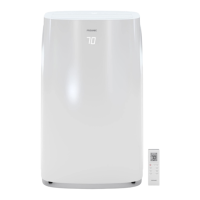
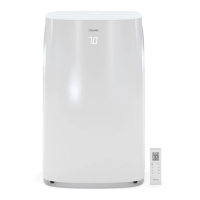
This document is a user manual for Freonic portable air conditioners, specifically models FHCP061AKR, FHCP071AKR, and FHCP081AKR. It provides comprehensive instructions for installation, operation, maintenance, and troubleshooting.
Function Description
The Freonic portable air conditioner is designed for indoor use to provide cooling, heating (for models with this function), fan operation, and dehumidification. It is a movable unit that can be easily relocated within a room, offering flexible climate control. The device aims to improve indoor comfort by adjusting temperature and humidity levels. It features various protection functions, including frost protection, overflow protection, automatic defrosting (for heating and cooling models), automatic thermal protection, and compressor protection, to ensure safe and reliable operation.
Important Technical Specifications
While specific numerical technical specifications like BTU ratings, power consumption, or dimensions are not explicitly listed in the provided pages, the manual highlights several operational and installation requirements:
- Placement: The unit must be placed on a flat, dry surface, maintaining a minimum distance of 19 inches from surrounding objects or walls to ensure proper airflow and prevent obstructions.
- Exhaust Pipe: The length of the exhaust hose is specified to be between 11 and 59 inches, designed to match the air conditioner's specifications. Using extension tubes or different hoses is cautioned against as it may cause malfunctions or overheating.
- Temperature Range: For optimal performance, the machine is recommended for use in ambient temperatures between 44-95 °F in cooling mode. In dehumidification mode, the ambient temperature should be greater than 62 °F.
- Power: The unit requires proper grounding and a stable power supply. The power plug must be intact and firmly connected to the outlet.
- Refrigerant: Although not explicitly stated, the presence of a compressor and cooling/heating functions implies the use of a refrigerant, and the manual's safety notes indirectly refer to components related to a refrigeration cycle (e.g., "temperature of the exhaust pipe is too low").
Usage Features
The portable air conditioner offers a user-friendly interface with both a control panel on the unit and a remote control.
- Modes: It supports multiple operating modes:
- Cooling: Reduces room temperature.
- Heating (if applicable): Increases room temperature.
- Fan: Circulates air without temperature adjustment, with selectable high, medium, and low fan speeds.
- Dehumidifying: Reduces humidity levels in the room.
- Temperature Control: Users can set desired temperatures using UP/DOWN buttons. The display window shows the current temperature, which can be switched between Celsius (°C) and Fahrenheit (°F).
- Timer Function: An integrated timer allows users to program the unit to automatically turn ON or OFF at specified times, with hourly increments.
- Sleep Mode: This mode optimizes comfort during sleep by setting the fan speed to low and potentially adjusting temperature settings automatically. It can be activated in cooling or heating modes.
- Swing Function: The louver (wind-guide strip) can be set to auto-swing or fixed in a desired position to direct airflow.
- Display Window: Provides visual feedback on current settings and operational status.
- Remote Control: A dedicated remote control mirrors most functions available on the unit's control panel, offering convenience.
- Installation: The manual details a straightforward installation process involving screwing the heat pipe assembly into the exhaust port and mounting the window sealing plate assembly. It emphasizes keeping the unit upright for at least two hours before initial use.
- Drainage: Two drainage methods are available:
- Manual Drainage: Required when the internal water pan is full, indicated by an "FL" alarm. Users must turn off the unit, unplug it, and drain water by unscrewing a rotary knob and removing a rubber stopper.
- Continuous Drainage: Applicable in cooling and dehumidification modes, allowing for continuous water discharge via a drainage pipe connected to a bucket or sewer.
Maintenance Features
Regular maintenance is crucial for the longevity and efficient operation of the air conditioner.
- Cleaning the Surface: The unit's surface should be cleaned with a wet, soft cloth. Harsh chemicals like benzene, alcohol, or gasoline are strictly prohibited to prevent damage.
- Cleaning the Filter Screen: The filter screen, if clogged with dust, reduces the air conditioner's effectiveness. It should be cleaned every two weeks. The process involves removing the filter screen frame, unscrewing it, and washing the EVA filter screen in warm water with neutral detergent, then drying it in the shade.
- Postseason Storage: Detailed instructions are provided for preparing the unit for storage after seasonal use:
- Drain all water from the water pan.
- Run the machine in low-wind ventilation mode until the drainage pipe is dry to prevent mildew.
- Turn off, unplug, and wrap the power cord.
- Reinstall the rubber stopper and rotary knob.
- Remove and properly store the exhaust pipe.
- Cover the air conditioner with a plastic bag and store it in a dry, child-safe place, protected from dust.
- Remove batteries from the remote control for storage.
- Troubleshooting Guide: A comprehensive table helps users diagnose common issues (e.g., unit not working, poor cooling/heating, loud noise, compressor issues, remote control failure, error codes like 'E1' and 'E2') and provides corresponding reasons and solutions. Users are advised against self-repair and encouraged to contact professional service for complex problems.


 To Next Page
 General