EasyManua.ls Logo

FRIDEN STW - Page 43

Default Icon
161 pages
Print Icon
To Next Page IconTo Next Page
To Previous Page IconTo Previous Page
Loading...
B-ts-80
FRIDEN
CALCULATING
MACHINE
CoO,,
INC.
Page
43
SPECIAL
FEATURES
FGI
FIG.
2
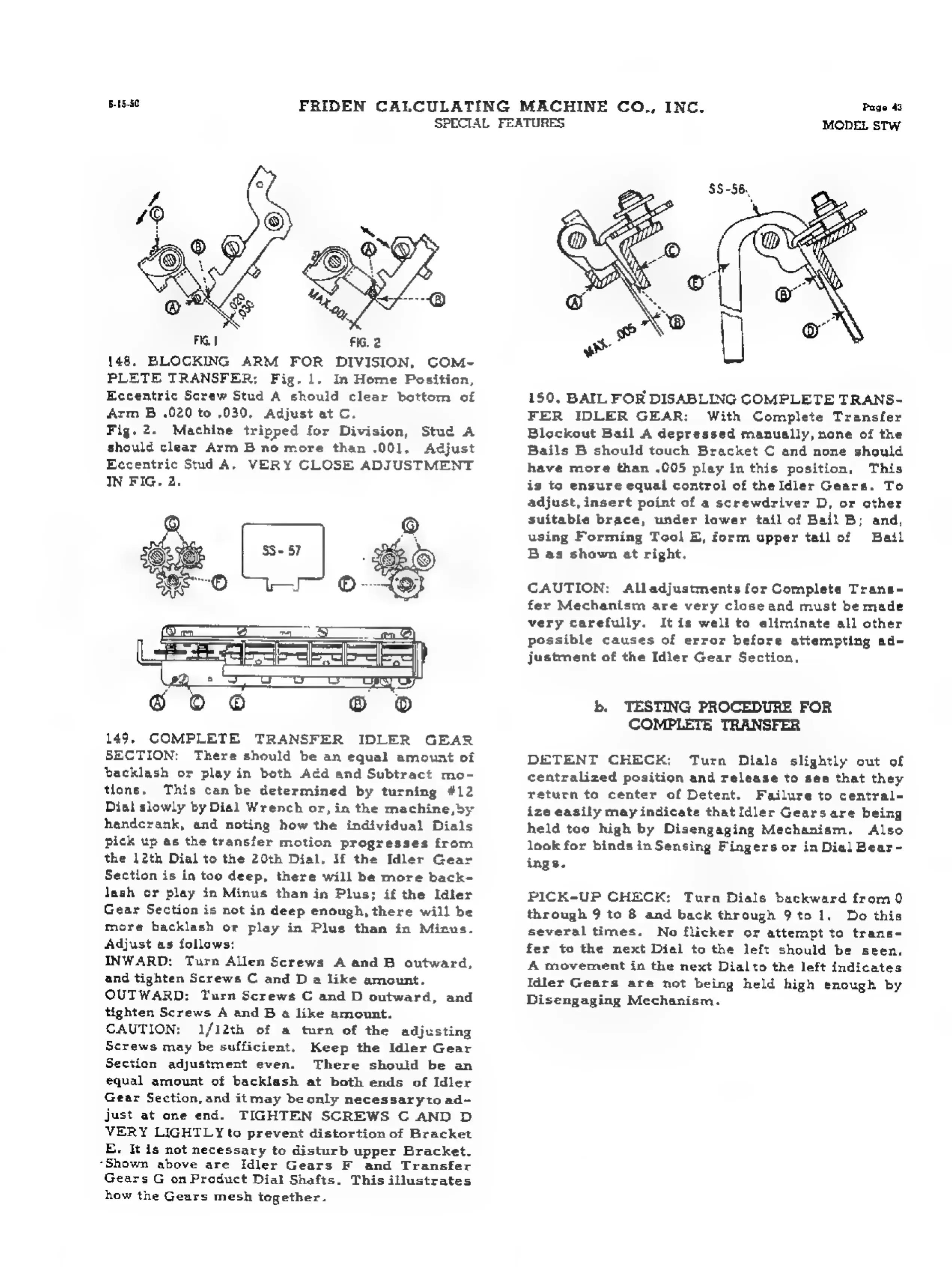
148.
BLOCKING
ARM
FOR
DIVISION,
GCOM-
PLETE
TRANSFER;
Fig.
1.
In
Home
Position,
Eccentric
Screw
Stud
A
should
clear
bettom
of
Arm
B
.020
to
,030,
Adjust
at
C.
Fig.
2.
Machine
tripped
for
Division,
Stud
A
should
clear
Arm
B
no
more
than
.001.
Adjust
Eccentric
Stud
A.
VERY
CLOSE
ADJUSTMENT
IN
FIG.
2.
I~
©
149.
COMPLETE
TRANSFER
IDLER
GEAR
SECTION:
There
should
be
an
equal
amount
of
backlash
or
play
in
beth
Add
and
Subtract
mo-
tions.
This
canbe
determined
by
turning
#12
Diat
slowly
by
Dial
Wrench
or,
in
the
machine,by
handcrank,
and
noting
how
the
individual
Dials
pick
up
as
the
transfer
motion
progresses
from
the
12th Dial
to
the
20th
Dial,
If
the
Idler
Gear
Section
is
in
too
deep,
there
will
be
more
back-
lash
or
play
in
Minus
than
in
Plus;
if
the
Idler
Gear
Section
is
not
in
deep
enough,
there
will
be
more
backlash
or
play
in
Plus
than
in
Minus.
Adjust
as
follows:
INWARD:
Turn
Allen
Screws
A
and
B
outward,
and
tighten
Screws
C
and
D
a
like
amount.
OUTWARD:
Turn
Screws
C
and
D
outward,
and
tighten
Screws
A
and
B
a
like
amount.
CAUTION:
1/12th
of
a
turn
of
the
adjusting
Screws
may
be
sufficient.
Keep
the
Idler
Gear
Section
adjustment
even.
There
should
be
an
equal
amount
of
backlash
at
both
ends
of
Idler
Gear
Section,
and
it
may
be
only
necessaryto
ad-
just
at
one
end.
TIGHTEN
SCREWS
C
AND
D
VERY
LIGHTLY
to
prevent
distortion
of
Bracket
E.
It
is
not
necessary
to
disturb
upper
Bracket.
“Shown
above
are
Idler
Gears
F
and
Transfer
Gears
G
on
Product
Dial
Shafts.
This
illustrates
how
the
Gears
mesh
together.
MODEL
STW
150,
BAIL
FOR
DISABLING
COMPLETE
TRANS-
FER
IDLER
GEAR:
With
Complete
Transfer
Blockout
Bail
A
depressed
manually,
none
of
the
Bails
B
should
touch
Bracket
C
and
none
should
have
more
than
.005
play
in
this
position,
This
is
to
ensure
equal
control
of
the
Idler
Gears.
To
adjust,
insert
point
of
a
screwdriver
D,
or
other
suitable
brace,
under
lower
tail
of
Bail
B;
and,
using
Forming
Tool
E,
form
upper
tail
of
Bail
Bas
shown
at
right,
CAUTION:
Alladjustments
for
Complete
Trans-
fer
Mechanism
are
very
close
and
must
be
made
very
carefully.
It
is
well
to
eliminate
all
other
possible
causes
of
error
before
attempting
ad-
justment
of
the
Idler
Gear
Section.
b.
TESTING
PROCEDURE
FOR
COMPLETE
TRANSFER
DETENT
CHECK:
Turn
Dials
slightly
out
of
centralized
position
and
release
to
see
that
they
return
to
center
of
Detent.
Failure
to
central-
ize
easily
may
indicate
that
Idler
Gearsare
being
held
too
high
by
Disengaging
Mechanism.
Also
look
for
binds
in
Sensing
Fingers
or
in
Dial
Bear-
ings.
PICK-UP
CHECK:
Turn
Dials
backward
from
0
through
9
to
8
and
back
through
9to
1.
Do
this
several
times.
No
flicker
or
attempt
to
trans-
fer
to
the
next
Dial
to
the
left
should
be
seen.
A
movement
in
the
next
Dialto
the
left
indicates
Idler
Gears
are
not
being
held
high
enough
by
Disengaging
Mechanism.