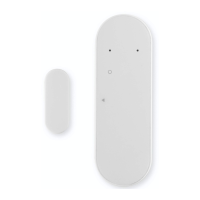
Sensor (a)
Magnet (b)
Sensor (a)
Magnet (b)
Sensor (a)
Magnet (b)
Sensor (a)
Magnet (b)
Sensor (a)
Magnet (b)
Sensor (a)
Magnet (b)
Sliding Door
Sensor (a)
Magnet (b)
g.
h.
i.
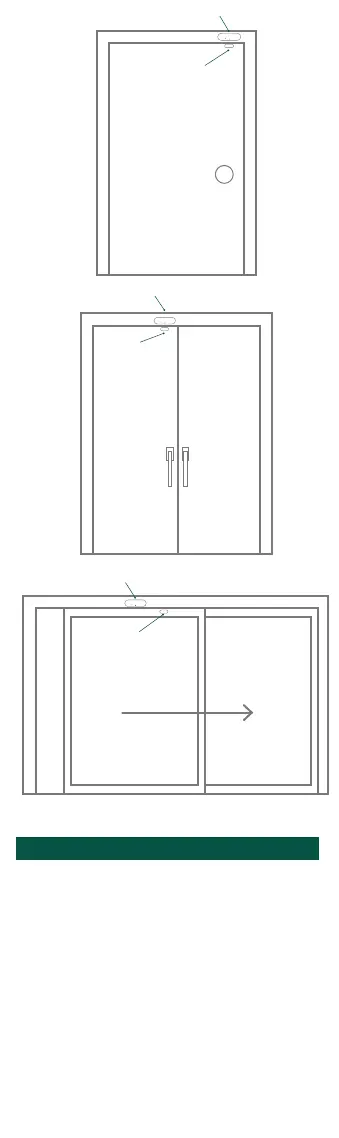
Placement Examples - Doors
• Be sure to mount the sensor on the frame,
to protect the electronics from heavy vibra-
tions.
• The sensor and magnet should be
mounted on the side opposite from the
hinge/pivot point.
• Pay careful attention to the arrow printed on
the sensor. This should be oriented to face
the magnet. The distance between the two
should not exceed 5mm.
Placement Examples - Windows
• Be sure to mount the sensor on the frame,
to protect the electronics from heavy
vibrations.
• The sensor and magnet should be mounted
on the side opposite from the hinge/pivot
point.
• Alternatively, if the window slides open, the
sensor and magnet may be mounted in
many positions, however the sensor should
always be placed on the frame.
• Pay careful attention to the arrow printed on
the sensor. This should be oriented to face
the magnet. The distance between the two
should not exceed 5mm.
frient assumes no responsibility for any
errors, which may appear in this manual.
Furthermore, frient reserves the right to alter
the hardware, software, and/or specications
detailed herein at any time without notice,
and frient does not make any commitment
to update the information contained herein.
All the trademarks listed herein are owned by
their respective owners.
Distributed by frient A/S
Tangen 6
8200 Aarhus N
Denmark
www.frient.com
Copyright © frient A/S
All rights reserved.
Other certications
• Zigbee Home Automation 1.2 certied.
CE certication
The CE mark axed to this product conrms
its compliance with the European Directives
which apply to the product and, in particular,
its compliance with the harmonized standards
and specications.
Frame
Frame
Frame
Frame
Frame
Window
Frame
Frame
Frame
Door
Window
Sensor (a)
Sensor (a)
Sensor (a)
Magnet (b)
Magnet (b)
Magnet (b)
Door
IN ACCORDANCE WITH THE DIRECTIVES
• Radio Equipment Directive (RED)
2014/53/EU
• RoHS Directive 2015/863/EU amending
2011/65/EU
IC statement
ISED statement
Innovation, Science and Economic
Development Canada ICES-003 Compliance
Label: CAN ICES-3 (B)/NMB-3(B).
ISED statement
Français
L’émetteur/récepteur exempt de licence
contenu dans le présent appareil est
conforme aux CNR d’Innovation, Sciences
et Développement économique Canada
applicables aux appareils radio exempts de
licence. L’exploitation est autorisée aux deux
conditions suivantes :
1. L’appareil ne doit pas produire de
brouillage;
2. L’appareil doit accepter tout brouillage
radioélectrique subi, même si le brouillage
est susceptible d’en compromettre le
fonctionnement.
English
This device contains licence-exempt
transmitter(s)/receiver(s) that comply
with Innovation, Science and Economic
Development Canada’s licence-exempt
RSS(s). Operation is subject to the following
two conditions:
1. This device may not cause interference.
2. This device must accept any interference,
including interference that may cause
undesired operation of the device.
This equipment complies with IC RSS-102
radiation exposure limits set forth for an
uncontrolled environment. This equipment
should be installed and operated with
minimum distance 20 cm between the
radiator and your body.
Cet équipement est conforme aux limites
d’exposition aux radiations IC CNR-102
établies pour un environnement non
contrôlé. Cet équipement doit être installé et
utilisé avec une distance minimale de 20 cm
entre le radiateur et votre corps.
FCC statement
Changes or modications to the equipment
not expressly approved by the party
responsible for compliance could void the
user’s authority to operate the equipment.
NOTE: This equipment has been tested and
found to comply with the limits for a Class B
digital device, pursuant to Part 15 of the FCC
Rules. These limits are designed to provide
reasonable protection against harmful
interference in a residential installation.
This equipment generates, uses and can
radiate radio frequency energy and, if not
installed and used in accordance with the
instructions, may cause harmful interference
to radio communications. However, there is no
guarantee that interference will not occur in a
particular installation.
If this equipment does cause harmful
interference to radio or television reception,
which can be determined by turning the
equipment o and on, the user is encouraged
to try to correct the interference by one or
more of the following measures:
• Reorient or relocate the receiving antenna.
• Increase the separation between the
equipment and receiver.
• Connect the equipment into an outlet on
a circuit dierent from that to which the
receiver is connected.
• Consult the dealer or an experienced
radio/TV technician for help.
This device complies with FCC RF radiation
exposure limits set forth for an uncontrolled
environment. The antenna used for this
transmitter must be installed to provide a
separation distance of at least 20 cm from
all persons and must not be co-located
or operating in conjunction with any other
antenna or transmitter.
This device complies with part 15 of the FCC
Rules. Operation is subject to the following
two conditions:
1. This device may not cause harmful interfer-
ence, and
2. this device must accept any interference
received, including interference that may
cause undesired operation.


 To Next Page
 Loading...