NOTICE - This service data sheet is intended for use by persons
having electrical and mechanical training and a level of knowledge
of these subjects generally considered acceptable in the appliance
repair trade. The manufacturer cannot be responsible, nor
assume any liability for injury or damage of any kind arising from
the use of this data sheet.
SAFE SERVICING PRACTICES
To avoid the possibility of personal injury and/or property damage, it is
important that safe servicing practices be observed. The following are
examples, but without limitation, of such practices.
1. Before servicing or moving an appliance remove power cord from
electrical outlet, trip circuit breaker to OFF, or remove fuse.
2. Never interfere with the proper installation of any safety device.
3. GROUNDING: The standard color coding for safety ground wires is
GREEN or GREEN WITH YELLOW STRIPES. Ground leads are not
to be used as current carrying conductors. It is extremely
important that the service technician reestablish all safety
grounds prior to completion of service. Failure to do so will
create a potential safety hazard.
4. Prior to returning the product to service, ensure that:
• All electric connections are correct and secure.
• All electrical leads are properly dressed and secured away from
sharp edges, high-temperature components, and moving parts.
• All uninsulated electrical terminals, connectors, heaters, etc. are
adequately spaced away from all metal parts and panels.
• All safety grounds (both internal and external) are correctly and
securely reassembled.
OVEN CALIBRATION
Set the electronic oven control for normal baking at 350°F. Obtain an
average oven temperature after a minimum of 5 cycles. Press STOP/
CLEAR to end bake mode.
p/n 316441741 (0611)
RTD SCALE
Temperature (°F) Resistance (ohms)
32 ± 1.9 1000 ± 4.0
75 ± 2.5 1091 ± 5.3
250 ± 4.4 1453 ± 8.9
350 ± 5.4 1654 ± 10.8
450 ± 6.9 1852 ± 13.5
550 ± 8.2 2047 ± 15.8
650 ± 9.6 2237 ± 18.5
900 ± 13.6 2697 ± 24.4
ELECTRONIC OVEN CONTROL FAULT CODE DESCRIPTIONS
ELECTRONIC OVEN CONTROL (E.O.C. Rear View)
IMPORTANT
DO NOT REMOVE THIS BAG
OR DESTROY THE CONTENTS
WIRING DIAGRAMS AND SERVICE
INFORMATION ENCLOSED
REPLACE CONTENTS IN BAG
TEMPERATURE ADJUSTMENT
1. Set EOC to bake at 550°F.
2. Within 5 seconds of setting 550°F, press and hold the bake pad for approximately
15 seconds until a single beep is heard (longer may cause F11 shorted keypad
alarm).
3. Calibration offset should appear in the display.
4. Use the slew keys to adjust the oven temperature up or down 35°F in 5°F
increments.
5. Once the desired (-35° to 35°) offset has been applied, press STOP/CLEAR.
Note: Changing calibration affects normal Bake mode. The adjustments made will not
change the Self-Cleaning cycle temperature.
COOKTOP LOCKOUT (some models)
For some models it may be necessary to unlock the cooktop before servicing.
If the Cooktop Locked Indicator Light is ON then the cooktop has been locked.
To turn the Cooktop Lockout Feature OFF:
1. BE SURE ALL GAS SURFACE BURNER CONTROLS ARE SET TO THE
OFF POSITION.
2. Press & hold
until one beep is heard (after 3 seconds). The
Cooktop Locked indicator light will turn OFF and the gas surface burners
may be used normally.
To turn the Cooktop Lockout Feature ON:
1. BE SURE ALL GAS SURFACE BURNER CONTROLS ARE SET TO THE
OFF POSITION.
2. Press & hold
until one beep is heard (after 3 seconds). The
Cooktop Locked indicator light will turn ON and the gas surface burners
and functions are locked out until the cooktop is unlocked.
RESISTANCE TEMPERATURE
DECTECTOR
E.O.C. CONTROL CONNECTIONS
CIRCUIT
ANALYSIS
MATRIX
P8 CONNECTIONS
(some models)
RTD TABLE
COOKTOP LOCKOUT CONTROL BOARD
(some models)
Suggested Corrective Action
Runaway Temperature.
Shorted Keypad.
Bad Micro Identification.
Bad EEPROM Identification/Checksum error.
Open probe circuit.
Shorted Probe circuit.
Cooktop Lockout Error.Cooktop lockout motor
failed to lock or unlock the valve.
NOTE: The valve lockout motor is very quiet.
Under normal conditions the motor can not be
heard when it is running.
Maximum oven door unlock time exceeded.
Maximum oven door unlock attempts exceeded.
Maximum oven door open time exceeded.
Maximum oven door lock time exceeded.
Maximum oven door lock attempts exceeded.
Likely Failure Condition/Cause
Fault Code
1. (F10 only) Check RTD Sensor Probe & harness. Replace if necessary.
If oven is overheating, disconnect power. If oven continues to overheat when the power is
reapplied, replace EOC. Severe overheating may require the entire oven to be replaced should
damage be extensive.
2. (F11, 12 & 13) Disconnect power, wait 30 seconds and reapply power.
3. (F11, 12 & 13) If fault returns upon power-up, replace EOC.
1. (F30 or F31) Check resistance at room temperature & compare to RTD Sensor resistance chart.
If resistance does not match the RTD chart replace RTD Sensor Probe. Check Sensor wiring
harness between EOC & Sensor Probe connector.
2. (F30 or F31) Check resistance at room temperature, if less than 500 ohms, replace RTD Sensor
Probe. Check for open or shorted Sensor Probe harness between EOC & Probe connector.
IF VALVE LOCKOUT MOTOR RUNS:
1.Test valve lock microswitch. If defective replace valve assembly
2. Test harness from valve lock microswitch to Cooktop Lockout Board and from Board to EOC.
Repair / Replace if defective
3. Replace Cooktop Lockout Board
4. Replace EOC
IF VALVE LOCKOUT MOTOR DOES NOT RUN:
1.Test valve lock motor windings. If open replace valve assembly
2.Test for line voltage to valve lock motor. If voltage is correct replace valve assembly.
3.Test harness from Cooktop Lockout Board to valve lock motor and from Cooktop Lockout Board
to EOC. Repair / Replace if defective.
4. Replace Cooktop Lockout Board.
5 Replace EOC.
IF LATCH MOTOR RUNS:
1. (F90, 91, 92, 93 & 94) Check the wiring between EOC & Lock Motor Micro Switch.
2. (F90, 91, 92, 93 & 94) Check the contacts of Micro-Switch on latch motor assembly.
If contacts are open when motor cam depresses switch, replace Lock Motor Assembly.
3. (F90, 91, 92, 93 & 94) Check for binding of the Latch Cam, Lock Motor Rod & Lock Motor Cam.
4. If all situations above do not solve probem, replace EOC.
IF LATCH MOTOR DOES NOT RUN
1. (F90, 91, 92, 93 & 94) Check to see if Lock Motor Coil is open. If open, replace Lock Motor
Assembly.
2. (F92, 93 & 94) Check oven door Light Switch - if open, replace Switch.
3. If all situations above do not solve probem, replace EOC.
F10
F11
F12
F13
F30
F31
F40 (some
models)
F90
F91
F92
F93
F94
** = some models.
**
SERVICE DATA SHEET
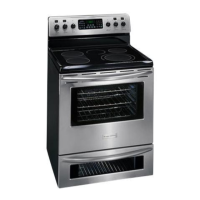
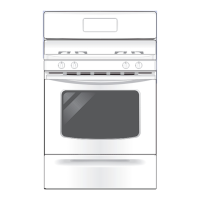
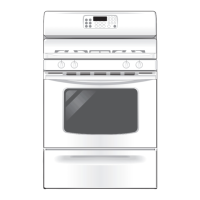
Gas Ranges with ES 330/335/340/345/355 Electronic Oven Controls (some models with Cooktop Lockout)

 Need help?
 General

 To Next Page