21
SOLUTIONS TO COMMON PROBLEMS
Many washing problems involve poor soil and stain removal, residues of lint and scum, and fabric dam-
age. For satisfactory washing results, follow these suggestions provided by The Soap and Detergent
Association.
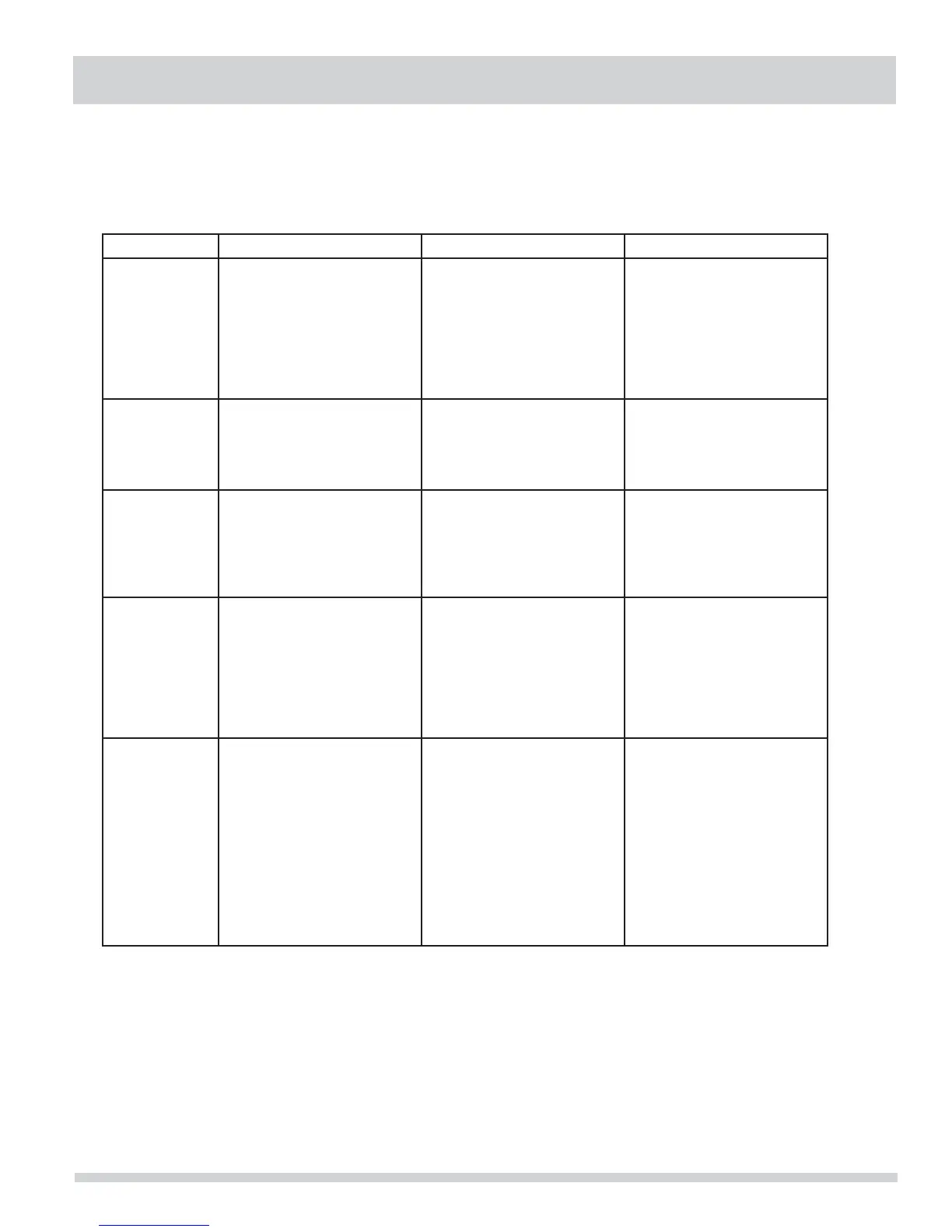
PROBLEM POSSIBLE CAUSES SOLUTIONS PREVENTIVE MEASURES
Blue stains Undiluted liquid detergent •
or fabric softener dispensed
directly onto fabric.
If caused by detergent, •
mix 1 cup (240 ml) white
vinegar with 1 quart (.95 L)
water in a plastic container.
Soak item 1 hour. Rinse.
If caused by fabric softener, •
rub stains with bar soap.
Wash.
Avoid overfilling detergent •
and fabric softener compart-
ments of dispenser.
Discoloration,
graying
Not enough detergent. •
Wash water temperature •
too low.
Incorrect sorting.•
Rewash with correct amount •
of detergent and hottest
water safe for fabric.
Add bleach safe for fabric.•
Sort items by soil level and •
color.
Use correct amount of de-•
tergent, hottest water and
bleach safe for fabric.
Greasy, oily
stains
Not enough detergent.•
Undiluted liquid fabric •
softener poured directly on
fabric.
Treat with prewash stain •
remover or liquid detergent.
Increase detergent and wa-•
ter temperature. Rewash.
Rub fabric softener stains •
with bar soap.
Use correct amount of •
detergent and hottest water
safe for fabric.
Do not pour liquid fabric •
softener directly on fabric.
See Operating Your, step 5.
Holes, tears, or
snags
Incorrect use of chlorine •
bleach.
Unfastened zippers, hooks, •
buckles.
Rips, tears and broken •
threads.
Overloading the washer.•
Degradation of fabric.•
May be irreversible if rips, •
tears and seams cannot be
mended.
Never pour chlorine bleach •
directly on fabric.
Check condition of items •
before washing. See Operat-
ing Your, steps 2 and 5.
Lint Incorrect sorting.•
Tissues left in pocket.•
Overloading the washer.•
Not enough detergent.•
Undissolved detergent has •
left a residue resembling
lint.
Static cling is attracting lint.•
Load washed too long.•
Reduce load size. Rewash •
using correct water tem-
perature, water level, and
amount of detergent.
Add nonprecipitating water •
conditioner to wash water to
remove detergent residue.
Add liquid fabric softener to •
final rinse.
Dry load in dryer.•
Remove lint with lint brush •
or roller.
See Operating Your, steps 1 •
and 2.
Do not overload washer.•
Use correct temperature •
and amount of detergent,
water and wash time.
Common Washing Problems




 To Next Page