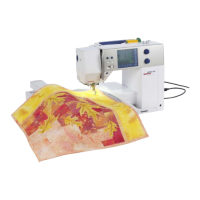
This document is a service manual for the BERNINA model 1230 sewing machine, providing detailed information for technical maintenance, diagnosis, and adjustment.
Function Description:
The BERNINA 1230 is an electronic sewing machine with its core electronics distributed across three main printed circuit boards: the L-4200 power print, the S-1230 control print, and the A-1230 display print. These components manage various functions, including motor control, power supply, stitch pattern selection, and display.
The L-4200 power print, located above the motor at the rear of the machine, handles motor control and power supply. It operates the main DC motor with pulse-width modulated speed control, with the closed-loop control circuit for the motor located on the small R-4200 print, which is part of the L-4200. This print also generates DC voltages for the step motors (30V), logic circuitry (5V for S-1230 and A-1230 prints), sewing light (6V), and bobbin winder motor (30V). Overload protection is provided by fuses F150, F151, and F152.
The A-1230 display print is mounted directly behind the operating control panel. It features the display and control elements, which are soldered onto an L-shaped printed circuit. A time multiplex control connects the numerous LEDs and control elements to the S-1230 control print using only 16 connection lines. The display shows utility stitch information, needle positions, presser foot status, buttonhole details, and bar graphs for stitch width and length.
The S-1230 control print, located behind the A-1230 print, houses the complete sewing machine control, including the microcomputer and power drive for the step motors. A notable feature is the microcomputer's control over the bobbin winder motor speed, which can be adjusted via the foot control. The S220 service switch on this print offers two positions: normal sewing operation and service position. In service mode, specific buttons and diodes on the display panel are reassigned for adjustment and testing. The microcomputer converts the analog signal from the foot control into a digital signal for the R-4200 print, which then controls motor speed. When the foot control is released, the motor is rapidly braked by the microcomputer via the R-4200 print. Signal transfer between the S-1230 and R-4200 prints is achieved through a 4-pole cable with an opto-coupler for electrical isolation, ensuring safety from dangerous voltage levels. Upon startup, step motors are calibrated to a defined zero position by a microcomputer command, enabling the selection and sewing of any stitch program.
Important Technical Specifications:
- Stitch Length: Max. forward 5 mm, max. reverse 5 mm. Increments: 0-1 mm (0.05 mm), 1-3 mm (0.1 mm), 3-5 mm (0.2 mm).
- Stitch Width: Max. 5.5 mm. Increment: 0.1 mm.
- Needle System: 130/705 H. Adjusting needle: 130/705 H/TCN.
- Hook System: BERNINA CB (Central bobbin).
- Lowest Point of Needle Bar: 0 degree.
- Presser Foot Height: 7.5 mm.
- Darning Foot Height: 0.5 mm.
- Automatic Long Stitch: 10 mm/2:1.
- Basting Device: 30 mm/6:1.
- Working Space: 105 x 195 mm.
- Overall Dimensions: Length 375 mm, Width 184 mm, Height 350 mm.
- Motor: 90 W.
- Stitches per Minute: Min.-max. 120-1050/min (reduced min.-max. 120-600/min).
- Sewing Light: 2x 6V/4W bulbs.
- Weight: 10.5 kg.
- Memory Capacity: 50 units (retained after power interruption).
Usage Features:
The BERNINA 1230 offers a wide range of features for diverse sewing needs:
- Needle Positions: 5.
- Light Beam: For enhanced visibility.
- Adjustable Stitches: Zig-zag and stitch length are freely adjustable.
- Automatic Adjustments: Basic automatic adjustments.
- Displays: Basic marking blinker, LED display for presser foot.
- Needle Stops: Upper and lower needle stops (general).
- Needle Positioning: Upper/lower with foot pedal.
- Reverse Sewing: Permanent reverse sewing.
- Pattern Start: Initiates stitch patterns.
- Buttonholes: Fully automatic, 3-step, and keyhole buttonholes.
- Special Stitches: Automatic long stitch, basting device.
- Feed Balance: For forward and reverse feed.
- Clear Switch: Resets settings.
- Pattern Control: Single pattern, mirror image, stitch pattern extended, stitch density remains constant.
- Limiter: 2 needle limiter.
- Memory: Stores 50 units.
- Stitch Programs: 7 practical stitches without reverse motion, 5 practical stitches with reverse motion, 12 decorative stitches with reverse motion, 32 number of stitch patterns.
- LED Control: For programmed patterns.
- Manual Stitch Size Adjustment: Memorized.
- Switches: Main switch, separate light switch.
- Speed Control: Using the foot control.
- Character Input: Letters A-Z, Numbers 0-9, Characters 4 (?), for programming.
Maintenance Features:
The service manual outlines diagnostic and adjustment procedures for various components:
- Service Programme: The model 1230 includes a service program for testing and adjustment tasks, accessible via the S220 service switch on the S-1230 print.
- Safety Warnings: Emphasizes waiting 30 seconds after unplugging the machine before touching the L-4200 print due to dangerous voltage levels from capacitors. Work on L-4200, main motor, and cable drum should only be done with the mains plug withdrawn.
- Test Adaptor L-4200: Used to check power supply for electrical parts connected to L-4200 and main motor control. LEDs indicate correct voltage levels for step motors, logic circuit, and sewing light.
- Power Supply 4200: An external power supply unit for mechanical adjustments when the L-4200 print needs to be removed. It provides low voltage for logic, step motors, and sewing light, and 30V for the main motor.
- Test Panel 1230: A dedicated panel for diagnosing various functions, including Hall sensors, step motor positions, and foot control signals.
- Diagnostic Instructions: A comprehensive table mapping faults to possible causes and repair instructions, covering components like the L-4200 print, R-4200 print, S-1230 print, A-1230 print, foot control, step motors, and sensors.
- Specific Tests:
- Test A (L-4200): Checks power supply and motor rotation.
- Test B (L-4200/R-4200): Checks drive signal and motor rotation.
- Test C (S-1230/L-4200): Checks cable connections for continuity.
- Test D (Mains Cord): Checks mains cord continuity.
- Test E (S-1230/Foot Control): Checks foot control unit connection.
- Test F (P-4200): Checks needle position (lowest position) and handwheel rotation.
- Test G (Light Holder): Checks sewing light function.
- Test H1 (Step Motors): Checks step motor rotation and Hall sensors.
- Test H2 (Hall Sensors): Checks Hall sensor positions for stitch length and width.
- Test I (Step Motors Pinning Position): Checks step motor activation to pinning position.
- Test K (Foot Control Unit): Checks foot control resistance readings.
- Test L (Foot Control Digital/Analog): Checks digital/analog LEDs for foot control.
- Test M (A-1230/S-1230/L-4200): Checks display panel, step motors, and motor run.
- Test N (Ret-Button): Checks reverse button illumination.
- Test O (Forward/Reverse Feed Equalization): Adjusts feed balance using stitch programs 28 or 32.
- Test P1, P2 (Buttonhole): Tests and adjusts buttonholer potentiometer and sewing of buttonholes.
- Test Q (Sewing-off): Checks stitch length, width, needle position (L.C.R.), and automatic long stitch.
- Component Replacement: Instructions for replacing prints (S-1230, A-1230, R-print), buttonhole foot, and other faulty parts.
- Adjustments: Procedures for adjusting buttonhole sensors, forward/reverse feed equalization, and step motor zero positions.
- Function Tests Electronic: Checks bobbin winder, sewing light, main motor speed, reverse button, basting device, automatic buttonholer, stitch 1, rotary encoder, electrical transport equalization, and all function/stitch selection buttons.

 Need help?
 General

 To Next Page