Section 2 Functional Description
10 FT702LT Flat Front Wind Sensor Manual
2.2 Wind Speed Calibration
All FT702LT wind sensors are built and then calibrated in the same wind tunnel before dispatch. There is no
need to recalibrate a sensor over its lifetime as the sensor has no moving parts and so no measurement
degradation will occur. The sensor’s compact strong monolithic shape is designed to prevent accidental
transducer movement or damage. FT Technologies’ calibration procedure and wind tunnel are designed to give
a calibration profile that is within the accuracy limits set in the product technical specification (see section 2.1).
Every 3 months the accuracy of FT’s wind tunnel is compared with the accuracy of an independent wind tunnel
to ensure that no drift has occurred.
However, in exceptional circumstances users may wish to apply additional calibration factors. Version 22 sensors
and above therefore have an option to set a User Calibration Table, which can modify the wind sensor’s wind
speed output (see section 6.4.19).
The User Calibration Table can be programmed with up to 64 correction factors which are maintained in non-
volatile memory. When enabled, the uncorrected wind speed output is adjusted according to the stored User
Calibration Table records using linear interpolation. The adjustments are applied to wind speed readings
regardless of wind direction.
2.3 Wind Speed and Direction Filtering
It is important that the system does not rely exclusively on a single wind reading for any control decision. A
single reading may be inaccurate due to measurement error, turbulence, corruption or interference. It is
recommended that an average of wind readings is used. In addition if 100% data availability is required then a
second FT sensor or wind sensor should be fitted.
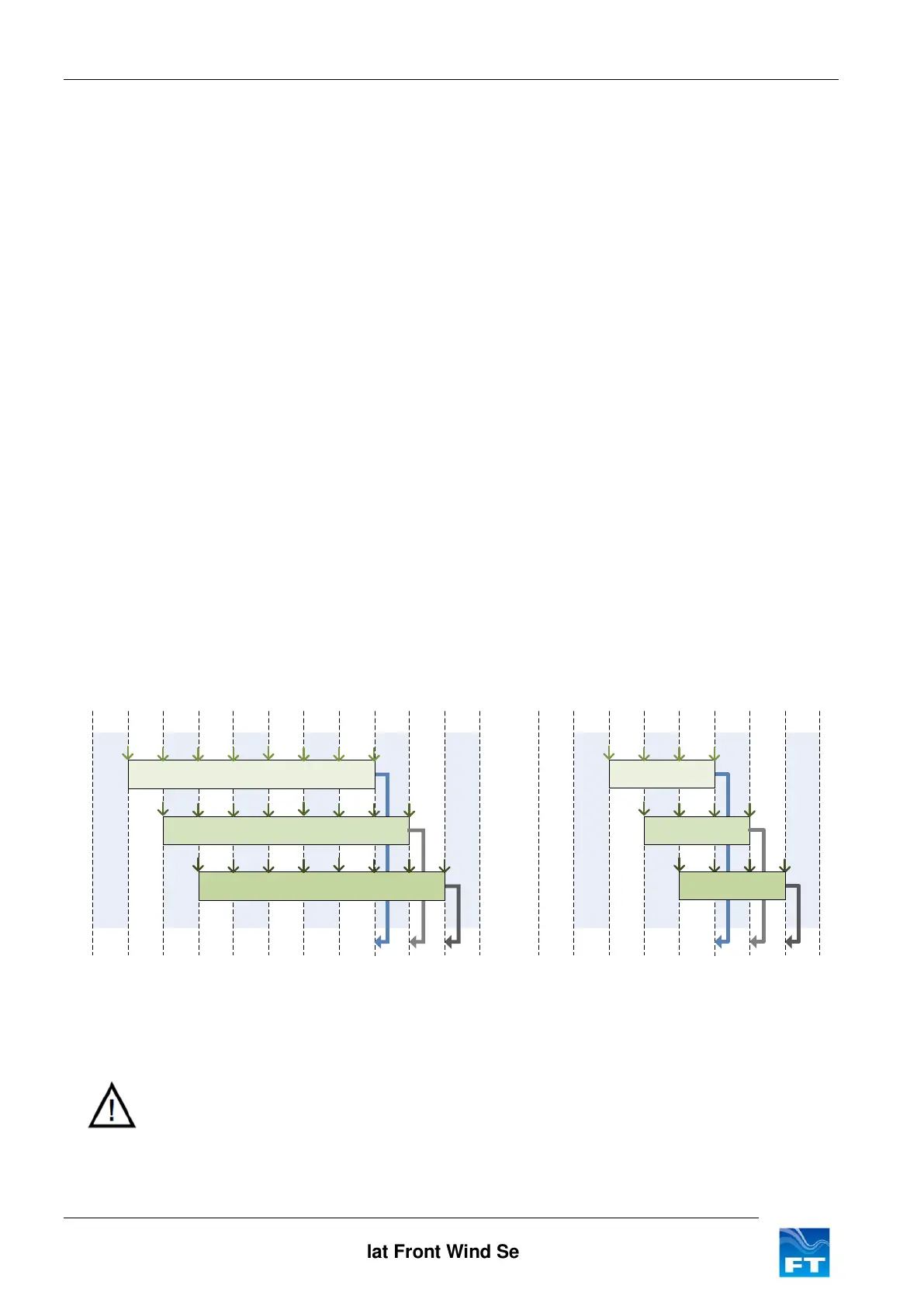
The FT702LT has optional internal filtering available. This is a digital finite impulse response (FIR) filter, which
works by calculating the moving average of a fixed number of previous readings. If filtering is being applied
externally, the sensor’s output filters can be disabled. If filtering inside the sensor is preferred, the length of the
averaging for both wind speed and direction can be independently set (See Sections 6.4.8 & 6.4.9).
First Reading
Second Reading
Third Reading
Forth Reading
-1
-2
-3
-4
-5
-6
-7
-8
Previous Readings
0.0 0.2 0.4 0.6-0.2-0.4-0.6-0.8-1.0-1.2-1.4-1.6
Time (s)
= Sum of 8 Readings /8
= Sum of 8 Readings /8
= Sum of 8 Readings / 8
First Reading
Second Reading
Third Reading
Forth Reading
-1
-2
-3
-4
-5
Previous Readings
0.0 0.2 0.4 0.6-0.2-0.4-0.6-0.8-1.0
Time (s)
= Sum of 4 Readings /4
= Sum of 4 Readings / 4
= Sum of 4 Readings /4
Filter length 0008 Filter length 0004
Figure 3: Examples of FIR Filtering
Always use an average of several readings for any calculations or control decisions because
single readings can accidentally become corrupted.



 To Next Page