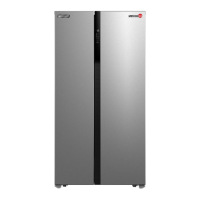
This document provides user instructions for the FUJIDENZO No-Frost Refrigerator Freezer, model INR-82S. It covers safety information, an overview of the appliance, installation procedures, and daily use guidelines, including maintenance features.
Function Description
The FUJIDENZO INR-82S is a no-frost refrigerator freezer designed for household and similar applications. It features separate compartments for refrigeration and freezing, each with its own temperature control. The no-frost technology helps prevent ice buildup, reducing the need for manual defrosting. The appliance uses isobutane (R600a) as a refrigerant, a natural gas known for its environmental compatibility. It is designed to store fresh and frozen food items, maintaining optimal temperatures to preserve their quality and extend their shelf life. The refrigerator is equipped with magnetic door seals to ensure a tight closure, contributing to energy efficiency.
Usage Features
The refrigerator freezer offers several features for convenient daily use:
- Temperature Control: The appliance has independent temperature control knobs for both the freezer and fridge compartments. The freezer compartment offers three settings: COLD, COLDER, and COLDEST. The fridge compartment provides four settings: OFF, COLD, COLDER, and COLDEST, where COLD is the warmest and COLDEST is the coldest. The OFF setting for the fridge compartment also turns off the freezer compartment. These controls allow users to adjust the internal temperature according to their needs and ambient conditions.
- Storage Compartments: The appliance includes shelves in both the freezer and fridge compartments, a chiller box, and crisper drawers. The shelves in the fridge compartment are movable, allowing users to adjust their height to accommodate items of various sizes. The door balconies are also adjustable, providing flexible storage options for different food packages.
- Crisper Humidity Control: The crisper drawer features a regulator to control humidity levels, with settings for "Low humidity" (regulator to the left) and "High humidity" (regulator to the right), optimizing conditions for storing fruits and vegetables.
- Freezing Fresh Food: The freezer compartment is suitable for freezing fresh food. Users are advised to place fresh food in the bottom compartment for freezing. The maximum freezing capacity within 24 hours is specified on the rating plate. It is recommended to freeze food in small portions, wrap them in aluminum foil or polythene, and ensure packages are airtight.
- Storing Frozen Food: For optimal performance, commercially frozen foodstuffs should be adequately stored by the retailer and transferred to the freezer as quickly as possible. Once defrosted, food should not be refrozen.
- Thawing Food: Deep-frozen or frozen food can be thawed in the fridge compartment or at room temperature. Small pieces can also be cooked directly from frozen, though this may require longer cooking times.
- Energy Saving Tips: To minimize energy consumption, users are advised not to place hot food in the appliance, avoid packing food too closely, ensure food does not touch the back of compartments, keep doors closed when electricity is off, avoid frequent or prolonged door openings, and not set the thermostat to excessively cold temperatures. Removing accessories like drawers can also increase storage volume and reduce energy consumption.
Maintenance Features
Regular maintenance is crucial for the appliance's longevity and hygienic operation:
- Cleaning the Interior: Before first use and regularly thereafter, the interior and all internal accessories should be washed with lukewarm water and a neutral soap. Abrasive powders or detergents should not be used as they can damage the finish.
- Cleaning Procedure: Before cleaning, the appliance must be disconnected from the mains power supply by unplugging it or switching off the circuit breaker/fuse. Steam cleaners should not be used. The appliance and its interior accessories should be cleaned with a cloth and lukewarm water, then wiped dry with fresh water. It must be completely dry before being reconnected to power.
- Drain Examination: The drain in the refrigerator for defrosted water should be regularly examined and cleaned to prevent blockages, which could lead to water collecting at the bottom of the appliance.
- Frost Removal: Sharp objects should not be used to remove frost. A plastic scraper is recommended for this purpose.
- Door Seal Maintenance: If heavy frost builds up on the door seal, it may indicate that the seal is not airtight. Users can carefully warm the leaking sections of the door seal with a hair dryer (on a cool setting) and manually shape it to ensure it sits correctly.
- Ventilation: It is important to keep ventilation openings clear of obstruction to prevent overheating and ensure efficient operation.
- Installation and Leveling: Proper installation, including ensuring adequate air circulation around the appliance and leveling the unit using the adjustable feet, contributes to optimal performance and prevents issues like improper door sealing.
- Troubleshooting: The manual provides a troubleshooting guide for common issues, such as the appliance not working, freezing too much, or not freezing enough. It offers solutions like checking the mains plug, fuse, temperature settings, and door seal. For persistent malfunctions, users are advised to contact a certified service center.
- Disposal: When discarding the appliance, users must disconnect the mains plug, cut the connection cable, and remove the door to prevent children from getting trapped. The appliance should be disposed of according to local regulations, as it contains flammable gases in its insulation foam and recyclable materials.

 Need help?
 General

 To Next Page