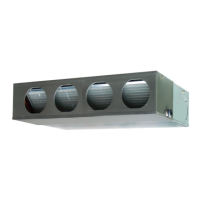
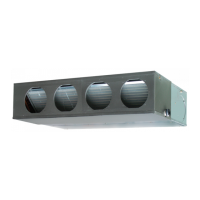
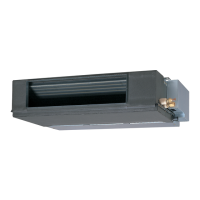
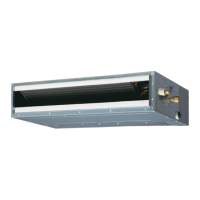
This document describes the AIRSTAGE VRF Indoor Unit, specifically the Duct Type models ARXA24L, ARXA30L, ARXA36L, ARXA45L, ARXB24L, ARXB30L, ARXB36L, ARXB45L, ARXC36L, ARXC45L, ARXC60L, ARXC72L, and ARXC90L. It serves as an operating manual, providing details on installation, operation, maintenance, and troubleshooting.
Function Description
The AIRSTAGE VRF Indoor Unit is a duct-type air conditioning system designed for various indoor environments. It operates as part of a Variable Refrigerant Flow (VRF) system, allowing for precise temperature control and energy efficiency. The unit can perform both cooling and heating functions, adapting to different seasonal requirements. It features automatic operation modes that adjust settings based on ambient conditions and user preferences. The system can be controlled via wireless remote, wired remote, or a simple remote controller, offering flexibility in management.
Important Technical Specifications
The manual provides detailed specifications for each model, including:
- Power Source: All models operate on 230 V - 50 Hz, with an available voltage range of 198 to 264 V.
- Cooling Capacity:
- ARXA24L: 7.10 kW
- ARXA30L: 9.00 kW
- ARXA36L: 11.2 kW
- ARXA45L: 12.5 kW
- ARXB24L: 7.10 kW
- ARXB30L: 9.00 kW
- ARXB36L: 11.2 kW
- ARXB45L: 12.5 kW
- ARXC36L: 11.2 kW
- ARXC45L: 12.5 kW
- ARXC60L: 18.0 kW
- ARXC72L: 22.4 kW
- ARXC90L: 25.0 kW
- Heating Capacity:
- ARXA24L: 8.00 kW
- ARXA30L: 10.0 kW
- ARXA36L: 12.5 kW
- ARXA45L: 14.0 kW
- ARXB24L: 8.00 kW
- ARXB30L: 10.0 kW
- ARXB36L: 12.5 kW
- ARXB45L: 14.0 kW
- ARXC36L: 12.5 kW
- ARXC45L: 14.0 kW
- ARXC60L: 20.0 kW
- ARXC72L: 25.0 kW
- ARXC90L: 28.0 kW
- Sound Pressure Level (dB(A)): Measured at high, medium, and low fan speeds.
- ARXA/B models: High (38-40), Medium (36-38), Low (34-39).
- ARXC models: High (49-53), Medium (45-51), Low (32-49).
- Dimensions and Weight:
- ARXA/B models: Height (270 mm), Width (1,135 mm), Depth (700 mm), Weight (43-45 kg).
- ARXC models: Height (400-450 mm), Width (1,050-1,550 mm), Depth (500-700 mm), Weight (45-82 kg).
- Standard Static Pressure:
- ARXA/B models: 100 Pa.
- ARXC36/45/60: 100 Pa.
- ARXC70/90: 150-250 Pa.
- Acoustic Noise Information: The maximum sound pressure level is less than 70 dB (A) for both indoor unit and outdoor unit.
Usage Features
- Automatic Operation: The unit can be set to "AUTO" mode, where it automatically selects between cooling and heating based on the room temperature. The fan speed is also automatically adjusted.
- Operating Tips:
- Priority State: The system allows for setting priority states for cooling/heating or dehumidification when multiple indoor units are connected.
- Standby State: When the unit is in standby, the OPERATION indicator lamp (green) and TIMER indicator lamp (orange) flash to indicate the state.
- Low Ambient Cooling: The fan speed drops when the outdoor temperature is low to prevent freezing.
- Heating Performance: The unit optimizes heating performance by monitoring outdoor air temperature and transferring heat indoors. It also features a microcomputer-controlled automatic defrosting function to prevent frost buildup on the outdoor unit.
- Oil Recovery Operation: Periodically, the system performs an oil recovery operation to return compressor oil to the outdoor unit.
- Temperature and Humidity Range: The unit operates within specified outdoor and indoor temperature and humidity ranges for optimal performance.
- Outdoor Temperature: 18 to 32 °C (cooling/dehumidification), 16 to 30 °C (heating).
- Indoor Temperature: 18 to 32 °C (cooling/dehumidification), 16 to 30 °C (heating).
- Indoor Humidity: 80% or less.
- Safety Precautions: The manual emphasizes critical safety warnings, including:
- Always disconnect power before cleaning or maintenance.
- Do not stand on unstable platforms.
- Avoid touching heat exchangers.
- Do not use water hotter than 40 °C, harsh abrasive cleansers, or volatile agents for cleaning.
- Regularly clean air filters to prevent dust accumulation and maintain efficiency.
- Do not insert fingers or objects into the air inlet or outlet.
- Do not stop the air conditioner by disconnecting the power supply cord.
- Ensure proper grounding and professional installation.
- Do not use flammable gases near the unit.
Maintenance Features
- Cleaning the Air Filter:
- The air filter should be cleaned regularly to maintain optimal performance.
- To clean, remove dust with a vacuum cleaner or by washing. After washing, dry thoroughly in a shady place before reinstallation.
- Extended Period of Non-Use: If the unit will not be used for an extended period, turn off the breaker at least 12 hours before stopping operation. This allows the unit to dry out and prevent mold or odors.
- Professional Servicing: For any issues that cannot be resolved through basic troubleshooting, it is recommended to contact authorized service personnel.
Troubleshooting
The manual includes a comprehensive troubleshooting guide for common issues, such as:
- Unit Does Not Operate Immediately: This could be due to power outages, circuit breaker trips, or the unit being in standby mode.
- Airflow is Weak or Stops: Possible causes include high outdoor temperature during cooling, low outdoor temperature during heating, or oil recovery operation.
- Flashing Lamps: Different flashing patterns of the OPERATION and TIMER indicator lamps indicate various operational states or errors, such as defrosting, power recovery, or standby.
- Noise: Unusual sounds can indicate water flowing inside the unit, fan operation, or expansion/contraction of parts due to temperature changes.
- Smells: Odors can be caused by furniture, tobacco, or other substances absorbed by the indoor unit.
- Fog/Steam from Indoor Unit: This can occur during cooling in humid conditions or during defrosting.
- Water from Outdoor Unit: This is normal during defrosting.
- Temperature Not Decreasing/Increasing: This could be due to incorrect thermostat settings, dirty air filters, blocked air inlets/outlets, open windows/doors, or too many people in the room.
The manual advises users to check simple solutions first and then contact service personnel if problems persist. It also provides a table of symptoms, possible causes, and corresponding page references for more detailed information.

 Need help?
 General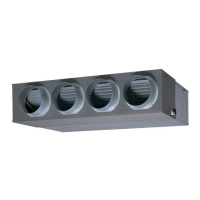


 To Next Page