20
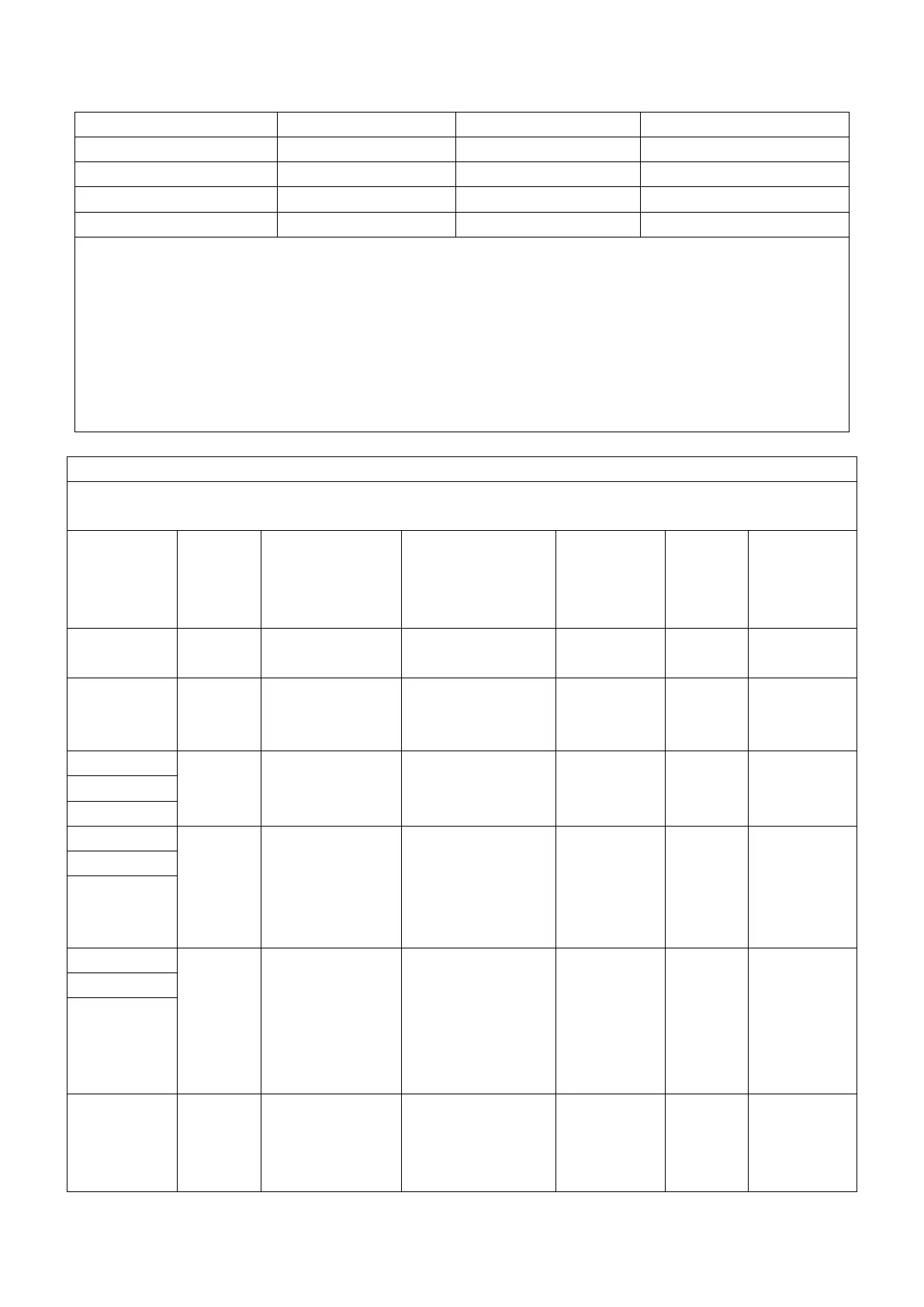
0.01 0.12 0.12 0.23
0.1 0.38 0.38 0.73
1 1.2 1.2 2.3
10 3.8 3.8 7.3
For transmitters rated at a maximum output power not listed above, the recommended separation
distance d in meters (m) can be estimated using the equation applicable to the frequency of the
transmitter, where P is the maximum output power rating of the transmitter in watts (W) according to
the transmitter manufacturer.
NOTE 1 At 80 MHz and 800 MHz, the separation distance for the higher frequency range applies.
NOTE 2 These guidelines may not apply in all situations. Electromagnetic propagation is affected by
absorption and reflection from structures, objects and people.
Guidance and manufacturer’s declaration - electromagnetic immunity
The device is intended for use in the electromagnetic environment specified below. The customer or
the user of the device should assure that it is used in such an environment.
Test
frequency
(MHz)
Band
a)
(MHz)
Service
a)
Modulation
a)
Maximum
power (w)
Distance
(m)
TEST
LEVEL
385
380-390
TETRA 400
b)
1.8
0.3
27
450
430-470
GMRS 460,
FRS 460
FM
c)
±5 kHz deviation
2
0.3
28
704-787
LTE Band 13,
17
Pulse Modulation
b)
217 Hz
0.2
0.3
9
810
800-960
GSM 800/900,
TETRA 800,
iDEN 820,
CDMA 850,
LTE Band 5
Pulse Modulation
b)
18 Hz
2
0.3
28
870
930
1700-
1990
GSM 1800;
CDMA 1900;
GSM 1900;
DECT;
LTE Band 1,3
Pulse Modulation
b)
217 Hz
2
0.3
28
1970
2450
2400-
2570
WLAN
802.11 b/g/n,
RFID 2450,
Pulse Modulation
b)
217 Hz
2
0.3
28


 To Next Page