
 Need help?
Do you have a question about the GAC EEG6500 and is the answer not in the manual?
Overview of the EEG6500 digital governor for engine speed regulation.
Technical performance metrics including isochronous operation and speed range.
Operating environmental conditions like temperature and humidity.
Electrical inputs and outputs for power, sensors, and actuators.
Physical dimensions and weight of the governor unit.
Reliability data including vibration, shock, and testing standards.
Regulatory compliance and communication standards (CE, J1939).
Important wiring notes and recommendations, including loss of magnetic pickup.
Details on trim and variable speed functions using resistive or voltage input.
Parameters to set before starting the engine for optimal performance.
Procedure for adjusting Gain for stable rated and idle speeds.
List of advanced parameters that can be configured by the user.
List of advanced parameters that are read-only and for diagnostic use.
Information regarding J1939 CAN communication and engine speed data.
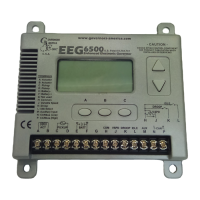
The EEG6500 Enhanced Electronic Governor is a digital governor designed to regulate engine speed in diesel and gaseous-fueled engines. It serves as a suitable replacement for mechanical governor systems requiring flexibility, precision, or accurate control of governed speed. The EEG6500 is specifically designed for industrial engine applications, including generator sets, mechanical drives, pumps, and compressors.
The EEG6500's primary function is to maintain precise engine speed. It offers both isochronous operation (maintaining a constant speed regardless of load) and droop governing (allowing speed to decrease slightly with increasing load), as well as variable speed control. The device integrates built-in fault protection with overcurrent sensing to safeguard the system. It also features an adjustable starting fuel strategy to reduce black smoke during startup and an extended speed range up to 12 KHz or 6000 RPM with frequency display. Speed ramping is supported for smooth transitions between idle, rated, or any other speed setting. For advanced applications, it includes a standard GAC AUX input for synchronizing and load sharing, J1939 engine data and speed output, and overspeed sensing and protection.
The EEG6500 features an improved and simplified LCD user interface, allowing for fast setup with 5 push buttons and no potentiometers. This eliminates the need for a computer or internet connection when used with GAC's Quikset Display. Users can select between rated, idle, and variable speed settings, and choose between isochronous, droop, and variable governing modes. The system also supports speed ramping from idle to rated or any other speed setting.
The Quikset Menu provides access to various adjustable parameters such as OVER SPEED, #TEETH (number of teeth on the flywheel), CRANK (crank termination RPM), SPEED (fixed or droop operating speed), SPEED RAMP, V.SPEED (variable speed or trim), START FUEL (initial actuator position at cranking), DROOP%, LOCKED (manual/auto locking of display), FUEL RAMP, GAIN (proportional set point of PID control), IDLE (engine speed when idle input is closed), STABILITY (integral set point of PID control), FUEL LIM (maximum actuator percentage allowed), and DEADTIME (derivative set point of PID control).
The device includes a "Lock Feature" to prevent unauthorized changes to parameters. It also offers "OEM Save Settings" to copy current settings to a separate configuration area for later restoration, and "OEM Restore" to load these saved settings.
The manual provides comprehensive troubleshooting guides for system inoperative conditions, instability (fast periodic, slow periodic, non-periodic), engine overspeeds, and situations where the actuator does not energize fully or the engine remains below desired governed speed. It includes electrical checks for battery supply voltage, speed sensor signal, and actuator output, along with probable causes and customer actions for various fault codes.
The EEG6500 also logs fault codes, including actuator overcurrent, loss of speed signal, overspeed, variable speed settings reversed, no potentiometer/signal detected, new/incompatible software loaded, and FLCU/NLCU setting invalid. These codes aid in diagnosing and resolving issues. The device's design, with vertical mounting preferred, facilitates the draining of fluids in moist environments, contributing to its longevity. Regular checks of actuator wiring, speed pickup, fuel system, and potentiometer wiring are recommended for maintenance.
 General
| Brand | GAC |
|---|---|
| Model | EEG6500 |
| Category | Controller |
| Language | English |

 To Next Page