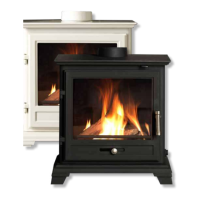
This document serves as an installation and operating manual for "The Gallery Collection" stoves, specifically the Firefox 8 ECO and Classic 8 ECO models. These appliances are CE approved and conform to EN13240:2001 and EN13240 A2:2004 standards. They are designed for intermittent use and should not be operated overnight.
Function Description:
The stoves are designed for burning solid mineral fuel, including wood logs and approved smokeless fuels, to provide heating. They feature primary and secondary air controls to regulate combustion and efficiency, as well as a riddling mechanism for de-ashing. A tertiary air supply is also incorporated to aid in clean burning by igniting unburned gases.
Important Technical Specifications:
The manual provides detailed dimensions for both the Firefox 8 ECO and Classic 8 ECO models, including width, depth, and height measurements.
For the Firefox 8 ECO:
- Width: 516mm
- Depth: 361mm
- Height: 699mm (top flue)
- Flue collar diameter: 125mm
For the Classic 8 ECO:
- Width: 530mm
- Depth: 334mm
- Height: 655mm (top flue)
- Flue collar diameter: 125mm
Both models share the following performance specifications:
- Rated Output: 5.0kW
- Output Range: 2.5-8.0kW
- Energy Class: A+
- Energy Efficiency Index: 112.0%
- Energy Efficiency at Nominal Heat Output: 84.0%
When burning wood:
- Efficiency: 84%
- Flue Gas Temperature: 244°C
- Emission of CO @ 13% O2: 0.11%
When burning anthracite:
- Efficiency: 71.5%
- Flue Gas Temperature: 280°C
- Emission of CO @ 13% O2: 0.24%
Installation Requirements:
- Installation must be carried out by a competent person and comply with BS8303, National Building Regulations, local by-laws, and the Health and Safety at Work Act.
- The stove must have its own chimney and not share with another appliance.
- A carbon monoxide (CO) alarm is essential and required by Building Regulations to be installed in the same room as the stove.
- The chimney must be in good condition, dry, free from cracks, leaks, and obstructions. Flue diameter should be between 150mm and 230mm. A 125mm flue liner may be used.
- A flue draught of minimum 12 Pascals is required. If it exceeds 25Pa, a draught stabiliser may be needed.
- Clearances to combustible materials: 600mm to the rear and 600mm to the sides.
- The stove can be recessed into a non-combustible fireplace, but a permanent free air gap of at least 100mm should be left around the sides and top.
- Less clearance (down to 50mm) is possible if the non-combustible material around it is at least 150mm thick, typically achieved with double-thickness chimney breast walls.
- Hearths: An apron of at least 225mm at the front and 150mm on either side is required. A light duty hearth can be placed on a wooden floor if minimum clearance distances to combustible materials are adhered to.
- Ventilation:
- For 2.5kW-5kW output without a flue draft stabiliser: No additional permanent ventilation for houses built before 2008. Houses built after 2008 require at least 4400mm² permanent ventilation direct to outside.
- For 5kW-8kW output without a flue draft stabiliser: A permanently open air vent is required. For houses built before 2008, 1650mm² free area. For houses built after 2008, 4400mm² free area.
- For 2.5kW-5kW output with a flue draft stabiliser: At least 1500mm² additional permanent ventilation direct to outside for houses built before 2008. For houses built after 2008, 6800mm² free area.
- For 5kW-8kW output with a flue draft stabiliser: At least 4050mm² permanent ventilation direct to outside for houses built before 2008. For houses built after 2008, 6800mm² free area.
- The stove can be configured for top or rear flue connection. The blanking plate and collar can be swapped.
Usage Features:
- Air Controls:
- Primary Air (Slide Control): Located at the bottom of the door. Slide right to open, left to close. Open for starting a fire and regulating anthracite fires. Close for established wood fires for best efficiency.
- Secondary Air (Slide Vent): Located above the door, functions as an 'airwash' to keep the glass clean and aids secondary combustion. Slide right to open, left to close. Use to control wood fires. Close for best efficiency when burning anthracite.
- Tertiary Air: Permanently open supply from the rear panel, ignites unburned gases for a clean burn.
- Lighting the Stove:
- Perform three or four small fires initially to cure the paint and "temper" the cast iron. Unpleasant smell may occur; ensure ventilation.
- Load with paper, dry kindling, and/or firelighters. Light at the base with all air controls fully open.
- Gradually build the fire. Once established, restrict primary air.
- For wood, primary air can be fully closed. For solid fuel, some primary air is needed.
- Maximum efficiency is achieved with a bright fire, minimum air inlet, and stove thermometer in the "Best Burn" range.
- Wood Burning:
- Burn on a bed of ash. Remove surplus ash occasionally.
- Use only kiln-dried or well-seasoned wood (less than 18% moisture content). Wet wood causes tar deposits and reduces heat output.
- Load 1kg of dry wood per 45 minutes with primary air fully closed and secondary air half to two-thirds closed for 5kW output. Do not exceed 2kg per 45 minutes for outputs above 5kW.
- Logs up to 300mm (12") long.
- Other Solid Fuel Burning (Anthracite/Approved Smokeless Fuels):
- Clean ash pan before refuelling. Do not let ash build up to the grate bars.
- Load about 0.75kg of anthracite or equivalent per 45 minutes with primary air about halfway open and secondary air fully closed for 5kW output. Do not exceed 1.5kg per 45 minutes for outputs above 5kW.
- Ensure tertiary air holes on the rear chamber brick are not covered by fuel.
- Recommended Fuels: HETAS Ltd Appliance Approval covers wood logs and approved smokeless fuels (anthracite large nuts, Ancit, Phurnacite, Taybrite, Homefire Ovals).
- Unauthorised Fuels: DO NOT burn Wildfire, bituminous coal, Housecoal, petroleum cokes, or household waste.
- Refuelling: Do not pile fuel higher than 30 degrees from the front bar rearwards to avoid over-fuelling and excess smoke.
- Refuelling Onto a Low Fire Bed: Refuel onto glowing embers and ash. Add kindling if too few embers to prevent excessive smoke.
- Door Operation: Operate with the door closed, except for refuelling. Operating with the door open reduces efficiency and causes excess smoke.
- Dampers: Do not operate with air controls or appliance dampers left open, as this causes excess smoke.
- De-Ashing:
- Use the riddling mechanism (knob on the right side of the stove, operated with the supplied stove tool) to remove ash, especially when burning anthracite or a mix of wood and anthracite. Rotate clockwise and anti-clockwise until air reaches un-burnt fuel.
- If the mechanism is hard to move, gently agitate the fuel bed with a poker (wearing a glove).
- Empty the ash pan only when the stove is cool.
Maintenance Features:
- General Maintenance: Only perform maintenance when the stove is cold. Structural repairs must be done by a qualified installer.
- Baffle Plate Removal and Replacement:
- Note position before removal. Push upwards, bring forwards, and drop the back edge from the rear fire brick. Withdraw through the doorway.
- To replace, angle the plate with the front edge higher, lift high to locate the front edge on the steel ledge, then reposition the back edge on the rear fire brick.
- Sweeping the Chimney:
- Chimney and flue pipe must be swept at least once a year, preferably every six months. More frequent sweeping may be needed if damp wood is burnt.
- Can be swept through the stove with the baffle plate removed. Removing bricks is advisable to prevent damage.
- Inner Grate Removal and Replacement:
- Remove ash pan, detach riddling arm. Lift inner grate vertically and manoeuvre out.
- When replacing, ensure the riddling arm is re-connected.
- Outer Grate Removal and Replacement:
- Remove all bricks and the inner grate. Lift the outer grate at an angle (left higher than right) and manoeuvre out left side first.
- Stove Body:
- Clean with a soft brush when cool.
- Finish can be renovated with stove paint from your supplier.
- Glass Panels:
- Clean with stove glass cleaner when cool. DO NOT use abrasives or scrapers.
- Replace broken glass by removing four screws and clips, replacing the panel with correct stove glass, and using a new glass fibre seal.
- Seasonal Maintenance:
- If unused for long periods (e.g., summer), clean thoroughly.
- Lightly oil air slides with WD40 and leave partially open for air circulation.
- Monitor internal components for condensation or water ingress. Rectify problems and dry the stove.
- Before reuse, clean the appliance again and sweep the chimney.
Safety Notes and Troubleshooting:
- Always use a fire guard with children, the elderly, or the infirm.
- Warn all persons of high temperatures during operation, including the stove pipe.
- Do not use as an overnight burner. Leave air controls open to burn out remaining fuel.
- Use the provided glove to open the door. Never empty the ash pan when hot.
- Do Not Over-Fire: Watch for signs of over-firing (e.g., glowing red parts). Adjust controls to a safe setting. Do not leave unattended for long periods.
- Smoke and Fumes Entering the Room:
- Occasional fumes from de-ashing and refuelling are normal. Persistent fume emission with closed doors is not tolerated.
- If persistent, evacuate the room, open doors/windows, let the fire go out or dispose of fuel, check for flue blockage. Seek professional advice if needed.
- Chimney Fire: Identified by roaring sounds, dense smoke, sparks. Close all air supply, ensure door is closed, call Fire Brigade. Regular maintenance prevents chimney fires.
- Poor Heat Output: Stove may be too small for the room. Consult a heating engineer. Check for restricted chimney/flue pipe or room ventilation. Use dry, seasoned timber and good quality solid fuels.
- Dirty Glass: Nearly always caused by poor fuel quality (check wood moisture). Open air vents to create a hot fire to "burn" the glass clean. Use stove glass cleaner on cold glass.
- Un-burnt Fuel: Insufficient air reaching fuel. Adjust air controls, empty ash pan if full, de-ash if front bar/fret is blocked. Check for jammed clinker or nails in grate when cold.
Accessories:
The manual lists various accessories available from retailers, including matching graphite high-temperature paint, stove glass cleaner, spare rope and adhesive, CO detector, stove fan, stove thermometer, wood moisture meter, spare glove, permanent ventilators, purpose-built ash vacuum cleaner, ash carrier, fire screens, companion sets, log baskets, and soot box.

 Need help?

 To Next Page
 General