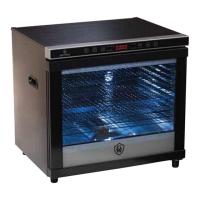
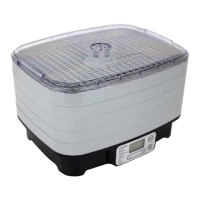
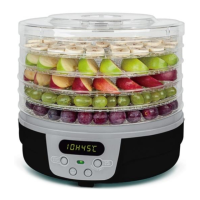
The document describes the GAME WINNER™ GW 6 Tray Dehydrator, an appliance designed for drying food.
Function Description:
The Game Winner GW 6 Tray Dehydrator is an electrical appliance used to remove moisture from food, preserving it for longer storage. It operates by circulating warm air, allowing users to dehydrate various foods such as vegetables, fruits, and meats (for jerky). The dehydration process helps to extend the shelf life of food by inhibiting the growth of bacteria, yeasts, and molds. The device offers precise control over temperature and drying time, making it suitable for a wide range of food items with varying moisture content and thickness.
Important Technical Specifications:
- Model: GW 6 Tray Dehydrator
- Number of Trays: 6 Food Trays
- Temperature Range: 104°F to 158°F (40°C to 70°C)
- Power Supply: 120V AC electricity supply
- Plug Type: Polarized plug (one prong wider than the other)
- Timer: Integral digital timer for setting run duration.
- Dimensions (implied): Designed for indoor, household use, requiring at least 12 inches of space around all sides for proper ventilation.
Usage Features:
- User Control: The dehydrator provides full control over both temperature (104°F to 158°F) and drying time using its digital timer. This allows for customization based on the type, thickness, and quantity of food being dried. Lower temperatures and shorter times are recommended for thinner/smaller pieces or smaller loads, while higher temperatures and longer times are for thicker foods and larger loads.
- Tray Stacking Options: The trays can be stacked in two different ways—for "Thin Foods" or "Thick Foods." By rotating a tray 180 degrees, the stacking height can be adjusted. This flexibility accommodates various food sizes, such as banana chips (short stack) or large strawberry halves (tall stack). When properly stacked, trays lock into each other.
- Visibility of Arrows: To ensure proper airflow and drying, users are instructed to set trays so that all arrows on the tray handles are visible on the top of the handles. Improper stacking can negatively affect the drying process.
- Pre-Operation Preparation: Before first use, all trays and parts that will contact food must be washed and dried. The power unit should never be immersed in water.
- Odor Removal (First Use): During the first use, an odor may be noticed. To prevent this odor from transferring to food, the unit should be run for 20 minutes at 158°F (70°C) with one tray and the lid in place, without food, until the odor dissipates. This is only necessary for the initial use.
- Food Preparation Guidelines: The manual provides detailed guidelines for drying various vegetables, fruits, and meats (jerky), including recommended preparation methods (e.g., slicing, blanching), usual drying temperatures, and expected drying times. It also includes "dryness tests" to determine when food is properly dehydrated (e.g., brittle, leathery, crisp, no moisture).
- Placement: The dehydrator should be placed on a flat, dry, stable, and heat-resistant surface (not carpeted or flammable materials like wood tablecloths). An additional heat-resistant cooking surface (e.g., tile, Formica) at least the size of the unit or larger is recommended underneath to protect the surface from heat.
- Airflow: It is crucial to ensure at least one inch of clearance around the dehydrator for proper airflow. The ventilation holes at the bottom of the power unit and the center hole/vents on the top lid should never be covered or obstructed.
- Food Loading: Food should be spread in single layers on the trays unless otherwise specified in the guidelines.
- Troubleshooting Guide: A comprehensive troubleshooting guide helps users diagnose and resolve common issues such as "No Heat, No Fan," "Slow drying," "Uneven drying," "Overheating or insufficient heat," and "Noisy Fan/Motor." Solutions range from checking power connections and rearranging food to re-stacking trays and contacting customer service.
Maintenance Features:
- Cleaning: After each use, drying trays and the dehydrator lid should be cleaned with warm soapy water. Stubborn particles can be removed by soaking and using a plastic scrubber. Abrasive materials or solvents should not be used on plastic parts.
- Power Unit Cleaning: The power unit (base with motor and heating element) should be unplugged and wiped clean with a damp sponge or cloth. It must NEVER be immersed in water, and liquid should not flow into the electrical parts.
- Dishwasher Warning: Trays, lid, and base are NOT dishwasher safe.
- Storage: The dehydrator should be stored in a cool, dry, and dark place after all parts have been cleaned and dried. Drying trays should be stacked on the base for storage.
- Food Storage Tips: The manual provides general food storage tips, emphasizing the importance of cooling food completely before storing, keeping it in dry, cool, dark places, removing air from containers, and avoiding metal containers or those with weak seals. It also advises checking dehydrated food for moisture periodically and replacing produce annually. Dried meats, game, poultry, and fish have shorter storage recommendations (3 months in refrigerator, 1 year in freezer), with vacuum sealing suggested to extend shelf life.
- Storage Location: For optimal quality, dried food should be stored in cool, dark, and dry locations, away from direct light and strong odors (e.g., varnish, paint remover). It should not be placed directly on cement walls or floors to prevent condensation.


 To Next Page
 General