
 Need help?
Do you have a question about the Gardner Denver RDS Series and is the answer not in the manual?
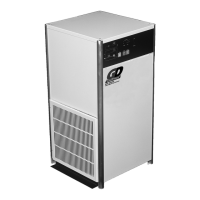
The Gardner Denver RDS Series Refrigerated Dryer is an industrial device designed for the treatment of compressed air, specifically for removing moisture. It operates on a refrigeration principle, cooling warm, moist compressed air to condense moisture, which is then collected and drained by an automatic drain valve. The dryer is available in models ranging from 50 to 1000 SCFM (Standard Cubic Feet per Minute), with both air-cooled and water-cooled configurations.
The core function of the RDS Series dryer is to reduce the temperature of compressed air, causing water vapor to condense into liquid water. This liquid condensate is then automatically removed from the system. The air circuit involves warm, wet compressed air entering an air-to-air heat exchanger, where it is pre-cooled by cool, dry air exiting the evaporator. The pre-cooled air then enters the air-to-refrigerant heat exchanger (evaporator) and is further cooled to approximately 33-35°F, leading to condensation of water vapor. The refrigerant circuit uses R-22 gas, pumped by a compressor to a condenser (air or water-cooled) where it condenses into a liquid. This liquid then passes through a metering device, causing a pressure drop and lowering its boiling point before entering the evaporator. Heat from the compressed air causes the refrigerant to boil and become a low-pressure gas, which is then returned to the compressor to restart the cycle. A liquid injection circuit may bypass a portion of the liquid refrigerant to keep the compressor cool under high load and ambient temperatures.
The dryers come in various flow capacities (50-1000 SCFM) and voltage options (115/1/60, 230/1/60, 230/3/60, 460/3/60, 380/3/50, 575/3/60). Water-cooled models are available for 150 SCFM and larger. Dimensions vary by model, with smaller units (50-250 SCFM) having a back view with specific length, width, and height measurements, and larger units (300-1000 SCFM) having different back view dimensions. For instance, a 50 SCFM unit (RDS50A-1) has a length of 17 inches, width of 16 inches, and height of 32 inches, while a 1000 SCFM unit (RDS1000A-4) has a length of 36 inches, width of 30 inches, and height of 51.6 inches. Electrical specifications include Compressor RLA (Rated Load Amps), LRA (Locked Rotor Amps), HP (Horsepower), Minimum Circuit AMPS, and Fan Motor FLA (Full Load Amps). For example, the RDS50A-1 (50 SCFM, 115/60/1) has a compressor RLA of 5.80, LRA of 28.0, HP of 0.46, Minimum Circuit AMPS of 15, and Fan Motor FLA of 0.50. Standard operating conditions are 100 PSIG inlet air pressure, 100°F inlet air temperature, and 100°F ambient air temperature. Heat rejection values range from 3300 BTU/HR for smaller units to 66000 BTU/HR for larger units. Test pressures are 190 PSIG for the low side and 400 PSIG for the high side. Refrigerant charge (R-22) varies from 16 oz for a 50 SCFM unit to 120 oz for a 1000 SCFM unit. Water-cooled units have specific GPM (Gallons Per Minute) requirements at different inlet water temperatures (75°F, 80°F, 85°F, 100°F). For instance, an RDS50W-1 requires 0.4 GPM at 75°F and 2.7 GPM at 100°F, while an RDS1000W-4 requires 4.4 GPM at 75°F and 26.2 GPM at 100°F.
The dryer is designed for indoor installation in a protected, well-ventilated area with ambient temperatures between 40°F and 100°F. Clearances of at least 12 inches on all sides are recommended for maintenance and air circulation. It is rated NEMA 1 (NEMA 4 optional). The dryer should only be used for compressed air and is not suitable for breathing air systems without further filtration. The unit features a control panel with "STOP" and "ON" buttons, and a MANUAL/AUTO switch for operation mode selection. Remote operation contacts (48V Max. Input) are optional, allowing for remote start/stop and alarm monitoring. These contacts provide signals for running status, high refrigerant temperature alarms, and high dewpoint alarms. The dewpoint alarm activates 15 minutes after startup to allow the dryer to reach operating conditions. Drain valve timer options allow for adjustment of interval and duration settings based on SCFM flow. For example, a 50 SCFM unit has an interval of 11 and a duration of 1.5 seconds, while a 1000 SCFM unit has an interval of 11 and a duration of 2.5 seconds.
A preventive maintenance schedule is provided, including daily, weekly, monthly, and semi-annual tasks.
 General
| Brand | Gardner Denver |
|---|---|
| Model | RDS Series |
| Category | Dryer |
| Language | English |

 To Next Page