Reverse Operation
Bleeding Instructions
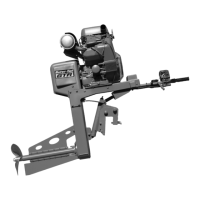
To engage reverse, put the motor in neutral and squeeze the reverse lever. The
lever must be squeezed or pulled for the reverse gear to work. DO NOT engage the
motor into reverse while the motor is in forward. This will void your warranty and
can damage the transmission.
After 15 hours of use, you must change the fluid in the transmission.
Your transmission is engaged using a hydraulic system. If for some reason the lever
loses resistance, follow the following procedure for bleeding the system.
Be sure all hydraulic connections are secure. Never use Teflon tape to seal the
fittings in the castings. An appropriate Teflon paste like that used from the
manufacturer is recommended. The high pressure tubing should be inserted
completely into the cap and ferrule. Use only type “H” high pressure nylon tubing.
From finger tight, the fitting cap should be tightened 2 turns. This should leave a
gap of about 0.50” between the cap and the hex part of the fitting body.
Remove the filler plug from the master cylinder top and for standard systems, fill
reservoir with DOT-5 silicone brake fluid only! The filler plug must be left loose all
during the bleeding process so do not replace it tightened. Stroke the master
cylinder lever arm a full stroke and open the bleed screws on the caliper for about 2
seconds then close. Allow the master cylinder arm to return the the rest position
and wait approximately 15 to 20 seconds to allow for the fluid in the reservoir to
transfer into the bore of the master cylinder thought the transfer port. Repeat the
process of stroking the master cylinder again. Open and close the bleed screw the
same as before. Allow the master cylinder lever arm return to rest and wait again.
It typically takes about 4 strokes to fill the bore of the master cylinder. Check the
reservoir for fluid and keep topped up.
Continue this procedure until a more firm pedal is realized and the brake pads begin
to move. At this point the procedure changes. You should now have a shorter
master cylinder to stroke to work with as the pads are making contact with the
rotor. From this point on, open and close only one bleed screw for a very short time.
Basically open and close the bleed screw about as fast as possible. Do not be
concerned if you get only fluid. Repeating the process, continue to pump the
master cylinder rapidly, hold firm and open a bleed screw. Continue this process
until satisfied that this half of the caliper is bled. Repeat the process on the other
caliper half until bled. If a large amount of fluid is allowed to escape from the bleed
screw during this process, you will most likely draw air into the system causing a
spongy pedal. The reason for this you would inadvertently cause a strong vacuum
in the power side of the system with no means for the master cylinder piston to get
back to the resting position where the transfer port reservoir is uncovered.
When finished, check the reservoir for the proper fluid level which is about a 1/16”
below the bottom of the master cylinder cap threads. Replace the filler plug and
finger tighten only. Check all hydraulic connections for fluid leaks.
9


 To Next Page
 Loading...