PROBLEM
WRINKLING IN
PERM PRESS AND
"NO-IRON" ITEMS
!continued I
SHRINKAGE.
GENERAL
SHRINKAGE.
KNITS
CLOTHES TAKE
TOO LONG TO DRY
POSSIBLE CAUSE
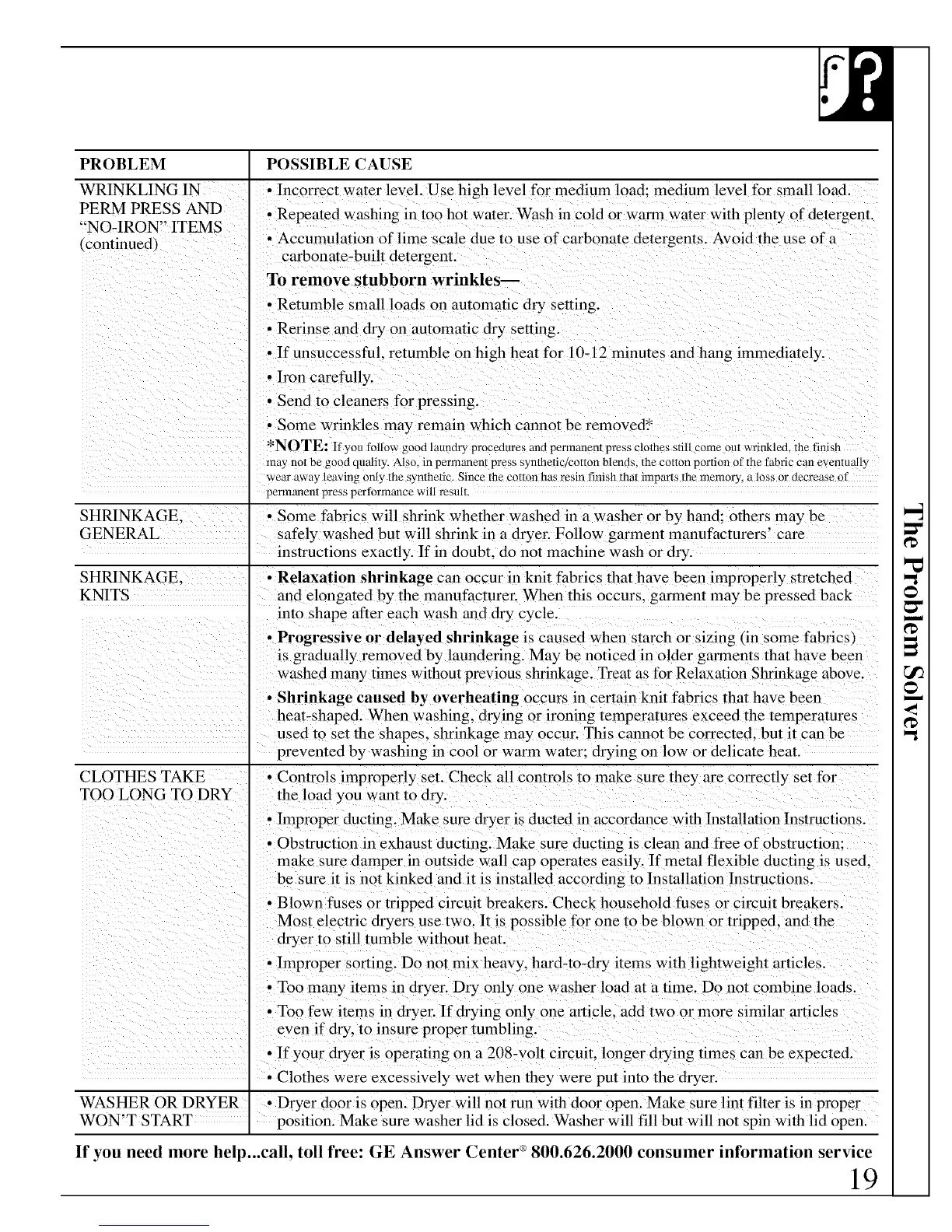
• Incorrect water level. Use high level for medium load: medium level for smM1 load.
• Repeated washing in toe hot water. Wash in cold or warm water with plenty of detergent.
• Accumulation of lime scale due to use of carbonate detergents. Avoid the use of a
carbonate-built detergent.
To remove stubborn wrinklesm
• Retumble small loads on automatic dry setting.
• Rerinse and dry on automatic dry setting.
• If unsuccessful, retumble on high heat for 10-12 minutes and hang immediately.
• Iron carefully.
• Send to cleaners for pressing.
• Some wrinkles may remain which cannot be removed_ _
*NOTE'. If you follow good laundry procedures and permanent press clothes still come out wrinkled, the finish
may not be good quality-. Also, in permanent press s)nthetic/cotton blends, the conon portion of the fabric can eventually
wear away leaving only tile synthetic. Since the cotton has resin finish that imparts the memory, a loss or decrease ol
permanent press pertimnance will result.
• Some fabrics will shrink whether washed in a washer or bv hand: others may be
safely, washed but will shrink in a dryen Follow garment manufacturers' care
instructions exactly. If in doubt, do not machine wash or dry.
• Relaxation shrinkage can occur in knit fabrics that have been improperly stretched
and elongated by the manufacturer. When this occurs, garment may be pressed back
into shape after each wash mad dry cycle.
• Progressive or delayed shrinkage is caused when starch or sizing (in some fabrics)
is gradually, removed by laundering. May be noticed in older garments that have been
washed many times without previous shrinkage. Treat as for Relaxation Shrinkage above.
• Shrinkage caused by overheating occurs in certain knit fabrics that have been
heat-shaped. When washing, drying or ironing temperatures exceed the temperatures
used to set the shapes, shrinkage may occun This cannot be corrected, but it can be
prevented by washing in cool or warm water: drymg on low or delicate heat.
• Controls improperly set. Check all controls to make sure they are correctly set for
the load you want to dr).
• Improper ducting. Make sure. dryer is ducted in accordance with Installation Instructions.
• Obstruction in exhaust ducting. Make sure ducting is clean and fi'ee of obstruction:
make sure damper in outside wall cap operates easily. If metal flexible ducting is used.
be sure it is not kinked and it is installed according to Installation Instructions.
• Blown fuses or tripped circuit breakers. Check household fuses or circuit breakers.
Most electric dryers use two. It is possible for one to be blown or tripped, and the
dryer to still tumble without heat.
• Improper sorting. Do not mix heavy, hard-to-dry items with lightweight articles.
• Too many items in dryer. Dry only one washer load at a time. Do not combine loads.
• Too few items in dryer. If drying only one article, add two or more similar articles
even if dry, to insure proper tumbling.
• If your dryer is operating on a 208-volt circuit, longer drymg times can be expected.
• Clothes were excessively wet when they were put into the dryen
• Dryer door is open. Dryer will not run with door open. Make sure lint filter is in proper
position. Make sure washer lid is closed. Washer will fill but will not spin with lid open.
WASHER OR DRYER
WON'T START
If you need more help...call, toll free: GE Answer Center ®800.626.2000 consmner information service
19
¢/z
W


 To Next Page
 Loading...