,a,
OF D
GEApp/iances.com
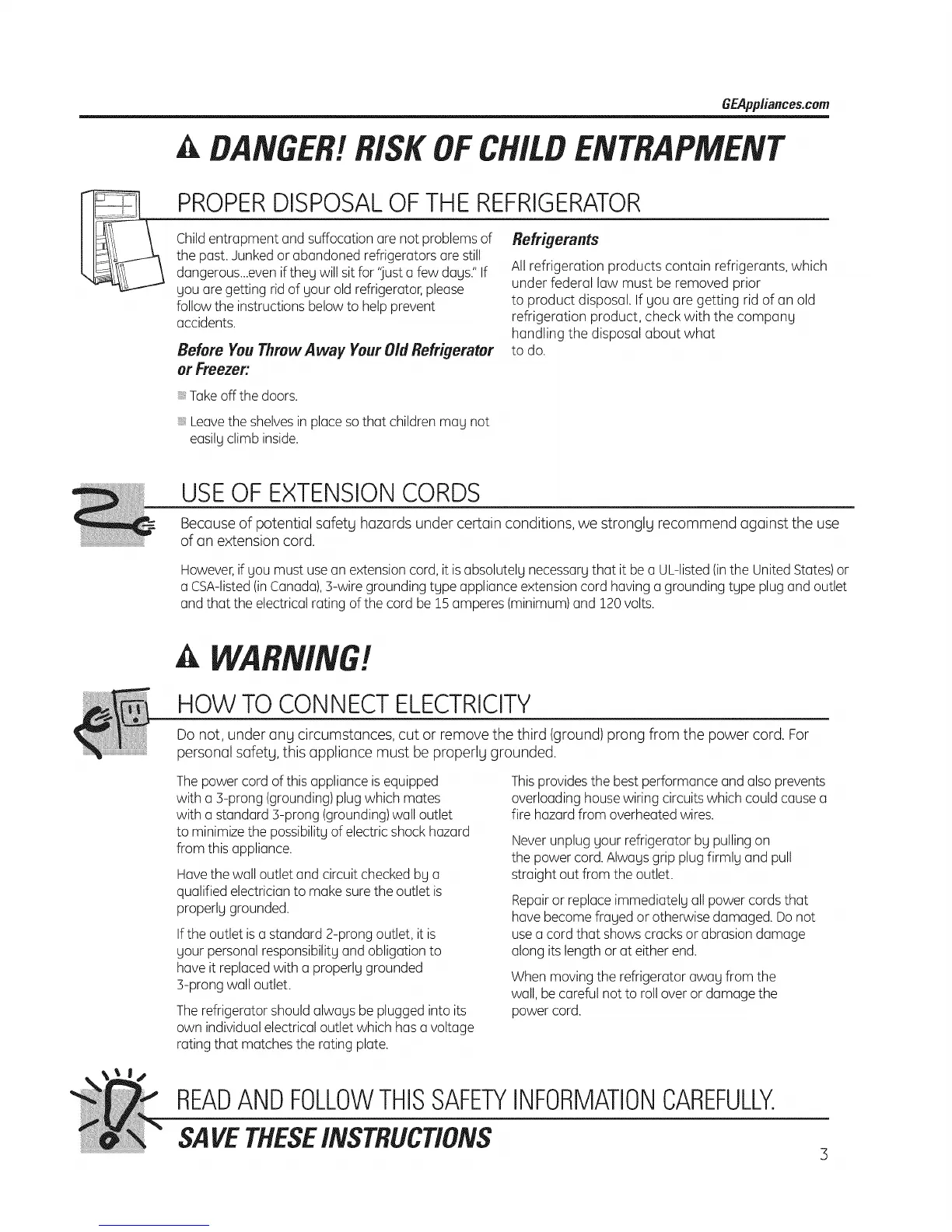
PROPERDISPOSAL OF THE REFRIGERATOR
Childentrapment and suffocation are not problems of
the past. Junked or abandoned refrigerators are still
dangerous...evenif they will sit for 'lust a few days." If
you are getting rid of your old refrigerator,please
follow the instructions below to help prevent
accidents.
Before You ThrowAway YourOld Refrigerator
or Freezer:
Takeoff the doors.
Leavethe shelvesin place so that children may not
easily climb inside.
Refrigerants
All refrigeration products contain refrigerants, which
under federal law must be removed prior
to product disposal. If you are getting rid of an old
refrigeration product, check with the company
handling the disposal about what
to do.
USEOF EXTENSION CORDS
Because of potential safety hazards under certain conditions, we strongly recommend against the use
of an extension cord.
However,ifyou must use an extensioncord, it is absolutely necessarythat it be a UL-listed(inthe United States)or
a CSA-listed(inCanada),:S-wiregrounding type appliance extension cord having a grounding type plug and outlet
and that the electrical rating ofthe cord be 15 amperes (minimum) and 120 volts.
A
,!
m
HOW TO CONNECTELECTRICITY
Do not, under any circumstances, cut or remove the third (ground) prong from the power cord. For
personal safety, this appliance must be properly grounded.
Thepower cord of this appliance is equipped
with a 3-prong (grounding) plug which mates
with a standard :S-prong(grounding)wall outlet
to minimize the possibility of electric shock hazard
from this appliance.
Have the wall outlet and circuit checked by a
qualified electrician to make sure the outlet is
properly grounded.
If the outlet is a standard 2-prong outlet, it is
your personal responsibility and obligation to
have it replaced with a properly grounded
:S-prongwall outlet.
Therefrigerator should always be plugged into its
own individual electrical outlet which has a voltage
rating that matches the rating plate.
Thisprovides the best performance and also prevents
overloading house wiring circuits which could cause a
fire hazard from overheated wires.
Never unplug your refrigerator by pulling on
the power cord. Always grip plug firmly and pull
straight out from the outlet.
Repairor replace immediately all power cords that
have become frayed or otherwise damaged. Do not
usea cord that shows cracks or abrasion damage
along its length or at either end.
When moving the refrigerator away from the
wall, be careful not to roll over or damage the
power cord.
READANDFOLLOWTHISSAFETYINFORMATIONCAREFULLY.
SAVETHESEINSTRUCTIONS
3



 To Next Page