Need help?
Do you have a question about the GE GSC3500 and is the answer not in the manual?
Key safety information and warnings for operating the dishwasher.
Details on proper electrical connection, grounding, and circuit requirements.
Safety precautions regarding child entrapment and proper disposal of dishwashers.
Explanation of cycles, options, and control settings on the dishwasher panel.
Instructions on how to operate the dishwasher using the cycle dial.
Guide on connecting and disconnecting the unicouple for water supply and drainage.
Guidance on water temperature, using rinse agents, and detergent for optimal cleaning.
Best practices for loading upper and lower racks and the silverware basket.
Guidelines for loading 10 and 12 place settings, plus tips for forgotten dishes.
Instructions for cleaning the control panel, exterior, and protecting against freezing.
Steps to diagnose and resolve issues when the dishwasher fails to start.
Troubleshooting common causes for water remaining in the bottom of the tub.
Guidance on addressing issues caused by using the wrong detergent leading to suds.
Causes and solutions for interior stains, including tomato-based foods and tea/coffee.
Tips for improving drying performance, including water temperature and rinse agent use.
Addressing issues with food residue, improper loading, and detergent use.
Solutions for preventing and removing spots or film from dishes and glasses.
Explanation of etching and how to prevent it through detergent and cycle selection.
Details on the limited one-year warranty, coverage, and exclusions for the dishwasher.
Information on accessing the GE Appliances website for manuals, parts, and service.
How to schedule expert GE repair service online or by phone.
Information on ordering parts and accessories for your dishwasher.
How to contact GE Customer Relations for service or satisfaction issues.
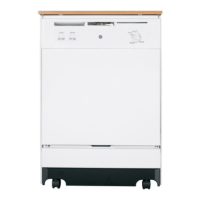
This document serves as an owner's manual for a GE dishwasher, model GSC3500, providing comprehensive instructions for its safe operation, maintenance, and troubleshooting.
The GE GSC3500 dishwasher is designed to efficiently clean dishes, glasses, flatware, cookware, and plastic items. It offers various wash cycles and options to accommodate different levels of soil and user preferences. The appliance is equipped with a heating element for drying and can preheat wash water for improved performance. It is intended for household use and requires proper installation and connection to a hot water supply. The dishwasher utilizes specialized detergents and rinse agents to ensure optimal cleaning and spot prevention.
The dishwasher's control panel features a timer dial and push-button selections for cycles and options.
To start a cycle, users typically ensure the door is unlatched, select the desired cycle and options using the pads, turn the dial to the corresponding start position (e.g., RINSE ONLY, PLATE WARMER, HOT START, LIGHT WASH, or START), and then latch the door. A time delay may occur between start-up and water fill.
A forgotten dish can be added before the main wash by pushing the door latch to the left, waiting for the water to calm, opening the door, adding the dish, closing the door, and pushing the latch to the far right.
The entering water temperature should be between 120°F and 150°F for effective cleaning and to prevent dish damage. Users can check the temperature with a thermometer at the nearest hot water faucet and adjust the water heater if needed.
Before first use, the special faucet adapter must be assembled to the sink faucet. To connect, run the hot water faucet to purge cold water, pull out the Unicouple hoses, attach the Unicouple connector to the faucet adapter by depressing the collar, and then release the collar to lock it. The Unicouple's small hose carries water to the dishwasher, and the large hose carries drain water to the sink. The sink drain must be open, and if connected to a disposer, the disposer should be operated until empty before starting the dishwasher. The dishwasher's power cord should then be plugged into an outlet.
If the dishwasher is left in an unheated area during winter, a service technician should:
The manual provides a detailed troubleshooting chart to address common issues such as the dishwasher not running, noise, water standing in the tub, suds, stained tub interior, dishes not drying, spots and filming, cloudiness on glassware, detergent cup lid not latching, detergent left in cups, steam, and black/gray marks on dishes. Solutions range from checking fuses/circuit breakers, ensuring power is on, proper loading, using correct detergent/rinse agent, to adjusting water temperature and cleaning specific components. For hard water mineral deposits, citric acid (Part number: WD35X151) can be ordered through GE Parts.
The manual directs users to the GE Appliances Website for assistance, scheduling service, accessing Real Life Design Studio for universal design concepts, purchasing extended warranties, and ordering parts and accessories. It also provides contact information for customer relations. Users are encouraged to register their appliance online for enhanced communication and service under warranty terms.
 General
| Type | Built-In |
|---|---|
| Control Type | Electronic |
| Number of Wash Cycles | 6 |
| Number of Options | 4 |
| Water Filtration System | Yes |
| Racks | 2 |
| Upper Rack Features | Adjustable |
| Silverware Basket | Yes |
| Place Settings | 14 |
| Noise Level | Quiet |
| Energy Star Certified | Yes |
| Soil Sensor | Yes |
| Delay Start | Yes |
| Third Rack | No |
| Stainless Steel Interior | Yes |
| Water Usage | 4.5 Gallons |

 To Next Page