The Geith Quick Coupler is an attachment designed for excavators, enabling the rapid and secure connection and disconnection of various work tools. It is engineered for durability and ease of use, enhancing productivity and versatility on construction sites.
Function Description:
The Geith Quick Coupler serves as an interface between an excavator's arm and a range of attachments such as buckets, hammers, and rippers. Its primary function is to allow operators to quickly change attachments without leaving the cab, significantly reducing downtime and increasing operational efficiency. The coupler features a robust design with a fixed hook and a sliding hook, which engage with the attachment pins to create a secure connection. Both hydraulic and mechanical versions are available, offering different levels of automation and control. The hydraulic version integrates with the excavator's hydraulic system, allowing for in-cab control of attachment engagement and release, while the mechanical version requires manual operation for locking and unlocking.
Important Technical Specifications:
The Geith Quick Coupler is available in various models to suit different excavator weights and pin diameters.
For excavators weighing 2-6 tons, pin diameters of 35mm, 38.1mm, and 40mm are supported. Coupler models like QC35-40 H (hydraulic) and QC35-40 M (mechanical) are designed for this range, with pin centers varying from 130-153mm to 200-225mm, and base widths of 122mm. The coupler weight for these models is typically 35 kg (77 lbs).
For excavators weighing 4-12 tons, pin diameters of 45mm and 50mm are accommodated. Models such as QC45 H1, QC45 H2, QC45 M1, QC45 M2, QC50 H, and QC50 M are available. Pin centers range from 218-267mm to 338-375mm, with base widths of 150mm or 160mm. The coupler weight for this range is 65 kg (143 lbs) or 73 kg (161 lbs), and 91 kg (201 lbs).
For heavier excavators, specifically 10-14 tons, pin diameters of 60mm and 65mm are supported. Models like QC60 H, QC60 M, QC65 H1, and QC65 M1 are offered. Pin centers vary from 280-380mm to 355-430mm, with base widths of 160mm, 210mm, or 250mm. The coupler weight for these models is 150 kg (330 lbs), 175 kg (386 lbs), or 183 kg (403 lbs).
For excavators weighing 13-18 tons, pin diameters of 70-71mm and 80mm are supported. Models such as QC70 H, QC70 M, QC80 H1, and QC80 M1 are available. Pin centers range from 370-465mm to 390-500mm, with base widths of 250mm or 300mm. The coupler weight for this range is 215 kg (473 lbs) or 327 kg (720 lbs).
For excavators weighing 30-36 tons, pin diameters of 90mm are supported. Models such as QC90 H1 and QC90 M1 are available. Pin centers range from 460-570mm, with base widths of 320mm. The coupler weight for this range is 422 kg (930 lbs).
For excavators weighing 30-52 tons, pin diameters of 100mm and 110mm are supported. Models such as QC100 H1 and QC110 M1 are available. Pin centers range from 536-640mm to 525-640mm, with base widths of 370mm or 390mm. The coupler weight for this range is 768 kg (1693 lbs) or 990 kg (2182 lbs).
The "MIN - MAX" centers refer to the range of pin centers that the coupler can accommodate. Attachments with pin centers outside this range will not be properly retained. The "BASE WIDTH" refers to the width of the coupler's mounting area. The "COUPLER WEIGHT" is the weight of the coupler itself.
Usage Features:
- Spacer Installation: Spacers can be added to the quick coupler to adjust for variations in attachment pin widths, ensuring a snug fit and minimizing play. This customization helps maintain the correct pin centers for optimal performance.
- Quick Coupler Installation: The coupler is installed by positioning the excavator arm into the coupler, aligning mounting holes, and securing it with pins, dust seals (O-rings), shims/spacers, and retaining hardware. For hydraulic couplers, hydraulic hoses must also be connected.
- Engaging Attachments (Hydraulic Coupler):
- Power On: Press the POWER button on the four-port control box. An alarm will sound, and the button will illuminate.
- Unlock: Within six seconds, press the UNLOCK button. The alarm tone will change, and the button will illuminate. Failure to press within six seconds will shut off the system, requiring a restart.
- Crowd Coupler: Crowd the quick coupler fully inwards to build hydraulic pressure. The sliding hook and locking clasp will open.
- Engage Pins: Position the coupler to engage the front pin of the attachment, then rotate the coupler to engage the rear pin.
- Lock: With the coupler crowded fully inwards, press the system LOCK button on the control box. All lights and alarms will shut off.
- Verify Lock: Continue crowding the coupler for 10 seconds until the locking clasp fully closes and the sliding hook fully lowers.
- Check for Leaks: Inspect hydraulic lines, connections, fittings, and the cylinder for leaks.
- Engaging Attachments (Mechanical Coupler):
- Open Coupler: Lower the quick coupler and open it.
- Engage Front Pin: Engage the front pin of the attachment.
- Lift Coupler: Lift the quick coupler vertically, allowing the attachment link pin to contact the coupler body.
- Install Drive Bar: Install the drive bar onto the cylinder drive shaft at the back of the engaging plate.
- Tighten: Tighten the drive bar clockwise. The locking clasp will close over the front pin, and the engaging plate will move under the attachment link pin.
- Remove Drive Bar: Remove and store the drive bar.
- Attachment Safety: Always connect attachments using both attachment pins. For single-pin attachments, a two-pin adapter must be used. Keep the attachment close to the ground during engagement and release to prevent serious injury or death from falling attachments.
- Releasing Attachments (Hydraulic Coupler):
- Power On: Press the POWER button on the control box.
- Unlock: Within six seconds, press the UNLOCK button.
- Crowd Coupler: Crowd the quick coupler to build pressure until the locking clasp and sliding hook open.
- Lower Attachment: Lower the quick coupler and attachment slightly off the ground.
- Release Pins: Fully crowd the quick coupler inward, then roll the coupler away from the attachment pins to release it.
- Releasing Attachments (Mechanical Coupler):
- Lower Attachment: Lower the quick coupler and attachment until slightly off the ground.
- Install Drive Bar: Install the drive bar onto the cylinder drive shaft.
- Loosen: Turn the drive bar anti-clockwise to release the back pin lock and open the quick coupler.
- Remove Drive Bar: Remove the drive bar.
- Release Pins: Roll the quick coupler away from the attachment pins to release it.
- Lifting Objects with Quick Coupler: The quick coupler can be used for lifting, but only if the machine is rated and equipped for lifting operations. The attachment must be removed from the quick coupler before lifting. Always use an appropriate shackle and lift with the quick coupler vertical, allowing the load to hang free. Never use the attachment pin connection hooks for lifting.
Maintenance Features:
- Delivery Report: A comprehensive delivery report form is provided to document the quick coupler's details, transaction type, customer information, and installation specifics. This report includes sections for hydraulic pressure, oil temperature, and a checklist for safety and operational checks, ensuring proper setup and initial inspection.
- Safety Decals: The manual details the location and text of various safety decals, including warnings for pinch points, attachment interference, and moving parts. These decals are crucial for operator safety and must be kept clean, legible, and replaced if damaged.
- Daily Inspection:
- Remove all dirt and debris from the quick coupler and internal mechanisms (hydraulic cylinder, linkage, spring mechanism).
- Inspect the fixed hook, sliding hook, and locking clasp for wear or damage.
- Inspect the hydraulic cylinder for wear or damage.
- Check all fixing points (bolts, nuts, clips, pins, etc.) for wear or damage.
- Check all hydraulic hoses and connections for leaks.
- Weekly Inspection:
- Clean the quick coupler and visually inspect its structure and all components for excessive wear or damage.
- Troubleshooting Guide: A table is provided to help diagnose and correct common issues, such as the control box intermittently working or not working at all, the quick coupler not unlocking, and the quick coupler not staying locked. Solutions include checking harness connections, replacing fuses, repairing hydraulic hoses, and replacing damaged cylinders or springs.
- Part Replacement: Detailed instructions are provided for removing the quick coupler from the machine, disassembling hydraulic couplers (QC60-QC110 and QC35-QC55), and disassembling mechanical couplers (QC45-QC110). This includes steps for tightening/loosening retaining bolts, removing spring assemblies, removing roll pins, and detaching the hydraulic cylinder.
- Hydraulic System Maintenance: Instructions for installing and removing hydraulic hoses are provided, emphasizing the importance of clean work areas, using caps and plugs to prevent contamination, and properly disposing of oil leakage.
- General Safety Instructions: The manual stresses the importance of only trained and authorized personnel operating and maintaining the attachment, following all safety rules, and being aware of potential hazards like high-pressure fluids and moving parts. It also includes guidelines for safe disposal of hazardous materials and proper ventilation in enclosed areas.

 Need help?
 General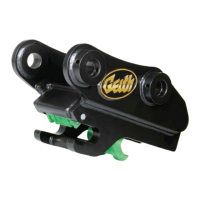

 To Next Page