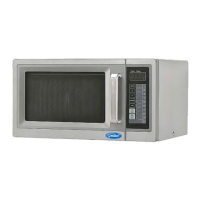
This document is an instruction manual for the General Commercial Microwave Oven, model GEW1050E-C, manufactured by Asbury Foodservice.
Function Description:
The General Commercial Microwave Oven is designed for heating and cooking food using microwave energy. It is intended for commercial use, although some safety instructions mention household use, indicating a robust design suitable for demanding environments. The oven features a control panel for setting power levels and cooking times, and includes various functions such as multi-stage cooking, memory function, multi-quantity cooking, and a child lock. The primary purpose is to provide efficient and controlled microwave heating for various food items.
Important Technical Specifications:
- Model: GEW1050E-C
- Rated Voltage: 220V~50Hz
- Rated Input Power (Microwave): 1500W
- Rated Output Power (Microwave): 1000W
- Oven Capacity: 1.0 Cu.ft.
- External Dimensions (WxHxD): 20x14x12 inches
- Net Weight: Approximately 40 Lbs
- Power Levels: 11 power levels are available, ranging from PL0 (0%) to PL10 (100%).
- Maximum Cooking Time: 30 minutes for PL10 to PL7, and 60 minutes for PL6 to PL0.
- Accessories: Includes a turntable ring assembly and an instruction manual.
Usage Features:
The oven offers a range of features to facilitate cooking:
- Microwave Cooking: Users can select a specific power level (from 0% to 100%) and set a precise cooking time using the number keys. The default power is PL10 (100%) if not specified.
- Speedy Cooking:
- Directly pressing the "TIME" key allows for immediate input of cooking time with 100% power, up to 30 minutes.
- Pressing "START" initiates cooking for 30 seconds at 100% microwave power, with each subsequent press adding 30 seconds, up to a maximum of 30 minutes. This feature can also increase cooking time during multi-stage or memory procedures without altering the power settings.
- Multi-Stage Cooking: The oven supports up to two cooking stages. Each stage can have different power levels and cooking times. The buzzer rings once after each stage, signaling the start of the next. The memory function cannot be used as part of multi-stage cooking.
- Memory Function: Users can program and save up to 10 different cooking procedures (0-9). These procedures can consist of one or two stages with specific power levels and cooking times. Once set, a memory procedure can be recalled and started with a single press of the "START" key. Saved programs are retained even if electricity is cut off.
- Multi-Quantity Function (X2/X3): This feature allows users to double (X2) or triple (X3) the cooking time of a saved memory program. If the multiplied time exceeds the maximum allowed, the oven will not start and will alarm.
- Lock-out Function for Children: A child lock can be activated by pressing "STOP" for 3 seconds, preventing unintended operation. The display will show "(- - -)". To deactivate, press "STOP" for 3 seconds again.
- Inquiring Function: In cooking states, pressing "POWER" displays the current power level for 3 seconds. For memory states, opening the oven door and pressing a number key (0-9) will display the power level and cooking time for each stage of the saved program.
- Cooking End Reminding Function: The oven emits 5 beeps to signal the completion of cooking.
- Display Specification: The LED display shows the clock and a flashing ":" in waiting state, relevant settings in function setting state, and residual cooking time during operation or suspension.
Maintenance Features:
Maintaining the cleanliness of the oven is crucial for performance and safety.
- General Cleaning:
- Glass Viewing Window, Inner Door Panel, and Oven Front Face: These parts should be kept free of food or grease build-up. Wipe with a mild detergent, rinse, and wipe dry. Abrasive powders or pads should not be used.
- Control Panel and Plastic Parts: Clean with a dry cloth. Avoid detergents or alkaline liquid sprays, as they can cause damage.
- Oven Interior: After each use, clean up spilled liquids, spattered oil, and food debris promptly. If the oven is used when dirty, efficiency decreases, and odors may develop. Clean the interior with a cloth soaked in lukewarm water with a mild detergent, then rinse with a damp cloth.
- Caution: Do not use bleach, thinners, or other cleaning agents on plastic and painted sections, as these can cause dissolution or discoloration.
- Troubleshooting: The manual provides a troubleshooting guide to help users identify and resolve common issues such as the oven not starting, arcing or sparking, unevenly cooked food, overcooked food, undercooked food, and improper defrosting. Solutions include checking power connections, ensuring the door is closed, using microwave-safe cookware, cleaning the cavity, defrosting food completely, adjusting cooking time and power level, and ensuring ventilation ports are not restricted. If problems persist, users are advised to contact an authorized service center.
Precautions for Use:
The manual emphasizes several safety precautions to prevent exposure to excessive microwave energy and other hazards:
- Do not operate the oven with the door open or if the door is damaged (bent, broken hinges/latches, damaged seals).
- Do not place objects between the oven front face and the door, or allow residue to accumulate on sealing surfaces.
- Only properly qualified service personnel should adjust or repair the oven.
- Maintain cleanliness to prevent degradation of surfaces and dangerous situations.
- Ensure the oven is on a leveled surface with adequate clearance for vents (3.0 inches from adjacent walls, 12 inches above).
- Do not operate the oven empty or with very low moisture food to prevent fire or sparking.
- Do not cook bacon directly on the turntable.
- Avoid heating baby bottles, baby food, or narrow-necked containers due to uneven heating and potential for physical injury or explosion.
- Do not attempt deep-frying or home canning in the microwave oven.
- Stir hot liquids before and during heating, allow them to stand, and use extreme care when inserting utensils to prevent delayed eruptive boiling or scalding.
- Use caution to avoid overcooking food.
- Children should use the oven in combination mode only under adult supervision.
- The appliance must be grounded using a 3-pronged plug and a properly installed, grounded outlet.
- Use only specified bag sizes for popcorn.
- Remove wire twist-ties and metal handles from containers before microwaving.
- Do not store combustible items inside the oven.
- Avoid heating whole eggs or sealed containers that may explode.
- Do not immerse the cord or plug in water, and keep the cord away from heated surfaces.
- The product contains lead, which can cause cancer and birth defects; wash hands after handling the cord.
Utensils:
The manual provides a comprehensive list of materials safe and unsafe for microwave use:
- Safe Materials: Aluminum foil (for shielding, 1 inch from walls), browning dish (follow manufacturer instructions, 3/16 inch above turntable), microwave-safe dinnerware (no cracks/chips), glass jars (remove lid, heat until warm), heat-resistant oven glassware (no metallic trim, no cracks/chips), oven cooking bags (follow instructions, no metal ties, slit for steam), paper plates/cups (short-term use, unattended), paper towels (cover food, absorb fat, short-term use), parchment paper (cover, wrap for steaming), microwave-safe plastic (follow instructions, slit/pierce/vent boiling bags), plastic wrap (cover food, retain moisture, do not touch food), microwave-safe thermometers, wax paper (cover, retain moisture).
- Avoided Materials: Aluminum tray, food carton with metal handle, metal or metal-trimmed utensils (cause arcing), metal twist ties (cause arcing/fire), paper bags (cause fire), plastic foam (may melt/contaminate), wood (dries out, splits/cracks).
- Utensil Test: To test if a non-metallic utensil is safe, place it with 1 cup of cold water in the oven, cook on maximum power for 1 minute. If the empty utensil is warm, it is not microwave-safe. Do not exceed 1 minute test time.


 To Next Page
 General